A Guide to Finding Hyped Sneakers and What Makes a Pair Hype

Hyped sneakers are the pairs where demand runs far ahead of supply, but there is no foolproof recipe for finding them. What this guide can do is show you the pattern behind them: brand pull, a story, short runs, collabs, endorsements and ads. According to Statista’s 2022 figures, Nike alone held 18% of the sneaker market.
- In short: a pair is hyped when you and thousands of others want it, but the brand makes far fewer.
- Brand pull: according to the same Statista figures, Jordan Brand held 11% and adidas 9%.
- Short runs: Wikipedia says the first Yeezy Boost 750 was limited to 9,000 pairs.
- Collabs: according to StockX, the Travis Scott x Air Jordan 1 High OG retailed at $175 in 2019.
- Story and ads: Wikipedia dates the first Air Jordan’s public release to 1 April 1985.
Which brands carry the most hype?
Nike and Jordan Brand are the two labels with the most pull, and adidas, Vans, Converse and New Balance sit behind them.

Our graphic of the brands that carry the most hype. We’re gonna be honest here: not every brand builds a queue, but you should know which ones do. According to Statista’s 2022 figures, as reported by Hypebeast in August 2023, Nike held 18% of the sneaker market. The same report put Jordan Brand at 11% and adidas at 9%.
Brand Share of the 2022 sneaker market Nike 18% Jordan Brand 11% adidas 9% Vans 7% Skechers 7% Moonstar 5% Converse 4% New Balance 4% However, market share is not hype on its own. Hypebeast’s report says Vans held 7% and Converse 4%. Most of their pairs are easy to find, though, so you can wear them as beaters. Before the adidas and Yeezy breakup, adidas had a real contender. New Balance has also done solid work with its collabs. If you want the rest, our list of the most popular sneaker brands ranks them.
Why does the story behind a pair matter?
A backstory is one of the strongest hype signals, because sneakerheads buy the moment as much as the shoe.
Jordan Brand is the master of this game. According to Wikipedia’s Air Jordan entry, the first Air Jordan went on public sale on 1 April 1985. The same entry says Nike and MJ introduced Jordan Brand in 1997.
In fact, most retros and new colorways lean on a moment from His Airness’s playing days. That is why a retro can feel bigger than the shoe itself: you’re buying a piece of a story you already know. Sneakerheads are into that storytelling, and the brand knows it.
Similarly, the story pays off at the brand level. Wikipedia says Jordan Brand brought in $5.1 billion for Nike in 2022. That is the label’s revenue, not a resale figure, but it shows how far a good story can carry a logo. If you want the full timeline, our Air Jordan history and the Air Jordan 1 page cover each chapter.
How does short supply create hyped sneakers?
Short supply is the oldest hype lever there is: a run that most people cannot buy at retail builds demand on its own.

Our graphic of how supply and demand feed hype. Exclusive runs win the hype game, because you can’t buy what was never stocked. According to Wikipedia’s Yeezy entry, the first Yeezy Boost 750 “Light Brown” was limited to 9,000 pairs. The entry adds that it sold out within 10 minutes. Getting your hands on a pair was a big deal because so few existed.
The run ended for a different reason: the same entry says adidas ended its collaboration with West and the line on 25 October 2022. Our Yeezy history covers the full run.
By contrast, Nike plays both sides. Wikipedia’s sneaker collecting entry says Nike launched its SNKRS app in 2015 to give better access to its latest releases. If you play the draws, our page on getting shoes on SNKRS goes deeper. If you want to see what a checkout bot does with this, NikeShoeBot’s guides walk through it retailer by retailer.
Collabs vs general releases: why do collabs build hype?
A collab is a release where two names share one pair, and it is the quickest way to turn an everyday model into a hyped one.
Not every collab lands, but the good ones pull in two fan bases at once. As a result, an easy-to-find model like the Chuck 70 can become a pair you queue for. According to Wikipedia’s Off-White entry, its Nike project “The Ten” dates to early 2017 and included a Converse pair.
Pair Release date Retail price Source adidas Yeezy Boost 350 “Turtledove” 27 June 2015 $200 StockX Converse Chuck Taylor All Star 70 Hi Off-White 8 October 2018 $130 StockX Jordan 1 Retro High OG SP Travis Scott “Mocha” 11 May 2019 $175 StockX We checked the release dates and retail prices in this table on StockX’s product pages on 9 October 2026. Market prices move and are shown for reference, not as a promise. Travis Scott’s Jordans are a clear case. If you want more of his pairs, our page on Travis Scott sneakers covers them.

Our graphic of value vs exclusivity. Do athlete endorsements still create hype?
An endorsement is a bet on an athlete, and the right one can carry a sneaker line for decades.

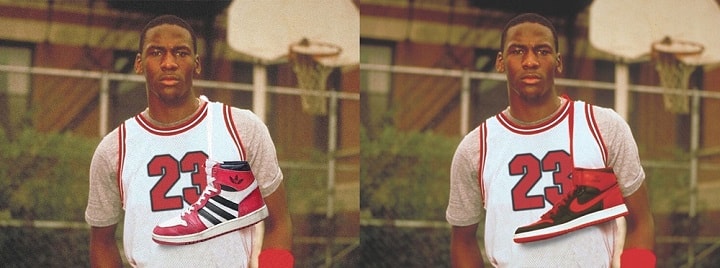
Our banner on athlete endorsements. The MJ deal is living proof. Wikipedia’s Air Jordan entry says adidas, Converse and Nike all approached him as he entered his rookie year in 1984. The same entry says Nike aimed for $3 million in sales over the first three years, and sales hit $126 million in one year.
Wikipedia flags that last figure as disputed, so you should treat it as a story the industry tells, not an audited number. If it holds, that is 42 times the three-year goal ($126 million ÷ $3 million = 42).
Because MJ was a sensation even as a rookie, the public’s love for him turned into demand for his shoe. Nike still runs the same playbook, although not every deal lands the way his did. If you scroll our list of Nike athletes, you’ll see how many names carry a pair, but not every signature shoe becomes a hyped one.
Can advertising turn a release into a hyped one?
Advertising is the amplifier: it does not make a pair rare, but it makes far more people want the same pair at once.
Nike’s “Banned” ad for the Air Jordan 1 is the classic case you probably know. Wikipedia’s Air Jordan entry records that the ad stated:
On September 15th, Nike created a revolutionary new basketball shoe. On October 18th, the NBA threw them out of the game.
Then came the Spike Lee spots. According to Wikipedia’s Mars Blackmon entry, Lee played Mars Blackmon next to MJ in Air Jordan commercials in the late 1980s and early 1990s. Those ads sold you a personality, not a spec sheet.
A well-executed campaign can make all the difference, because it reaches people who never read a release calendar. If you want to see more of them, our roundup of the best Nike commercials collects the classics.

From our roundup of the best Nike commercials. Our take: is there a foolproof way to spot hyped sneakers?
There is no foolproof formula, but a pair that stacks three or more of these signals is the one we would watch.
- Retro
- A re-release of an older model, often in an original colorway.
- Collab
- A pair made with a second brand or artist, usually in a shorter run.
- General release
- A wide release you can usually find, which makes it a great beater.
Design plays a part, but it’s not always what makes or breaks a release. Ugly kicks can still build a queue if the brand plays the game right. However, some hype depends on things even the brands can’t control, which is why nobody gets it right every time.
So when you look at a release, run through the list: brand, story, run size, collab and campaign. The more boxes a pair ticks, the bigger the crowd you can expect on release day.
The bottom line: hype is demand that outruns supply. If you’re new to the scene, our guides on who should start reselling sneakers, becoming a sneaker reseller and sneaker botting basics are good next reads.


Tagged