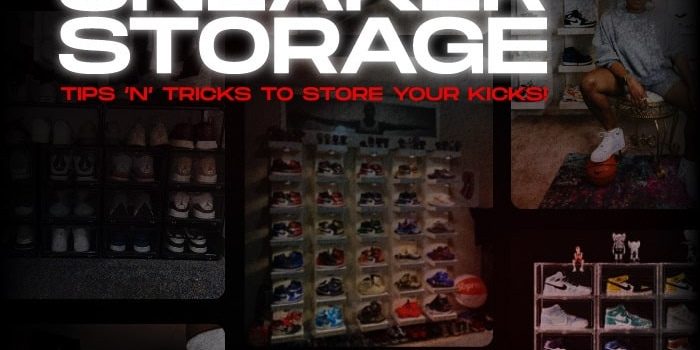
Sneaker storage comes down to a cool, dry, dark spot, clean pairs, a box that holds its shape and a regular check. These are our tips and tricks to store your kicks, whether you own ten pairs or two hundred. The figures come from National Park Service conservation leaflets, Nike, a footwear maker and a storage company, and each one is named where it appears.
- 40% to 55% humidity: a commonly recommended goal for organic materials such as leather, according to the National Park Service.
- Below 65% humidity: the line the National Park Service says humidity should always stay under to keep mold from taking hold, in its mold prevention leaflet.
- 64°F to 68°F (18°C to 20°C): the target temperature the same mold leaflet gives for museum collections.
- Several years: the timescale a footwear maker gives for polyurethane soles to break down from water vapor, even in storage.

Where should you keep your sneakers as the collection grows?
Where a pair lives depends mostly on how many pairs you own. The tiers below are our own rule of thumb, not a standard, and they say where to put things rather than promise anything about condition.
| Pairs owned | Where it usually works | What to watch |
|---|---|---|
| Up to 20 | A shelf or a closet floor in your room | Dust and direct sun |
| 20 to 50 | Shelves for favorites, boxes in a closet for the rest | Rotate pairs and label boxes |
| 50 to 150 | A walk-in closet or a spare room | Humidity and airflow in a closed room |
| 150 and above | A dedicated room or a rented unit | Ask for the unit’s temperature and humidity range |
From 20 to 50 pairs you need a system: favorites on shelves, the rest boxed in a closet, and a rotation so every pair gets worn and aired.
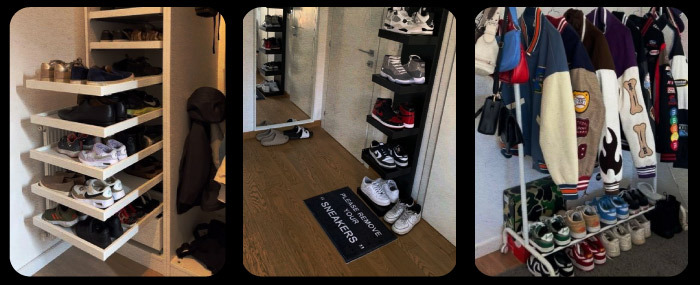
Past 50, shelves stop being enough and a walk-in closet or spare room is worth it. If you are still at the start, our A to Z guide on how to start a sneaker collection is the place to begin.
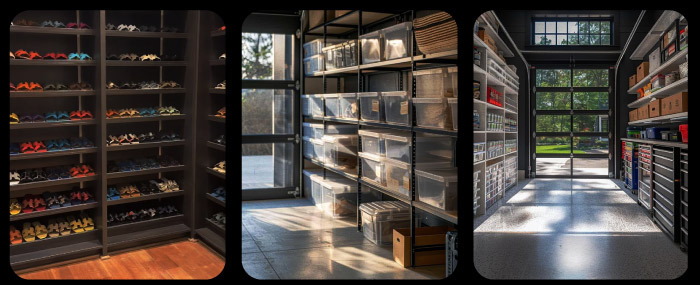
Garages are a poor home for a big collection. Nike’s storage guide says that because garages are rarely controlled for humidity, you do not exactly want to store your most prized pairs there.
Is a rented storage unit worth it for a big collection?
Past about 150 pairs, when you are knee-deep in shoes, a rented unit is a practical home for the collection, as long as you treat climate control as something to check rather than assume. Public Storage’s own page says climate-controlled units are designed to help maintain more consistent temperature and humidity than standard units, and it also says it does not guarantee temperature or humidity ranges.

So ask the facility what range it holds, and put a small hygrometer inside. The National Park Service (NPS) silica gel leaflet suggests humidity-monitoring strips or a hygrometer for checking the climate of a closed space.
As of 7 October 2026, Public Storage lists unit sizes from 5 by 5 feet, which it labels a Large Closet, up to 10 by 25 feet. We multiplied the two sides to get each floor area in the table. The company does not say how many pairs fit, because that depends on how you shelve them.
| Unit size (feet) | Floor area (square feet, our arithmetic) | Public Storage label |
|---|---|---|
| 5 x 5 | 25 | Large Closet |
| 5 x 10 | 50 | One Room |
| 5 x 15 | 75 | Two Rooms |
| 10 x 10 | 100 | Three Rooms |
| 10 x 15 | 150 | Four Rooms |
| 10 x 20 | 200 | Five Rooms |
| 10 x 25 | 250 | Six Rooms+ |
What temperature and humidity suit stored sneakers?
Stored pairs do best in steady, moderate conditions: a cool room, humidity in the middle of the range and no direct light. The National Park Service writes for museum collections, not bedrooms, but its numbers for leather and other organic materials show which way to push. Based on the table below, the leather range starts at 40% and the foam range ends at 40%, so a pair that mixes both sits on that boundary.
| What | Figure | Source |
|---|---|---|
| Humidity for organic materials such as leather | 40% to 55% | NPS Conserve O Gram 1/3 |
| Daily humidity swing | Less than 5% around the set point | NPS Conserve O Gram 1/3 |
| Seasonal humidity change | Less than 15% | NPS Conserve O Gram 1/3 |
| Humidity that makes mold spores less likely to germinate | 45% to 55% | NPS Conserve O Gram 3/4 |
| Humidity ceiling | Always below 65% | NPS Conserve O Gram 3/4 |
| Target temperature | 18°C to 20°C (64°F to 68°F) | NPS Conserve O Gram 3/4 |
| Polyurethane foam objects | Below 68°F and 30% to 40% humidity | NPS Conserve O Gram 8/4 |
Heat comes first. The National Park Service says excessive heating desiccates organic objects and may result in irreversible embrittlement, and it names direct sunlight and radiators among the common sources of heat. Light matters too: the NPS UV film leaflet says museum objects need both the intensity and the duration of light controlled.
Dark is not the whole answer. The NPS mold leaflet says mold growth speeds up under elevated temperature, poor air circulation, dim light or accumulated dirt, so a dark closet needs airflow and clean pairs.
Crumbling soles and musty uppers are damp-air problems
Polyurethane soles crumble through hydrolysis, a slow reaction with water vapor that warmth and humidity speed up. A safety footwear maker describes it as the chemical breakdown of the polyurethane polymer by the attack of water, usually as vapor, over several years, even when shoes sit in store.
The same page says polyether-based polyurethane soles resist hydrolysis well and polyester-based ones resist it poorly, so not every pair ages alike. It covers safety footwear, so we cannot tell you which of your pairs have which. The NPS plastics leaflet agrees that polyurethane foams are very unstable, listing crumbling, weeping, discoloration and loss of elasticity, and it names imitation leather and imitation suede among polyurethane’s uses.
Uppers have their own risk. The NPS says leather is particularly susceptible to mold and can be stained and weakened by it, and that the first sign is often a characteristic musty odor.
Is the original box good enough for long-term storage?
The original box is a fine short-term home and a weak long-term one, mainly because boxes lose their shape under a stack. In Nike’s storage guide, certified professional organizer Jean Prominski puts it plainly:
Original boxes don’t hold their shape if they are stacked, so the shoes can get dented.
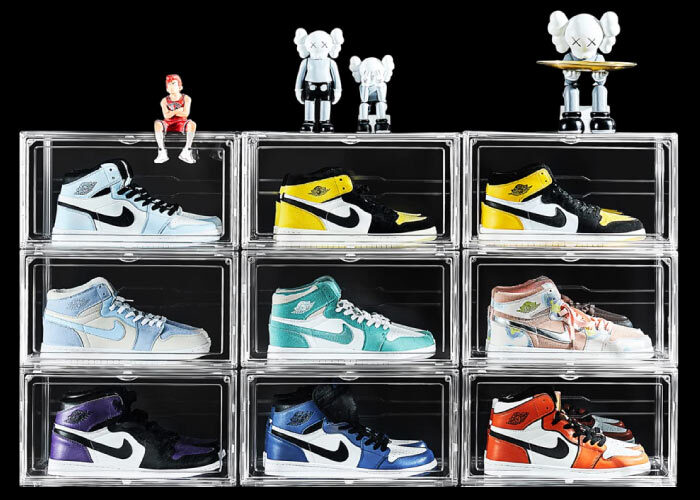
The guide itself calls clear acrylic shoe boxes an effective alternative, and it notes that some shoe crates use plastic with UV protection that can help keep shoes from fading or yellowing.
Putting each pair in a plastic bag inside its box needs a caveat. The NPS storage materials leaflet calls polyethylene inert, but it also says some recommend keeping bags open because of possible condensation when humidity swings, and it asks whether a breathable textile would be better than plastic. For us that points to a cotton bag, or a bag left unsealed.
Do silica gel packets help in a shoe box?
Silica gel packets help only in a well-sealed container, and a lidded cardboard shoe box is probably not one. The National Park Service says silica gel can only maintain a microenvironment in a well-sealed enclosure, and it adds that gel should never touch the object itself. A packet also has a limit, because the same leaflet says gel can absorb up to 40% of its weight in moisture.
The leaflet describes gel working in sealed museum cabinetry, where leaks are closed with caulk or gaskets. So in a shoe box, treat a packet as a small extra at most, kept away from the upper, rather than a cure for a damp room. The same leaflet says traditional gel is a desiccant for drier microenvironments, below 40% humidity, while the moisture-sensitive objects it names, leather among them, often need 40% to 60%.
If the room itself runs damp, the fix is the room. The NPS mold leaflet says a portable dehumidifier is necessary once humidity rises above 65%.
Preparing a pair means cleaning, drying and shaping it
Preparing a pair for storage takes three steps: clean it, let it dry completely, then give it something that holds its shape. Dirt comes first, because the NPS organic objects leaflet says dirt is unsightly, abrasive, corrosive and generally detrimental. Our tricks for keeping sneakers fresh and spotless and our guide to cleaning sneaker soles cover the how.
Drying comes next. Nike’s cleaning guide says to air dry at room temperature, that many pairs need at least 8 hours to dry fully, and that the heat from a dryer can deform a pair of shoes.
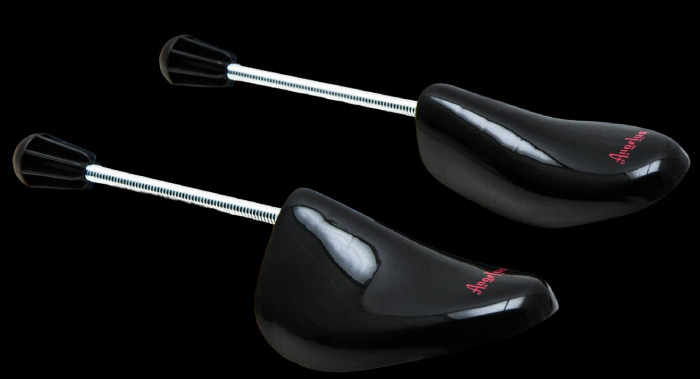
Shape is last. A shoe tree is a shaped insert that holds the toe box open. The NPS says collapsed or creased organic materials develop local weaknesses, and it lists acid-free tissue and washed, undyed cotton among the supports it favors. Our guide to uncreasing shoes covers pairs that have already folded.
Is the washing machine a good way to clean pairs before they go in a box?
Nike’s cleaning guide says it does not recommend washing shoes in a washing machine, because delicate shoe materials can be damaged in the washer. It names careful hand washing as the best way to avoid harming a pair, followed by air drying at room temperature.
How often should you check on stored pairs?
Regular inspection matters more than any single product, and the National Park Service says the right frequency may be weekly, monthly or annually depending on the object and its environment. A check means taking each pair out, looking for stains and cracking, and smelling for the musty odor the NPS names as the usual first sign of mold.
It is also a chance to let the pair air. The NPS mold leaflet says proper ventilation helps keep materials dry and reduces pockets of high humidity.
Rotating the pairs you wear, as suggested above for collections of 20 to 50 pairs, does a similar job, because every pair leaves its box on a regular basis. For protecting pairs through the seasons, see our guide on how to protect sneakers.