Zellerfeld Shoes Guide: 3D-Printed Footwear & 60% Creator Royalty Split

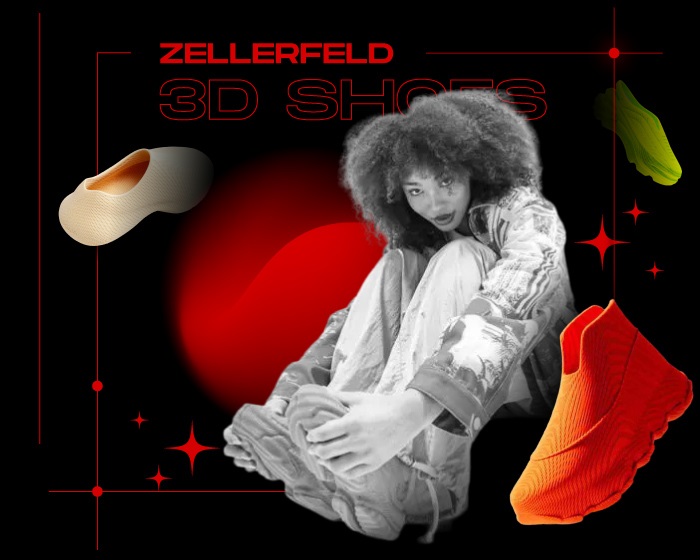
Zellerfeld shoes are stitchless, 100% recyclable 3D-printed sneaker models engineered by the German footwear company Zellerfeld. Here is how their 2024 open-source platform works to grant independent users a 60% creator royalty share on approved community designs. Each custom-fitted thermoplastic polyurethane (TPU) pair retails between $250 and $400 without adhesives or factory molds.
- Creator Royalty Split: Independent footwear designers who submit approved 3D models through the 2024 creator portal receive a 60% royalty share on net design royalties per pair sold.
- Manufacturing Specs: Printed from a single recyclable thermoplastic polyurethane (TPU) filament without stitches, glue, or multi-material foam layers, rated for at least 2 years of daily wear.
- Luxury Archive Collabs: Produced runway and commercial 3D-printed silhouettes for Heron Preston (2021), Kanye West’s Yeezy SZN 9 (2022), Ambush, Moncler, and Louis Vuitton ($1,200+ retail tiers).
- Custom Fit & Recycling: Per company data, smartphone LiDAR foot scans print millimeter-accurate lasts and worn pairs return for 100% melt-down re-extrusion into new footwear.
What Is Zellerfeld and How Does Its Stitchless 3D Shoe Printing Work?
Zellerfeld is a Hamburg, Germany-based footwear engineering company founded by Cornelius Schmitt and Lennartisen. It builds custom 3D-printed sneakers inside automated printer farms. Traditional factories in the global sneaker industry assemble 30 to 60 stitched leather, mesh, and EVA foam parts using solvent glues. By contrast, Zellerfeld prints an entire shoe from one continuous filament of thermoplastic polyurethane (TPU).
Adjusting internal lattice density during printing lets one TPU material serve three structural roles. It forms a firm, abrasion-resistant outsole, a springy midsole, and a breathable mesh-like upper. Eliminating steel injection molds removes $50,000 to $150,000 in per-size factory tooling costs. Per company testing data, each printed pair delivers at least 2 years of structural wear before recycling. Each automated printer cell operates continuously without human assembly line workers.
Which Luxury Brands Collaborated With Zellerfeld Before Its 2024 Platform Launch?
Before opening its public design portal in 2024, Zellerfeld validated its printing hardware through luxury fashion partnerships. Key collaborators included Heron Preston, Yeezy, Louis Vuitton, and Moncler. In October 2021, the brand debuted the HERON01 with Heron Preston at $350 retail. That release marked the first commercially sold fully 3D-printed shoe. The beta test proved that printed TPU lattices handle daily pavement impact without delaminating.
During Paris Fashion Week in October 2022, Kanye West debuted a 3D-printed boot with Zellerfeld for Yeezy SZN 9. Luxury houses soon followed with sculptural slip-on models including the Ambush 100S ($335 retail) and Moncler Trailgrip 3D. Louis Vuitton also tapped the Hamburg lab for its LV Cobble and LV Footprint lines. Those runway pieces showed how additive manufacturing builds internal cavities that injection molds cannot release.
| Zellerfeld Model or Collaboration | Release Year | Retail Price Tier | Primary Lattice Construction |
|---|---|---|---|
| Heron Preston HERON01 | 2021 | $350 Retail | Single-Filament Printed TPU Slip-On |
| Yeezy SZN 9 3D Boot | 2022 | Runway Sample Only | High-Shaft Monochromatic TPU Lattice |
| Finn Rush-Taylor FRT01 / Nami | 2023 to 2024 | $250 to $315 Retail | Breathable Zonal-Density TPU Runner |
| Community Creator Portal Models | 2024 | $250 to $400 Retail | Custom-Scanned Open-Source 3D Prints |
How Do Custom Foot Scans and Closed-Loop Recycling Work on Zellerfeld Shoes?
Every pair of Zellerfeld shoes prints to the buyer’s exact foot dimensions instead of standard US half-size lasts. Buyers use a smartphone camera to capture a 30-second optical scan of both feet on a sheet of paper. The software measures arch height, instep volume, heel width, and individual toe lengths. It then generates a personalized digital last for the left and right foot.
Because the entire shoe uses mono-material TPU without cotton threads, eyelets, or glue, it supports closed-loop recycling. That mono-material approach sets it apart from traditional sustainable sneaker innovations. When a pair reaches the end of its 2-year lifespan, the wearer ships the worn shoes back to Hamburg. Zellerfeld washes, shreds, and melts the old TPU into fresh printer filament while refining your next fit profile.
How Does the 60% Creator Royalty Submission Process Work on Discord?
In July 2024, Zellerfeld launched an open-source creator platform that grants independent 3D artists a 60% royalty split per pair sold. Traditional footwear brands typically pay freelance industrial designers a flat fee or a 1% to 3% wholesale royalty. Opening the printer farm to independent creators removes minimum order quantities and upfront inventory costs entirely.
Designers begin by joining the official Zellerfeld Discord community and downloading the parametric last templates. Next, the creator opens a ticket in the #submit-model channel and uploads the 3D mesh file. Automated software checks wall thickness, overhang angles, and lattice density. Once the file passes the auto-check, the model goes live on zellerfeld.com for public custom-fit orders.
Under the 2024 Zellerfeld creator structure, Zellerfeld deducts its base TPU printing and fulfillment cost from the retail price. It then distributes 60% of the remaining design margin directly to the creator on every completed customer order.
What Are the Monochromatic Design Limitations and Secondary Market Fees?
Despite eliminating factory molds, single-nozzle TPU printing carries visual constraints compared to multi-material high-tech footwear designs. Because each printer extrudes one continuous TPU filament at a time, Zellerfeld shoes print in monochromatic colorways. Common finishes include solid black, red, orange, neon green, and off-white. Each pair also requires 12 to 24 hours of continuous print time, creating multi-week production queues.
Secondary market buyers on resale platforms must verify the closest standard US size equivalent before purchasing a custom-scanned pair. Under the StockX seller fee schedule, Level 1 sellers pay a 9% base transaction fee plus a 3% payment processing fee (12% total). On a $350 resale transaction, StockX deducts $42 in fees ($308 net payout). Meanwhile, the eBay athletic shoe fee structure charges an 8% final value fee ($28 deducted, $322 net payout) on shoes sold at $150 or more.
| Distribution or Resale Channel | Typical Price ($350 Reference) | Platform Fee or Base Deduction | Net Payout to Seller or Creator |
|---|---|---|---|
| Zellerfeld Creator Portal ($300 Retail, $200 Base Cost) | $300 Direct Retail Order | $200 Printing Cost + 40% Split ($40) | $60 Creator Royalty (60% of $100 Margin) |
| StockX Level 1 Resale ($350 Sale) | $350 Secondary Sale | 12% Total (9% Base + 3% Processing = $42) | $308 Net Seller Payout |
| eBay Athletic Shoes Tier ($350 Sale) | $350 Secondary Sale | 8% Final Value Fee ($28 on $150+ Shoes) | $322 Net Seller Payout |
| Traditional Brand Royalty ($250 Retail) | $250 Retail ($125 Wholesale) | 97% to 98% Retained by Brand | $2.50 to $3.75 (2% to 3% Wholesale Royalty) |
How Do Collectors Track Limited 3D-Printed Footwear Releases?
While community portal models remain made-to-order, limited-edition Zellerfeld collaborations with luxury labels release in capped print-slot batches. Those capsule drops often sell out their initial printer allocation within minutes of launch. Collectors monitoring limited footwear drops across specialty storefronts review our sneaker bot comparison guide to see how automated monitors track restocks and shock drops.
Leading multi-brand checkout platforms including Valor AIO, Cybersole, Stellar AIO, and NikeShoeBot support keyword monitoring alongside residential proxy rotation. Pairing dedicated residential proxies with pre-configured checkout profiles helps collectors secure limited allocation slots before print queues fill. Collectors also organize local sizing profiles before capsule countdowns expire. Readers can follow 3D-printed footwear collaborations and design news on the NikeShoeBot blog.
Are 3D-printed TPU sneakers machine washable or waterproof?
Yes, the mono-material TPU lattice does not absorb water like leather or cotton canvas. You can rinse the entire shoe under cold running water with mild soap and shake it dry within minutes.
Do you need to wear socks inside a custom-scanned 3D-printed shoe?
Although the internal TPU lattice is smooth and antimicrobial for barefoot wear, wearing thin moisture-wicking socks prevents skin friction during warm weather or extended walking sessions.