How Much Does It Cost to Make a Jordan? A Detailed Breakdown

Understanding how much does it cost to make Jordans requires a detailed breakdown of factory assembly, ocean freight, tariffs, and licensing. Across standard retro basketball releases, Free on Board (FOB) factory production costs range between $16 and $30 per pair. Shipping and import duties add $6.50 per pair, while athlete royalties add $5.00 before $180 to $230 retail pricing.
- Factory Production Range: Contract manufacturing costs between $16 and $30 per pair, averaging $17 on a classic AJ1 ($11 materials, $3 labor, $3 overhead).
- Freight & Customs Duty: Ocean container shipping ($4,000 for 3,000 pairs) adds $1.50 per pair, while a 20% US import duty adds $5.00 ($6.50 combined).
- Athlete Licensing Royalty: The signature athlete receives an estimated 5% wholesale licensing royalty, adding roughly $5.00 per pair to Nike’s landed expense.
- Wholesale vs Retail Split: Authorized retail chains apply a 50% keystone markup to the ~$90-$110 wholesale invoice to reach $180 to $230 shelf prices.
How Much Does It Cost to Make a Jordan at the Factory?
Direct factory manufacturing for a standard signature retro sits between $16 and $30 per pair. Upper leather grades and midsole tooling drive the exact plant invoice. On the classic Air Jordan 1 retro silhouette, raw materials cost roughly $11 per pair. Direct assembly labor costs $3 per pair. Plant overhead costs $3 per pair, and the factory fee is $1 per pair.
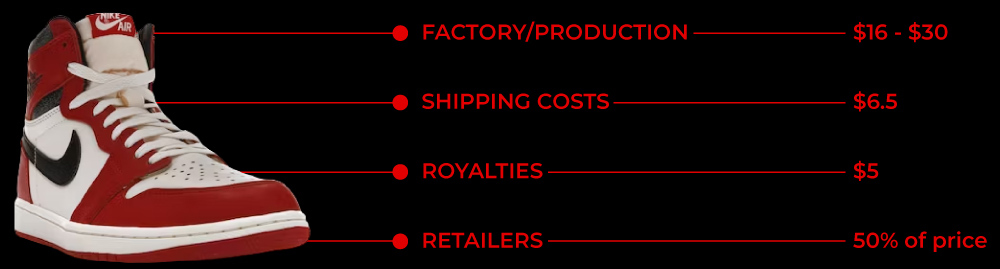
Those four factory components total $17 in Free on Board (FOB) production costs at the origin port. Per Nike annual manufacturing disclosures, partner plants in Vietnam, China, and Indonesia assemble nearly 100% of these basketball pairs. Readers can compare these plant numbers against our detailed guide on how much it costs to make a shoe across athletic categories.
How Do Materials, Labor, and Overhead Vary Across Retro Models?
A rubber cupsole model like the AJ1 costs $16 to $17 per pair at the factory gate. Later numbered silhouettes carry significantly higher bills of materials. The AJ4 requires TPU wing eyelets, visible Air units, and nubuck panels priced around $22 per pair. Similarly, the AJ11 uses carbon fiber spring plates and patent leather mudguards costing $26 to $30 FOB per pair.
Cutting and stitching 30 to 40 leather pattern pieces requires skilled hand assembly across hundreds of operators. Our breakdown of where Nike shoes are made shows how Tier 1 plants amortize steel outsole molds. Factories spread those tooling costs across 50,000+ pairs per colorway run. Smaller collaborative releases cost more per unit because dye-lot expenses spread across fewer pairs.
| Cost Component | AJ1 High OG Baseline | Upper-Tier Retro (AJ4 / AJ11) | Share of $180 Retail Price |
|---|---|---|---|
| Leather, Rubber & Cushioning Materials | $11.00 | $18.00 to $21.00 | 6.1% to 11.7% |
| Factory Assembly Labor & Overhead | $6.00 ($3 labor + $3 overhead) | $7.00 to $8.00 | 3.3% to 4.4% |
| Contract Factory Fee ($1) & Freight ($1.50) | $2.50 ($1.00 + $1.50) | $2.50 ($1.00 + $1.50) | 1.4% |
| US Import Duty (20%) & Royalty (5%) | $10.00 ($5.00 + $5.00) | $10.00 ($5.00 + $5.00) | 5.6% |
How Much Do Ocean Shipping and 20% Import Duties Add Per Pair?
Once finished shoes leave Asian assembly plants, international logistics and tariffs add roughly $6.50 ($6.5) per pair. A standard 40-foot ocean container holds approximately 3,000 boxed pairs of adult basketball footwear. Commercial trans-Pacific container freight costs roughly $4,000 per voyage across major shipping lanes. Ocean shipping and marine insurance therefore average $1.33 to $1.50 ($1.5) per pair.
Shipments arriving at US ports in Los Angeles or Long Beach face federal customs duties on the FOB invoice. Per the Shoemakers Academy US footwear tariff guide and USITC Harmonized Tariff Schedule Chapter 64, athletic shoes carry import duties up to 20% (~$5 per pair). Adding $6.50 in freight and customs duty to $17-$30 FOB costs yields $23.50 to $36.50 ($36.5) per pair.
How Do 5% Athlete Royalties and 50% Retail Margins Work?
Beyond physical manufacturing and customs clearance, every pair carries a contractual licensing fee paid to Michael Jordan. Under the 1984 Nike licensing structure, the Hall of Fame guard receives an estimated 5% wholesale royalty per industry data. On a retro sneaker with a $90 to $100 wholesale invoice, that 5% royalty costs roughly $4.50 to $5.00 per pair.
Direct factory production ($17) and ocean freight with 20% customs duty ($6.50) total $23.50 per pair. Adding the $5.00 athlete royalty brings total landed costs to $28.50 on an $180 AJ1.
Standard keystone pricing applies whenever Nike sells inventory to third-party chains like Foot Locker or JD Sports. Retailers buy pairs at roughly 50% of the final MSRP ($90 wholesale on a $180 shoe). That retail share covers mall store rent and staff payroll. Selling directly through the SNKRS app allows Nike to retain that 50% retail share internally.
Why Do Retro Basketball Prices Range Between $180 and $230 at Retail?
Shoppers tracking historical Air Jordan retail prices have watched retro tags climb since 2015. Standard releases now retail between $180 and $230 per pair across adult sizes. That $151.50 to $193.50 spread above landed factory cost funds global corporate operations. Nike spends billions of dollars annually on NBA athlete contracts and biomechanical R&D labs. Those budgets also support SNKRS cloud servers and global marketing campaigns.
On a $180 AJ1 sold wholesale for $90, subtracting the $28.50 landed cost leaves $61.50 in gross brand margin (68.3% per table data). Corporate SG&A expenses, regional warehousing, and corporate tax assessments reduce that gross figure. Across footwear divisions, Nike’s net operating margin averages 11% to 13% per annual corporate filings.
| Retro Basketball Silhouette | Estimated FOB Factory Cost | Total Landed + Royalty Cost | Standard Retail MSRP |
|---|---|---|---|
| AJ1 High OG | $16.00 to $17.00 | $27.50 to $28.50 | $180 |
| AJ3 & AJ4 Retro | $21.00 to $24.00 | $32.50 to $35.50 | $200 to $215 |
| AJ11 Retro (Holiday) | $26.00 to $30.00 | $37.50 to $41.50 | $230 |
| AJ1 Low OG | $14.50 to $16.00 | $26.00 to $27.50 | $140 |
How Can Buyers Secure Limited Retro Releases at Retail Price?
Limited-edition retro releases frequently trade above their $180 to $230 MSRP on secondary marketplaces like StockX and GOAT. Securing pairs at the primary retail counter avoids aftermarket markups and 12% seller platform fees. Collectors who buy multiple pairs should review sneaker reseller tax reporting rules before filing annual returns. Our guide on how to buy sneakers in bulk also explains verified retail ordering rules.
High-demand AJ1, AJ4, and AJ11 drops often sell out within seconds across Shopify boutiques and major footwear chains. Automated checkout software manages parallel tasks across multiple storefronts during these morning releases. Our overview of sneaker botting tools and our sneaker release blog cover leading platforms. Top multi-site options include Valor AIO, Cybersole, Stellar AIO, and NikeShoeBot across major retail releases.
What percentage of a $180 AJ1 goes to the factory assembly worker?
Direct factory assembly labor accounts for approximately $3.00 per pair on a standard AJ1. That equals 1.67% of the $180 retail price and 17.6% of the $17 FOB factory cost.
How much royalty is paid per pair of signature retro basketball shoes sold?
Under the 1984 licensing structure with Nike, the signature athlete receives an estimated 5% wholesale royalty per industry data. That equals roughly $4.50 to $5.00 per pair on a standard $180 to $200 retro release.