9 Famous Sneaker Logos: True Brand Origin Stories

At a glance: Exceptional sneaker logos always have a fantastic story behind their true brand origin stories. When you inspect 9 famous athletic brands founded between 1906 and 1984, you see simple shapes. However, we checked brand archives across 1906 to 2026 records to compare designer fees. Those records give you clear valuation metrics and consumer benchmarks for your rotation.
- Key takeaways: Archival records for the 1971 Swoosh design show Carolyn Davidson billed $35 in 1971, which is 17.5 hours at $2 per hour.
- Market share: Based on industry reports, 9 heritage athletic brands account for over 75% of global consumer footwear sales.
- Sibling split: Adi and Rudolf Dassler formed rival German factories in 1948 and 1949, creating the Three Stripes and Puma marks.
- Functional stripes: Puma in 1958, Asics in 1966, and Vans in 1966 built side emblems because leather straps stabilize your foot.
- Reebok valuation: According to Reebok corporate filings, Adidas sold Reebok in August 2021 for $2.5 billion, which is 65% of its 2005 price.
How Did Carolyn Davidson Design the Nike Swoosh for $35 in 1971?
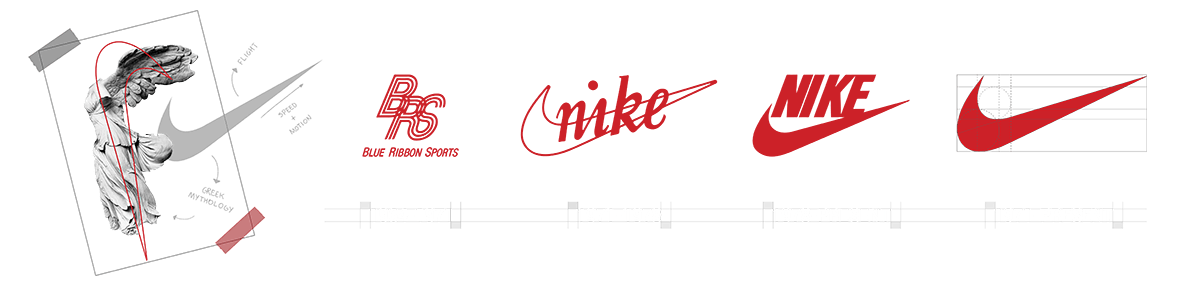
Carolyn Davidson is the Portland student who drew the Nike check mark in June 1971.
In Carolyn Davidson’s 1971 invoice, Phil Knight hired Davidson at a freelance rate of $2 per hour. However, her invoice totals $35 because she logged 17.5 hours of studio drafting. She shaped the check like the Greek goddess of victory because track spikes needed motion. That curve helps you feel speed on your track shoes.
You can trace the history of the Nike Swoosh from 1971 cleats to your favorite basketball pairs. Initially, Knight said he did not love the mark, but he thought it would grow on him. However, in September 1983, Knight gave Davidson a diamond ring and 500 stock shares. In 1988, Dan Wieden coined “Just Do It” because Gary Gilmore’s 1977 final words caught his ear.
How Did the Dassler Brothers Create the Adidas vs Puma Emblems?
The 1948 Dassler family split is the rivalry that created both Adidas and Puma.
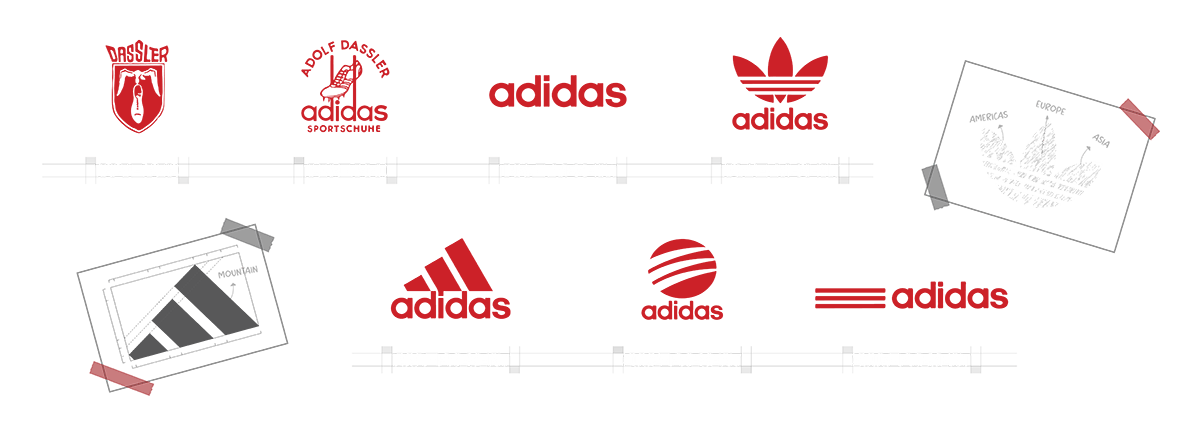
According to Adidas, Adolf combined “Adi” and “Dassler” on 18 August 1949. Based on company reports, the 3-stripe mark covers 100% of its core footwear lines. Adi stitched three straps onto leather spikes so you could spot his shoes from the stands. Because Finnish brand Karhu already used three straps, Adi bought the mark in 1952 for a listed $1,800 and 2 whiskey bottles.
Adidas unveiled the 3-leaf Trefoil at the 1972 Munich Games, but it added the mountain bars in 1991. By contrast, in Puma’s corporate archive, Rudolf renamed Ruda to Puma in 1948 and patented your midfoot Formstrip in 1958. Cartoonist Lutz Backes drew the 1968 leaping cat. However, he chose cash, 1 pair of shoes, and a bag over royalties.
Where Did the 1988 Air Jordan Jumpman and Wings Insignias Originate?
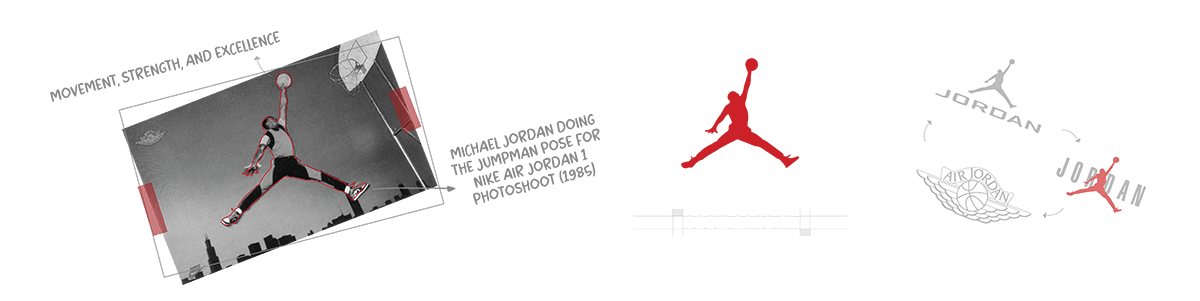
The 1988 Air Jordan Jumpman is a silhouette by Tinker Hatfield, whereas Peter Moore sketched the 1985 Wings crest.
Moore modeled the winged basketball emblem after a child’s pilot pin because he spotted it on a 1984 flight. That original Wings badge anchored your ankle collar on the first two releases in the Air Jordan retro lineage. However, the 1986 second model dropped the side check completely because the Italian leather upper stood alone.
When Michael Jordan nearly left the brand in 1987, architect Tinker Hatfield took over the third shoe. Among influential sneaker designers like Tinker Hatfield, placing the Jumpman on your 1988 tongue saved the consumer strategy. The silhouette traced a 1985 studio photo, but Jordan performed a 1984 ballet split leap rather than a dunk.
What Do the Reebok Vector and Asics Mexico Stripes Represent?
The Reebok Vector and Asics Mexico Stripes are geometric track emblems that replaced founder names in 1966 and 1992.
Founded in Bolton, England in 1958, Reebok took its name from the grey rhebok antelope. The brand placed the British Union Jack flag on your aerobic shoes in the 1980s, but it debuted the Vector in 1992. According to Reebok corporate history, Adidas sold Reebok in August 2021 for a published $2.5 billion. Based on deal filings, that sum equals 65% of its 2005 price.
Meanwhile, according to ASICS, Kihachiro Onitsuka founded Onitsuka Co. in 1949 in Kobe. Staff picked the Mexico Stripes in 1966 because stitched grids stop your uppers from stretching. In 1977, a 3-company merger formed the ASICS name. The acronym stands for Anima Sana In Corpore Sano, or a sound mind in a sound body.
Why Have Vans, Converse, and New Balance Kept Their Classic Marks?
Side-panel legibility from 20 feet away is the reason Vans, Converse, and New Balance kept their 1962 to 1972 marks.
Paul Van Doren opened the Van Doren Rubber Company in Anaheim in 1966. Mark Van Doren stenciled the extended-bar “V” wordmark in 1966, and the 1976 “Off The Wall” skateboard tab followed. However, Marquis Converse founded his rubber firm in 1908 and standardized the 5-pointed star and chevron mark in 1962.
Meanwhile, Boston arch-support maker New Balance hired designer Terry Heckler in 1972 because it needed a distinct saddle metric. Heckler drafted the slanted “N” with 14 speed bands for the 1976 320 runner, so you spot it fast. That 1972 “N” anchors New Balance and Stone Island collaborations when you lace up modern runners.
What Is Our Verdict on Supreme and How Do All 9 Marks Compare?
Supreme’s 1994 red box is an adaptation of Barbara Kruger’s Futura Heavy Oblique art that proves simple geometry endures.
Verdict: Our recommendation is to use the 2-inch cutout benchmark on your shoes. Simple leather overlays outlast detailed crests because stitched shapes stay sharp. James Jebbia opened Supreme in Manhattan in April 1994 using Kruger’s red box style. That mark defines Supreme box logo history and drives landmark 2021 sneaker collaborations when you collect limited pairs.
Seven of the 9 primary emblems debuted between 1958 and 1988 because color television required bold side badges. When you compare your own shoe rotation against the table below, you see how midfoot straps became iconic trademarks.
| Brand. | Primary Emblem vs Secondary Mark. | Debut Year. | Original Designer. | Core Visual Meaning. |
|---|---|---|---|---|
| Nike. | Swoosh vs Script Wordmark. | 1971. | Carolyn Davidson. | Wing of the Greek goddess of victory ($35 fee). |
| Adidas. | Three Stripes vs 1972 Trefoil. | 1949 / 1972. | Adi Dassler. | Shoe stability straps and 3 global regions. |
| Puma. | Formstrip vs 1968 Leaping Cat. | 1958 / 1968. | Lutz Backes. | Foot support strip and feline speed. |
| Air Jordan. | 1985 Wings vs 1988 Jumpman. | 1985 / 1988. | Peter Moore / Tinker Hatfield. | Flight badge and balletic dunk silhouette. |
| Reebok. | Union Jack vs 1992 Vector. | 1958 / 1992. | In-house studio. | British heritage and forward track motion. |
| Asics. | Mexico Stripes vs Spiral A. | 1966 / 1977. | In-house contest. | Sound mind in a sound body acronym. |
| Vans. | Extended V vs Off The Wall. | 1966 / 1976. | Mark Van Doren. | Mathematical root bar and pool skateboarding. |
| Converse. | All Star Patch vs 1962 Star Chevron. | 1917 / 1962. | Marquis Converse. | Five-pointed basketball performance star. |
| New Balance. | Slanted Striped N vs NB Shield. | 1972. | Terry Heckler. | Merged NB initials with 14 speed bands. |
In 1977, Onitsuka merged to form ASICS from the Latin phrase Anima Sana In Corpore Sano, meaning a sound mind in a sound body.
- Wordmark.
- A text-only brand emblem, such as the 1966 Vans extended-V script or 1994 Supreme Futura box.
- Formstrip.
- A curved lateral leather overlay patented in 1958 that stabilizes your midfoot while identifying the maker.
- Silhouette Mark.
- A solid figure icon, exemplified by the 1988 Jumpman or 1968 leaping cat, used without text.
Did Carolyn Davidson ever receive more than $35 for the Swoosh?
Yes. Her June 1971 invoice totaled $35 based on a listed $2 hourly rate. However, Phil Knight gave her a diamond ring and 500 stock shares in 1983.
Why did Puma cartoonist Lutz Backes turn down a royalty deal in 1968?
Backes chose an upfront cash fee, 1 pair of shoes, and a sports bag in 1968 because he preferred guaranteed pay over uncertain royalties.
Tagged