Complete History of Supreme: 1994 Lafayette Shop to Global Icon

Supreme is a New York skateboarding and clothing company founded by James Jebbia on Lafayette Street in April 1994. Growing from New York to the world, the brand that reigns over Thursday 11:00 AM drops expanded to Japan in 1998 and sold to VF Corp for $2.1 billion per 2020 filings. Below we trace its 1994 origins, Box Logo history, and landmark Nike sneakers.
- 1994 Manhattan debut: Opened in April 1994 at 274 Lafayette Street with $12,000 in startup costs before moving to 190 Bowery in 2019.
- Global retail footprint: Expanded to Tokyo, Osaka, and Fukuoka in 1998 and operates 17+ flagship stores worldwide.
- Corporate valuation: Acquired by VF Corporation in November 2020 in a deal valued at $2.1 billion per filings, then by EssilorLuxottica for $1.5 billion per 2024 data.
- 2002 sneaker grail: The September 2002 Nike SB Dunk Low Black Cement (500 pairs at $65 retail) trades between $3,800 and $5,500 on StockX.
How Did James Jebbia Launch the Lafayette Street Skate Shop in 1994?
British-born entrepreneur James Jebbia opened the original 274 Lafayette Street skate shop in lower Manhattan in April 1994.
Before launching his own label, Jebbia managed the New York SoHo store for Stussy streetwear brand history pioneer Shawn Stussy. Stussy had founded his California surf and apparel label in 1980. Downtown Manhattan skaters lacked a dedicated neighborhood shop in the early 1990s. Jebbia spent $12,000 in startup costs to build an open-floor space. Racks lined the perimeter walls so riders could skate straight inside carrying their boards.
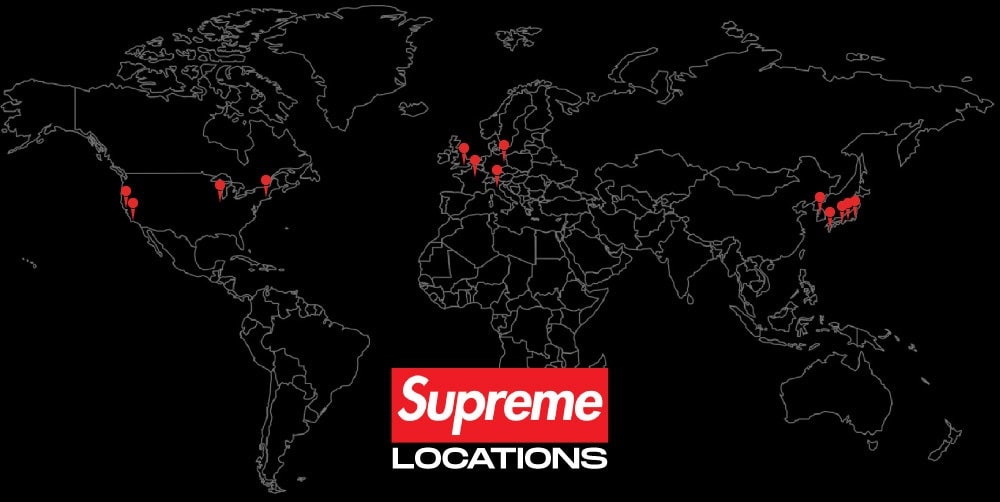
Early momentum from Tokyo tastemakers Hiroshi Fujiwara and Nigo prompted international expansion in 1998. Three Japanese stores opened in Daikanyama, Osaka, and Fukuoka. The original Lafayette storefront closed in 2019 and relocated to 190 Bowery. VF Corporation completed a $2.1 billion VF Corp acquisition in November 2020 per corporate filings. Its global flagship store locations span 17 cities from Paris and Milan to Seoul and Shanghai.
Where Did the 1995 Box Logo Come From and What Trademark Battles Followed?
White Futura Heavy Oblique text inside a red rectangle debuted on tees in 1995. The typography drew directly from feminist conceptual artist Barbara Kruger’s 1981 work.
Throughout the 1990s and 2000s, the skate label sampled corporate and cultural emblems with irreverent humor. A 2000 skate deck and beanie pack used Louis Vuitton’s toile monogram. That unauthorized release triggered a swift cease-and-desist demand from the French house. Seventeen years later, the two houses reunited officially for a 2017 luxury streetwear fashion capsules collection. Later pieces sampled 1990s Farmland Foods oval logos and French deco artist Erté’s alphabet illustrations.
In 2013, the company filed a $10 million lawsuit per court filings against New York label Married to the Mob. That dispute centered on a “Supreme Bitch” parody tee and prompted Barbara Kruger to mock the lawsuit publicly. European court rulings later shut down counterfeit “Supreme Italia” stores in 2019. Full United States and Chinese trademark registrations followed by 2020.
Which Archive Nike Collaborations Command the Highest Aftermarket Prices?
Five landmark Nike footwear releases between 2002 and 2014 established the skate label as a dominant force in sneaker collecting.
The partnership began in September 2002 with the Nike SB Dunk Low Pro in Black Cement and White Cement. Those pairs transferred Tinker Hatfield’s 1988 Air Jordan 3 elephant print onto a skate shoe. Production totaled 500 pairs per colorway at $65 retail. Deadstock 2002 pairs trade between $3,800 and $5,500 on StockX data. In August 2003, the Dunk High Pro SB Stars pack added gold stars and croc leather at $75 retail.
In April 2006, quilted leather SB Blazer highs with snakeskin Swooshes retailed at $100. A 10th-anniversary Red Cement SB Dunk Low followed in July 2012, priced at $138 retail. In April 2014, the ornate Air Foamposite One released at $250 retail. Massive crowds prompted the NYPD to cancel the Manhattan in-store drop.
| Collaborative Sneaker | Release Date | Retail MSRP | Secondary Market Range |
|---|---|---|---|
| SB Dunk Low Black Cement (500 pairs) | September 2002 | $65 retail | $3,800 to $5,500 StockX |
| SB Dunk High Pro Blue Stars | August 2003 | $75 retail | $2,600 to $3,900 StockX |
| SB Blazer Quilted Red | April 2006 | $100 retail | $1,200 to $1,950 StockX |
| SB Dunk Low Red Cement | July 2012 | $138 retail | $1,100 to $1,650 StockX |
Which Anniversary and Store-Opening Box Logo Tees Top Collector Lists?
Store-opening exclusives and milestone anniversary releases represent the highest-valued cotton Box Logo t-shirts from the past decade.
Whenever a new flagship opens, the shop prints a city-specific tee available only on opening weekend. The Paris Marais store opened on March 10, 2016. Its white tee featured a black front box and “Bonjour Madame 10-3-2016” on the back. Priced at €44 (~$50 retail), the Paris tee trades between $850 and $1,400 per market data. Earlier in April 2014, the 20th Anniversary Box Logo tee retailed at $32 with a back neck stamp.
In June 2017, the Italian-made Louis Vuitton Monogram Box Logo tee retailed at $485 to $890. Verified pairs trade between $1,800 and $2,900 per resale data. For the 25th anniversary in April 2019, the Swarovski crystal tee retailed at $398 with 1,161 crystals.
What Inspired the Motion Logo, Courrèges Script, and Collectible Accessories?
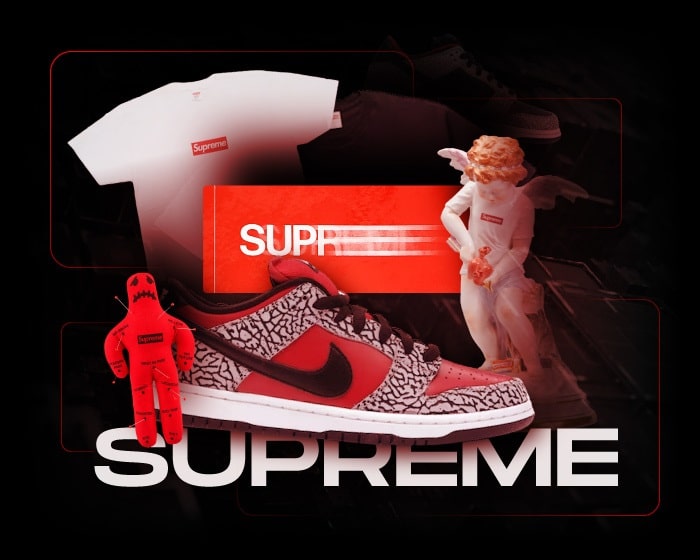
Classic graphic reinterpretations like the 1998 Motion Logo and 1961 Courrèges emblem sit alongside novelty accessories ranging from $4 retail stickers to porcelain statues.
Beyond the red box, designers adapted iconic 20th-century typography for seasonal graphics. The blurred Motion Logo pays homage to graphic designer Saul Bass’s 1990 opening title sequence for Martin Scorsese’s film Goodfellas. Another staple, the accented “Suprème” emblem, borrows the geometric mark created in 1961 by French fashion designer André Courrèges. Meanwhile, the 1997 Arabic script graphic translates to “Subhan” (“Glory Be To”).
From $4 retail sticker packs and a $30 retail stamped red clay brick in 2016 to a $3,998 retail hand-painted Meissen porcelain Cupid figurine in 2019, accessories turn everyday objects into pop-art collectibles.
Other sought-after oddities include 2018 transparent anatomical torso models priced at $110 retail. Seasonal catalogs also featured voodoo dolls at $54 retail and clear acrylic lockpicking practice padlocks at $60 retail.
How Do Weekly 11 AM Shopify Releases and Secondary Market Fees Work?
Seasonal collections launch across 19 to 20 consecutive Thursdays at 11:00 AM EST through a Shopify Plus storefront.
Since completing its Shopify Plus storefront switch, the webstore enforces per-IP queue throttling and hCaptcha checkpoints during high-traffic weeks. Those anti-bot queuing mechanics follow the Shopify storefront rate limit documentation. Readers checking online checkout bot legality note that automated software is lawful on retail apparel sites. Desktop suites including Cybersole, Valor AIO, Stellar AIO, and NikeShoeBot support automated Thursday checkout tasks across North American and European regions.
On the secondary market, the StockX seller fee structure deducts 9% plus 3% processing and $4 shipping. By comparison, the GOAT seller commission schedule charges 9.5% plus $5 and a 2.9% cash-out fee. Original store tags and dust bags must remain intact for physical verification.
| Collector Item | Original Retail Price | StockX Gross Sale | Net Payout After 12% + $4 |
|---|---|---|---|
| 2016 Clay Brick Accessory | $30.00 (2016 MSRP) | $160.00 sale | $136.80 net payout |
| 2014 20th Anniversary Tee | $32.00 (2014 MSRP) | $650.00 sale | $568.00 net payout |
| 2019 Swarovski Box Logo Tee | $398.00 (2019 MSRP) | $580.00 sale | $506.40 net payout |
| 2017 Louis Vuitton Box Tee | $485.00 (2017 MSRP) | $2,200.00 sale | $1,932.00 net payout |
How many weeks does each Spring/Summer and Fall/Winter season last?
Each seasonal collection spans 19 to 20 weekly Thursday drops at 11:00 AM EST, followed by a 6-to-8-week off-season hiatus between July/August and January/February.
When did the original 274 Lafayette Street store in Manhattan close?
The original 274 Lafayette Street shop opened in April 1994 and closed in 2019 when the Manhattan flagship permanently relocated to a larger space at 190 Bowery.