Nike Court Vision vs Air Force 1: Price, Cushioning, and Fit

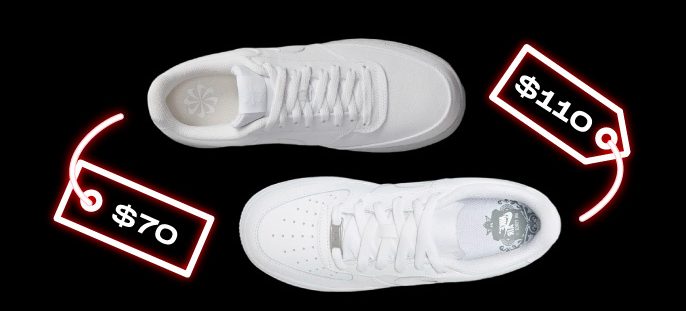
Comparing Nike Court Vision vs Air Force 1 comes down to a $35 retail price gap and what sits inside the rubber midsole. The Air Force 1 retails at $110 with thicker tumbled leather and encapsulated Air cushioning, whereas the Court Vision Low lists at $70 to $75 with a plain foam midsole.
What actually separates them
The two shoes are separated by five things. The price is the one that decides it for most people.
- Price: The Air Force 1 starts at $110. The other one starts at $70 to $75 and drops to around $50 on sale.
- Age: The AF1 landed in 1982 and its rival in 2014, so there are 32 years between them.
- Cushioning: The AF1 was the first basketball shoe to carry Nike Air. The newer pair runs on foam, with no Air unit.
- Build: The 2014 shoe is slimmer and lighter. If the AF1’s chunkiness is what puts you off, that is the entire pitch.
- Collabs: The AF1 has thousands of colorways and the big collaborations, like the Tiffany pair that retailed at $400. The cheaper shoe does not play that game.
Nike Court Vision vs Air Force 1, side by side.
The two shoes are different on six things that matter and the same on almost everything else. This is exactly why people mix them up.
Every row that follows is a specification you can verify on Nike’s own product pages for either shoe. Read them as a shortlist of trade-offs rather than a scoreboard. Nothing here makes one shoe universally better; it makes one shoe better for a given buyer.
The single row that decides it for most people is the retail price. The single row nobody expects to matter is the cushioning.
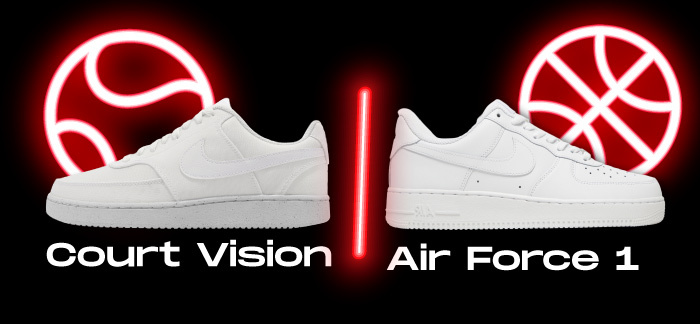
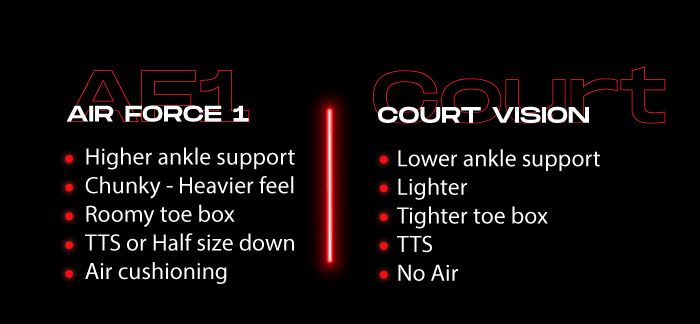
Nike Air Force 1 Nike Court Vision Released 1982 2014 Built as Basketball Tennis Retail From $110, collabs far higher About $70 to $75 On sale Rarely under retail As low as $50 Cushioning Nike Air Foam, no Air unit Profile Chunkier, thicker midsole Slimmer, lighter, lower Colorways Thousands, plus constant collabs A handful of core colors Is the Court Vision just a cheap AF1?
The Court Vision is not a cheap copy of the Air Force 1. This is the part most comparisons get lazy about. The two look alike because they share the panel-blocking and the low-top court shape. This is a design language Nike has used across dozens of silhouettes.
Underneath that they were built for different sports and they are put together differently. One is a 1982 basketball shoe with an Air unit under the heel. The other is a 2014 tennis-inspired shoe running on a foam midsole.
So the cheaper pair is not a knockoff, it is a lighter shoe that happens to land in the same visual neighbourhood for about a third of the money. Whether that is a win depends entirely on whether you wanted the Air.
Which one has the better story?
The AF1 is the one with the story. It is not close. According to the shoe’s documented history, designer Bruce Kilgore’s Air Force 1 launched in 1982 as the first basketball shoe to carry Nike Air cushioning. It really was state of the art for its day.
Sneaker tech has moved a long way since, and we covered where it went, but the AF1 stayed. As of 2026, it remains one of Nike’s best sellers with thousands of colorways in existence. We went through the full history of the AF1 separately if you want the long version.
Its rival is a much newer silhouette, released in 2014. As a result, it is barely ten years old and Nike marketed it as a tennis shoe. There is no folklore attached to it yet. That is fine. Not every shoe needs to be a monument.

1982 against 2014. One of these has a thirty year head start. What do you actually pay at the till?
The newer shoe is cheaper to buy and the AF1 is cheaper to own. Those are two different questions. Here is each of them separately. The Court Vision is about a third cheaper at the till, and the gap widens if you are patient. Money matters when you are buying sneakers, whatever anyone says.
Nike lists the Air Force 1 from $110, and a hot collaboration goes far past that: the Tiffany pair retailed at $400. This is 264% more than the standard price, and that was retail, not resale.
According to Nike’s own listings, its rival sells for about $70 to $75, a 34% gap at the midpoint, and a sale takes it to around $50, another 31% off. Run that arithmetic to the end: at full retail you are $40 apart, and at sale prices you are $60 apart. Two pairs of the cheaper shoe cost roughly what one pair of AF1s costs.
Why does one of them hold its value?
The AF1 is the one that holds its value, because demand for it never stops. That is the part the sticker price hides.
It has been in continuous production since 1982, the collaborations create genuine scarcity at the top end. There is a resale market that prices the rare pairs accordingly. A worn pair still has a floor.
The newer shoe has none of that: it is produced in a handful of core colors, nobody is queuing for it. A used pair is worth what a used pair of anything is worth. So the cheaper shoe to buy is also the one you get nothing back for. If you are the sort of person who sells pairs on, that changes the whole calculation.

$110 against $72.50. About a third apart. How different are they to actually wear?
The Court Vision is the lighter, lower shoe on foot. That is the honest summary of the difference. It is the smaller, slimmer version of the same shape. As a result, if you like the AF1 look but its bulk puts you off, this is the one to try.
What you give up is the Air unit. That means the AF1 feels more cushioned underfoot over a long day on your feet. On materials, panel-blocking and general aesthetics the two are close to a draw. Most people will not clock which one you are wearing from across the street.
Up close the midsole height gives it away immediately: one has a thick slab under the foot. The other does not. That single detail is most of what separates them visually.
Same neighbourhood, different midsole. Who should buy the Air Force 1?
Both are the right answer for somebody. As a result, the useful question is which somebody you are. Here are the two cases. The AF1 is the right buy if you want the icon. Choose it when you want the pair to hold resale value in a few years.
It is the right call if the history matters to you, if you are on your feet all day and want the Air unit under your heel, or if you want access to the collaborations. That heritage explains the price gap. The AF1 line is where the interesting colorways live, and none of them exist on the cheaper silhouette.
It is also the right call if you resell. In practice, it is the only one of the two with a floor under it.
At $110 retail, Nike lists a silhouette that has stayed in production since 1982. This is a different proposition from paying $110 for a shoe released last season. The forty years are not nostalgia, they are the reason a used pair still sells.
Who should buy the cheaper pair?
The Court Vision is the right buy if you want the look for a third less. Buyers pick it when resale value later does not matter. It is the right call if you want something light, if the AF1’s bulk has put you off, or if you want a beater you will not mourn when it scuffs.
At around $50 on sale it is close to disposable. For a lot of people that is a feature rather than a flaw: a shoe you can wear in the rain without thinking about it is worth more than a shoe you keep for good. It is also the sensible first pair if you are not yet sure the silhouette suits you.
If the low-top silhouette is what you are chasing rather than either of these, we compared the Dunk against the AF1, the Jordan 1 against the Dunk and Dunk highs against lows.
Does it have Air cushioning?
The Court Vision does not include an Air unit. The newer shoe runs on a foam midsole with no Air unit. The Air Force 1 does have one, and it was the first basketball shoe that did.
Is it a basketball shoe?
Nike markets it as a tennis silhouette rather than a basketball shoe. The name reads like basketball, but the build and the marketing both point at the other court.
Are there collabs on the cheaper pair?
There are no collaborations on the scale of the AF1. The AF1 gets the big collaborations and the thousands of colorways. Its rival sticks to a small run of core colors.