Jordan 12 History: 30 Years of OG Colorways & 1997 Flu Game

Jordan 12 History spans 30 years of an iconic championship shoe that debuted in November 1996 at $135 retail. Designed by Tinker Hatfield with full-length Zoom Air, the silhouette anchored the Chicago Bulls’ fifth NBA title in 1997. Below we examine its 5 OG colorways, top collaborations, and 2027 anniversary lineup.
- Original 1996 launch: Debuted in November 1996 at a $135 retail price as the first model released under the standalone brand division.
- 1997 Finals legacy: Worn on June 11, 1997, during Game 5 in Utah, where No. 23 scored 38 points in 44 minutes.
- First Zoom Air setup: Introduced a full-length Zoom Air cushioning bag paired with a woven carbon fiber midfoot shank plate.
- Collab aftermarket peaks: Non-OG grails trade around $310 for Wings, $350 for University Gold, $472 for PSNY Wheat, and $1,000 for OVO White.
How Did Jordan 12 History Begin With the 1996 Debut and 1997 Flu Game?
The twelfth signature silhouette debuted in November 1996 at $135 retail and gained immortality during the 1997 Finals.
Arriving for the 1996-1997 NBA season, this model dropped external Swoosh logos across the classic Air Jordan catalog. On June 11, 1997, in Salt Lake City, Chicago’s guard battled severe illness during Game 5. Wearing the Black and Varsity Red pair, he logged 44 minutes and tallied 38 points. He also grabbed 7 rebounds, dished 5 assists, and hit the decisive 3-pointer.
That 90-88 road victory cemented the 1997 Flu Game colorway across modern sneaker industry history. In June 2023, the game-worn, autographed pair from that night sold at auction for $1.38 million per auction data. Collectors still rank that black and red edition among the top five basketball shoes of all time.
How Did Tinker Hatfield Combine Dress Boot Styling With Full-Length Zoom Air?
Architect footwear designer Tinker Hatfield blended a 19th-century women’s Nisshoki dress boot profile with full-length Zoom Air cushioning.
Radiating stitch lines across the tumbled leather upper mimic sun rays expanding outward from the instep. A pebbled faux-reptile leather mudguard wraps the lateral and medial toe perimeter. That thick overlay prevents lateral blowouts on hard cuts. Two metallic upper lace hooks stamped with Jumpman crests reinforce ankle lockdown. A woven heel pull tab reads Quality Inspired By The Greatest Player Ever.
Underfoot, the 1996 release became the first model in the line with full-length Zoom Air. Measuring 8 millimeters thick, the tensile-fiber air bag sits above a rigid carbon fiber torsion plate. Modified herringbone traction pods complete the durable court outsole.
What Are the 5 Original 1996-1997 Colorways and Which Returns in 2027?
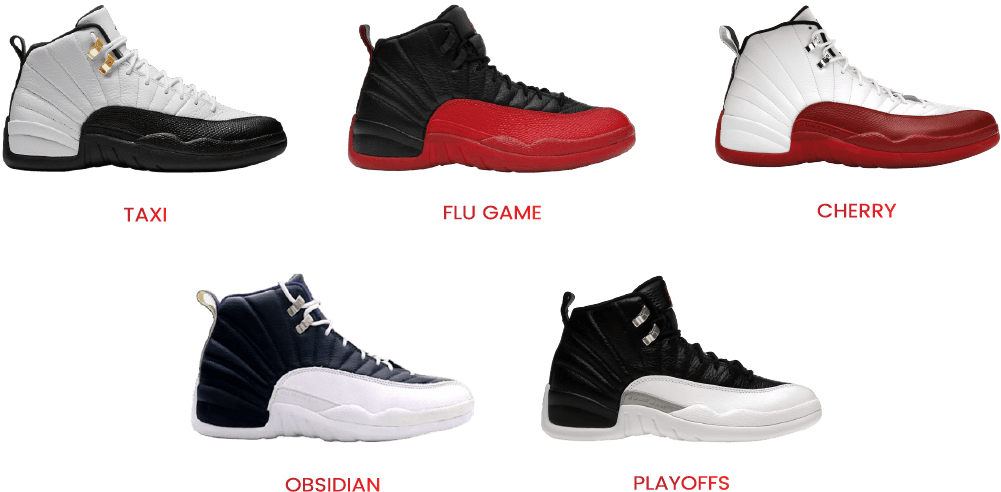
Five original colorways launched between November 1996 and June 1997 at $135 retail: Taxi, Cherry, Flu Game, Playoffs, and Obsidian.
The White and Black Taxi kicked off the run in November 1996 with gold upper eyelets. Next came the White and Varsity Red classic Cherry colorway in February 1997. The Black and Varsity Red Flu Game followed in March 1997. During the spring postseason, the Black and White Playoffs and Navy Obsidian completed the five-pair rotation.
To celebrate 30 years of the model, WWD footwear release reports confirm that the Obsidian returns in 2027. The anniversary pair restores original 1997 shape specifications and quilted leather panels. Modern anniversary retros carry a $210 retail price compared to the $135 MSRP in 1996.
Which Non-OG Collaborations Command $310 to $1,000 on the Aftermarket?
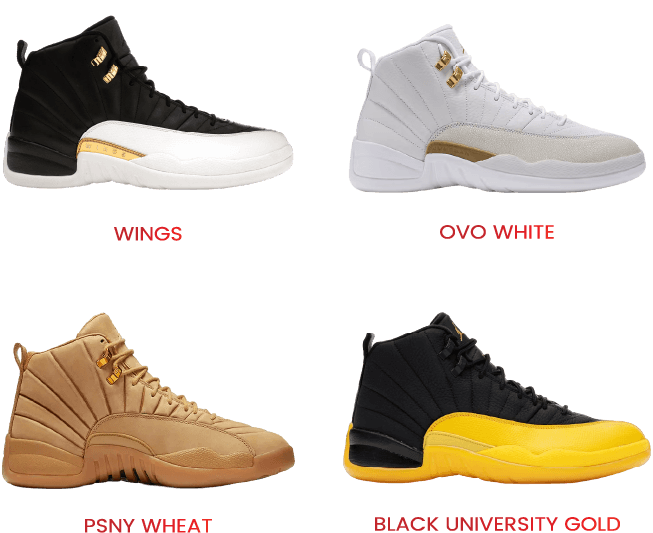
Four standout non-OG releases trade between $310 and over $1,000 on exchanges: Wings, University Gold, PSNY Wheat, and OVO White.
Released in April 2016 and limited to 12,000 numbered pairs at $225 retail, the Wings edition on StockX averages $310 on resale. Its black upper rubs away to reveal metallic gold wings underneath. In October 2016, Drake’s label dropped the stingray-textured OVO White at $225 retail. Deadstock OVO White pairs now trade above $1,000 across sizes 10 through 12.
Meanwhile, Public School New York crafted a nubuck PSNY Wheat regional pair in June 2017 at $300 retail. That monochrome edition averages $472 on resale exchanges. The July 2020 Black and University Gold ($190 retail) commands up to $350 per exchange data.
| Colorway Edition | Original Launch | Retail MSRP | Aftermarket Price Range |
|---|---|---|---|
| OG Taxi / Flu Game / Obsidian | 1996 to 1997 (Retros 2025-2027) | $135 OG / $210 Retro | $230 to $340 aftermarket |
| Wings (12,000 Pairs) | April 2, 2016 | $225 retail | $310 average StockX |
| OVO White (Drake Collab) | October 1, 2016 | $225 retail | $1,000+ deadstock ask |
| PSNY Wheat / University Gold | June 2017 / July 2020 | $300 / $190 retail | $472 average / up to $350 |
What Are the Aftermarket Prices and Seller Fees on Anniversary Retros?
Selling deadstock retro pairs between $310 and $472 incurs 8% to 12.4% in marketplace commissions across platforms.
Per the GOAT seller commission schedule, sellers with a 90+ rating pay a 9.5% base commission plus $5 and a 2.9% cash-out fee. On a $310 Wings sale, GOAT deducts $43.39 in combined charges. That leaves a $266.61 net payout. On a $472 PSNY Wheat sale, GOAT deducts $62.23, returning a $409.77 net payout.
By comparison, eBay charges a flat 8% final value fee on authenticated sneakers priced at $150 or more. Selling a $350 University Gold pair on eBay deducts $28.00. The seller keeps a $322.00 net payout before local tax.
Routing high-value $472 to $1,000 collaborative retros through eBay’s 8% authenticity tier saves $20 to $45 in seller fees compared to 12% platforms.
| Retro Pair Sold | Gross Sale Price | GOAT Fee (9.5% + $5 + 2.9%) | eBay 8% Auth Net Payout |
|---|---|---|---|
| Wings Retro (2016) | $310.00 sale | $266.61 net ($43.39 fee) | $285.20 net ($24.80 fee) |
| University Gold (2020) | $350.00 sale | $301.96 net ($48.04 fee) | $322.00 net ($28.00 fee) |
| PSNY Wheat (2017) | $472.00 sale | $409.77 net ($62.23 fee) | $434.24 net ($37.76 fee) |
| OVO White Collab (2016) | $1,000.00 sale | $876.45 net ($123.55 fee) | $920.00 net ($80.00 fee) |
How Can Collectors Secure 30th Anniversary Retros at Retail?
Securing 30th anniversary OG retros at $210 retail requires entering morning SNKRS draws alongside regional boutique raffles.
According to Nike SNKRS draw guidelines, Saturday heritage launches open at 10:00 AM EST with a 10-minute randomized entry window. Partner factories disclosed on the global manufacturing map produce smaller runs of men’s sizes 11.5 through 14. Collectors combine manual draw entries with multi-site checkout software on Footsites and Shopify boutiques.
- SNKRS 10-minute draw: Verify your saved payment card and shipping address 15 minutes before the 10:00 AM EST countdown begins.
- Tier-zero EQL raffles: Submit entries at A Ma Maniere, Social Status, and Sneaker Politics 3 to 5 days before launch.
- Multi-site checkout bots: Platforms like Valor AIO, Cybersole, Stellar AIO, and NikeShoeBot automate checkout tasks across Shopify and Foot Locker.
- True-to-size fit tip: Full-grain leather OG retros fit true to size, though wide-footed wearers loosen the top two metal lace hooks.
Did the original 1996 silhouette really draw inspiration from a women’s boot?
Yes, Tinker Hatfield modeled the high-contrast mudguard sweep after a 19th-century women’s dress boot alongside the Japanese Rising Sun motif.
How much does an original 1996 pair cost compared to modern retros?
Original 1996 releases retailed at $135, whereas 2025 through 2027 remastered OG retros carry a $200 to $210 retail price tag.