How Does New Balance Fit? A Classics Size Guide

The answer to “how does New Balance fit” starts with the brand itself: its shoes generally run true to size, and it sells them in widths from X-Narrow to XX-Wide. This classics size guide covers the 990, 550, 574, 327 and 2002R, where wearer reports sometimes split, and the checks that settle a doubtful pair.
- Widths: men’s widths run from 2A (X-Narrow) to 6E (XX-Wide), according to the brand’s own size guide.
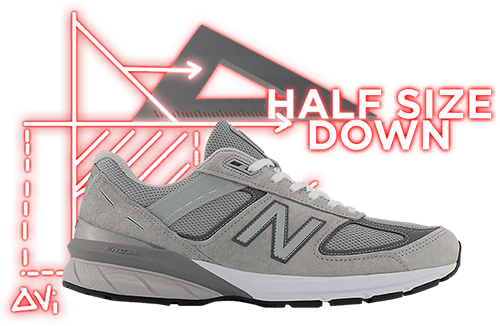
- The 990: fit sites split between true to size and half a size down for narrow feet.
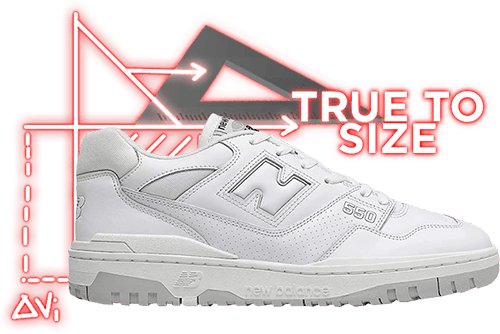
- The 550: true in length and narrow in the toe box, on all three fit sites we read.
- Between sizes: the brand advises taking the larger one when your feet fall between two.
How does New Balance sizing work?
New Balance sizing is standard industry sizing in half-size steps, such as men’s 9, 9.5 and 10 on the brand’s published chart, with a width letter added on top. An archived copy of the brand’s Product and Fit FAQ, dated 1 December 2023, gives the baseline in its own words:
Our shoes generally run true to size and align with standard industry sizing. If a style runs smaller or larger, we note that on the product page to help you choose the best size.
That second sentence makes the product page the last word on an unusual pair. The model-by-model notes below come from fit sites that collect wearer reports, not from the brand, and those sites do not always agree. Treat each note as a first guess, then use the width table and the measuring steps further down to confirm it.
What do the New Balance width letters mean?
New Balance width letters grade how much room a shoe gives your foot from side to side, from X-Narrow to XX-Wide. The guide on the brand’s industrial footwear site lists men’s widths as 2A, B, D, 2E, 4E and 6E, and women’s as 4A, 2A, B, D, 2E and 4E. Standard is D for men and B for women.
Width label Men’s letter Women’s letter X-Narrow 2A 4A Narrow B 2A Standard D B Wide 2E D X-Wide 4E 2E XX-Wide 6E 4E The FAQ adds a practical test. Pressure on the sides or tops of your feet suggests a wide width, while extra space at the sides suggests a narrow one. It also says the brand is “proud to offer one of the largest selections of shoes in extended widths.” A tight pair is therefore worth trying in the next width up before you add length.
How does the New Balance 990 fit?
The 990 fits close to true to size, with a long, roomy toe box that narrow feet often take up by going down half a size. WhatShoeSize’s 990v6 page, which summarises wearer threads on Reddit and was last reviewed on 13 June 2026, rates it true to size but long and narrow.

SoleFeed’s 990v6 guide, updated on 25 May 2026, says it often runs long and lists it as half a size big, though its FAQ says most buyers can start true to size. TruetoSizeFIT says most people can order their usual size.
All three say wide feet should use a wide width rather than extra length. The “v” in a style number is the version, according to the brand’s FAQ, so a 990v6 may not fit like an older pair. Our 990v6 article covers that release.
How does the New Balance 550 fit?
The 550 fits true to size in length but runs narrow through the toe box. It is the one point on which all three fit sites we read agree: WhatShoeSize calls it true to size with a narrow forefoot and a structured leather upper, TruetoSizeFIT says it runs a touch narrower than the 990 or 9060, and SoleFeed names the narrow toe box as the main complaint.

For wide feet, two sites suggest half a size more. WhatShoeSize says wide feet should go up, and TruetoSizeFIT says to consider half a size up for room across the toe box. Narrow and standard feet need no change. TruetoSizeFIT adds that the 550 “fits closer and more structured, which some wearers with wide feet find snug at first before the leather breaks in.”
How do the 574, 327 and 2002R fit?
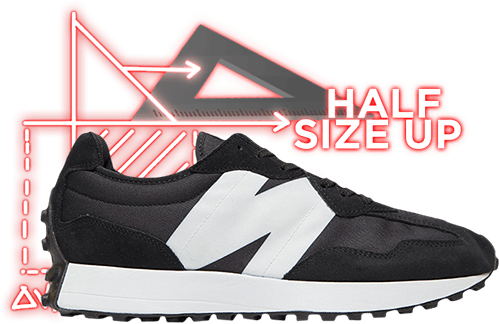
The 574 runs slightly snug, the 327 runs narrow, and the 2002R is the pair where reports split. SoleFeed’s 574 guide says it runs slightly snug and lists 2E and 4E widths. SoleFeed’s 327 guide says the 327 is true to size but narrow in the midfoot and toe box, with no wide option.

For the 2002R, SoleFeed’s guide says it runs snug in length and that half a size up is the safe bet. WhatShoeSize rates it true to size, labels that verdict high confidence, and says going up is too big, with narrow feet able to go down half a size.
When two sites disagree this directly, try both sizes in person if you can and let the width of your foot decide the tie. Our 2002R Protection Pack article covers one of its releases.
How should a New Balance shoe feel when the fit is right?
A well-fitted New Balance holds the heel without slipping, feels snug but not tight through the midfoot, and leaves room in the toe box to wiggle the toes. Those three checks come from the brand’s size and width guide, which adds habits that apply to any pair:
- Try on late in the afternoon, when feet are at their largest from normal swelling.
- Go with the larger of the two if your feet fall between sizes; socks, insoles and lacing can take up the slack.
- Fit both feet and buy for the larger one, since left and right can differ by as much as a full size.
- Measure again every year, because feet typically get bigger with age.
The same guide says people are more than twice as likely to buy a shoe that is too small than too big. Our guides to how to measure your shoe size and men’s to women’s size conversion cover the numbers.
Where does New Balance’s focus on widths come from?
New Balance’s interest in fit goes back to its start: according to Wikipedia’s company entry, William J. Riley founded the New Balance Arch Support Company in the Boston area in 1906, manufacturing arch supports and other accessories designed to improve shoe fit. The entry says his first product was a flexible arch support with three support points, built for balance and comfort in the shoe.
The same entry says the company designed and manufactured the Trackster in 1960, a running shoe that came in varying widths, and that it claims a greater selection of sizes, particularly very narrow or very wide widths, as a point of difference. Our guides to how Jordan 1s fit, how Yeezys fit and how Dunks fit cover the other classics.