Air Jordan 3 History: How Tinker Hatfield Saved Nike in 1988 & OG Specs

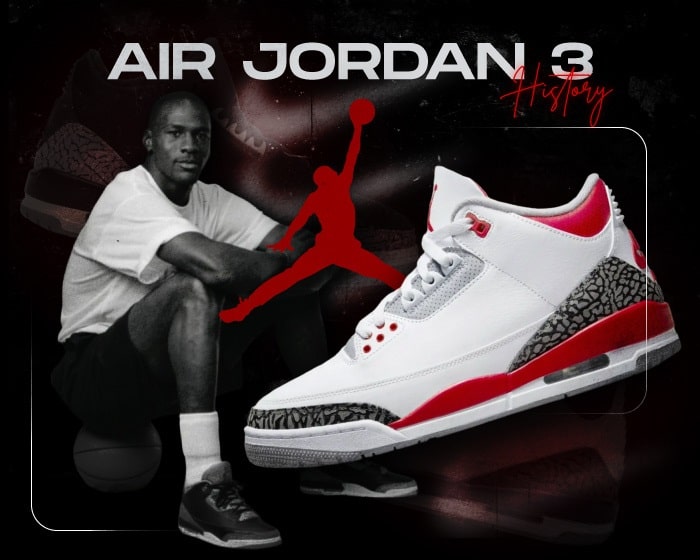
The Air Jordan 3 debuted in February 1988 at a $100 retail price, paving the way for experimental kicks in basketball history. Designed by Tinker Hatfield, it saved the partnership between Michael Jordan and Nike. The silhouette introduced a mid-cut frame, elephant print overlays, visible heel Air, and the Jumpman logo.
- 1988 Debut and Price: Launched in February 1988 at $100 retail across 4 original colorways: White Cement, Black Cement, Fire Red, and True Blue.
- First Signature Elements: Debuted the 1984-inspired Jumpman tongue emblem, visible heel Air window, and faux elephant-skin mudguards.
- 1988 All-Star Milestone: Worn during the 1988 NBA Slam Dunk Contest free-throw-line dunk and the 35.0 PPG MVP season.
- Enduring Legacy: Followed by 36 numbered signature models while remaining a $200 to $220 retail pillar for retro collectors.
How Did the 1988 Air Jordan 3 Save the Nike Partnership?
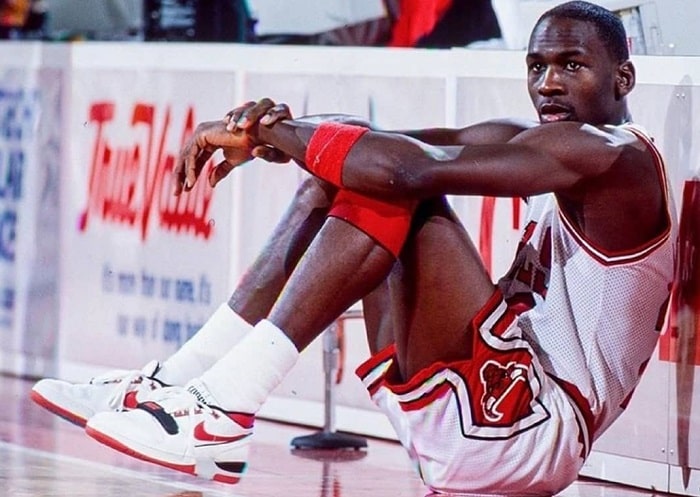
Across the broader history of the sneaker industry, few moments rival the corporate crisis Nike faced in late 1987. Following the Air Jordan 1 and the heavy Italian Air Jordan 2, Michael Jordan was dissatisfied with his footwear. In fact, he briefly wore the strapped Nike Air Alpha Force 88 during early 1987-88 NBA games.
Making matters worse for Nike, original lead designer Peter Moore and marketing VP Rob Strasser resigned in 1987. They launched their own firm, Van Grack, and actively pitched Jordan to leave Beaverton for an independent sportswear label.
With production already behind schedule, CEO Phil Knight handed the rescue assignment to former corporate architect Tinker Hatfield. Hatfield flew out to meet Jordan directly and listened to what the star actually wanted on court.
What Experimental Features Did Tinker Hatfield Introduce?
Among the most influential footwear designers in history, Tinker Hatfield broke convention by asking Jordan for his performance wish list. Jordan requested a lighter three-quarter mid-cut collar. He wanted a basketball shoe that required zero break-in time out of the box. He also asked for sophisticated luxury textures that looked sharp with tailored suits.
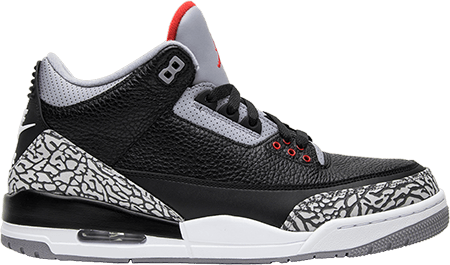
Hatfield answered with soft tumbled full-grain leather that flexed immediately without blistering the ankle. To satisfy the luxury brief without fragile exotic hides, he framed the toe and heel in grey elephant print leather.
Underneath the heel, Hatfield carried over the visible Air-Sole window from his 1987 Air Max 1. Finally, he placed a red embroidered Jumpman silhouette on the tongue. That logo came from Jordan’s leap in a 1984 Olympic photoshoot.
| Design Element | 1988 Specification | On-Court Function | Historical First |
|---|---|---|---|
| Collar Height | 3/4 mid-cut padded collar | Freed ankle mobility on cuts | First mid-top in the signature line |
| Tongue Branding | Chenille-style embroidered Jumpman | Replaced Wings logo on tongue | First sneaker with the Jumpman logo |
| Midsole Cushioning | Polyurethane with visible heel Air | Impact absorption on landings | First visible Air unit on a Jordan |
| Mudguard Overlay | Embossed grey elephant print | Abrasion resistance at toe/heel | Signature graphic pattern of the line |
What Were the Four Original 1988 Colorways and Retail Prices?
The third signature model arrived in retail stores in February 1988. It carried a $100 retail price tag across four original colorways. First came the White Cement (4365), which Jordan wore during the 1988 NBA Slam Dunk Contest in Chicago. Taking off from the free-throw line, he scored a perfect 50 to seal the title.
That same weekend, he laced up the Black Cement (4367) during the 1988 NBA All-Star Game. He poured in 40 points to capture All-Star MVP honors in front of his home Chicago crowd. During regular-season Bulls games, he rotated the White Cement with the Fire Red (4366) colorway.
The fourth original colorway was the True Blue (4368). It paired white tumbled leather with blue midsoles and red tongue liners. Jordan later wore the True Blue in a 1988 international exhibition game and with the 2001-2003 Washington Wizards.
How Did Spike Lee’s Mars Blackmon Ads Transform Sneaker Marketing?
Jordan’s 1987-88 Defensive Player of the Year and league MVP campaign drove immediate hardwood credibility. Meanwhile, Wieden+Kennedy’s television campaign turned the shoe into a nationwide pop-culture phenomenon. Rather than running standard slow-motion athletic spots, Nike cast filmmaker Spike Lee. Lee appeared as his Brooklyn bicycle-messenger character Mars Blackmon from his 1986 film.
Shot in high-contrast black-and-white 35mm film, those spots remain among the most memorable Nike commercials ever aired. Hanging from the rim alongside Jordan, Mars Blackmon asked whether the secret was the haircuts or the baggy shorts. He always concluded with the famous punchline: “Do you know? Do you know? Do you know?”
That campaign established the blueprint for pairing NBA athletes with cultural directors across 36 subsequent numbered models.
How Do Doernbecher and Black Cement Retros Perform on Resale?
Over three decades of retro cycles, both charity collaborations and Nike Air-branded OG returns have generated strong secondary demand. Patient Cole Johanson designed the red-and-metallic-silver charity edition for the OHSU hospital program in 2010. Re-released in 2013, the Doernbecher 2013 retro on StockX trades between $680 and $850 against a $160 retail price.
“Original 1988 colorways featuring ‘Nike Air’ heel tabs consistently outperform Jumpman-heel retros, while charity editions like the Doernbecher 3 command over 4x their $160 retail price.”
For everyday collectors, the return of the Air Jordan 3 Black Cement in November 2024 (SKU DN3707-010, $220 retail) anchors modern rotations. The 2023 White Cement Reimagined (DN3707-100, $210 retail) also holds steady premiums. Sellers listing pairs on secondary marketplaces factor in the 9.5% base commission in the GOAT seller commission schedule.
| Retro Edition | Style Code | Release Year | Retail vs. Market Avg |
|---|---|---|---|
| White Cement Reimagined | DN3707-100 | March 11, 2023 | $210 retail / $265 avg resale |
| Black Cement (OG Spec) | DN3707-010 | November 23, 2024 | $220 retail / $235 avg resale |
| Fire Red (Nike Air Heel) | DN3707-160 | September 10, 2022 | $210 retail / $225 avg resale |
| Doernbecher Charity Retro | 437536-600 | July 20, 2013 | $160 retail / $740 avg resale |
How Does the Third Signature Silhouette Fit and Secure at Retail?
Modern retros built on the post-2022 shape reconstruction feature a sleeker toe box and thinner collar padding. Those updates closely mirror the 1988 original profile. Standard and wide-footed wearers find that the silhouette fits true to size with comfortable midfoot support.
Independent contract factories manufacturing these tumbled leather and elephant-print uppers are disclosed on the Nike global manufacturing map. Keeping a dry suede brush on hand helps maintain the textured grooves of the elephant print panels.
Whenever one of the four 1988 OG colorways launches at $210 to $220 retail, inventory clears quickly. Experienced buyers comparing multi-site automation tools for Shopify boutiques evaluate Valor AIO, Cybersole, and Stellar AIO alongside NikeShoeBot to streamline checkout tasks.
Why do some retros have Nike Air on the heel while others have a Jumpman?
The 1988 originals and 1994/2001/2018/2024 OG retros feature authentic “Nike Air” heel tabs, whereas mid-2000s retros and non-OG team colorways use the Jumpman heel badge.
What inspired Tinker Hatfield to put elephant print on a basketball shoe?
Michael Jordan asked for a shoe that looked luxurious enough to wear with a suit, so Hatfield developed embossed faux elephant skin to deliver an exotic leather texture with high court durability.