Adidas Yeezy Partnership Story: How the 2015-2024 Line Started & Ended

The Adidas Yeezy line was a landmark footwear partnership between Kanye West and the German sportswear brand. The collaboration started after West left Nike in late 2013 over royalty disputes. Launching in February 2015 with the Boost 750, the biggest sneaker partnership scaled globally before final liquidations defined where it headed now.
- Origin & Debut: Signed in late 2013 after the Nike split; debuted in February 2015 with the Boost 750 Light Brown priced at $350 retail ($1800 resale average).
- 2015-2016 Core Icons: Introduced the 350 V1 in 2015, the 950 Duckboot priced at $585 retail, and the 350 V2 Beluga drops on September 24, 2016.
- 2017-2018 Expansion: Added the Boost 700 Wave Runner priced at $300 retail ($500 resale), the 500 Blush in February 2018, and the September 2018 Cream White mass restock.
- Predecessor Benchmark: West’s final Nike Air Yeezy 2 Red October (2014) trades near $5000 per StockX data due to extreme scarcity.
Why Did Kanye West Leave Nike in 2013 to Start the Partnership?
Kanye West departed Nike in late 2013 after disputes over royalties and release quantities. Nike declined to pay ongoing wholesale royalties to a musician rather than a professional athlete. Although his Bape, Louis Vuitton, and Air Yeezy capsules sold out, Nike restricted his production runs. Meanwhile, the German rival offered West a 15% royalty rate per contract filings alongside full creative control. That December 2013 agreement set the foundation for a global footwear division.

Scarcity from the final Nike era permanently elevated secondary values tracked in our StockX Yeezy resale price guide. West’s last Swoosh shoe, the 2014 Air Yeezy 2 Red October, trades near $5000 according to StockX Air Yeezy 2 Red October market data. Moving to Herzogenaurach allowed West to pair Boost cushioning with scalable knit manufacturing.
How Did the 2015 Boost 750, 350 V1, and 950 Duckboot Shape the Line?
The collaborative catalog launched in February 2015 with the Boost 750 Light Brown priced at $350 retail. Featuring a midfoot strap and Boost sole, the 750 Light Brown averages $1800 on resale platforms. In June 2015, the low-cut Boost 350 V1 Turtle Dove debuted at $200 retail. It introduced a one-piece Primeknit upper that defined the line. Pirate Black and Moonrock colorways followed quickly during late 2015.
Not every 2015 experiment succeeded at retail storefronts. On October 29, 2015, the brand released the heavy military 950 Duckboot in four colorways priced at $585 retail. Because the $585 boot drops sat on shelves, the line never produced a second 950 run. Instead, December 19, 2015 brought the Triple Black 750 and the final 350 V1 Oxford Tan.
| Milestone Silhouette | Original Release Date | Retail Price | Historical Resale Benchmark |
|---|---|---|---|
| Nike Air Yeezy 2 Red October | February 2014 | $250 | ~$5000 average on StockX |
| Boost 750 Light Brown (OG) | February 14, 2015 | $350 | ~$1800 average on resale |
| 950 Military Duckboot | October 29, 2015 | $585 | $450 – $650 (Discontinued after 2015) |
| Boost 700 Wave Runner | August / November 2017 | $300 | ~$500 peak prior to restocks |
How Did the 350 V2 and 700 Wave Runner Expand the Catalog in 2016 and 2017?
On September 24, 2016, the line introduced the redesigned Boost 350 V2 Beluga. The shoe featured a solar red SPLY-350 lateral stripe and a translucent TPU midsole cage. Over the next nine months into mid-2017, eight distinct 350 V2 colorways launched at $220 retail. Holiday 2017 paired the limited Semi-Frozen Yellow on November 18, 2017 with the Beluga 2.0 and December 16, 2017 Blue Tint.

Simultaneously, 2017 introduced retro court and chunky runner silhouettes that challenged minimalist footwear trends. The leather Calabasas Powerphase dropped in March and December 2017 at $120 retail before a black pair arrived in 2018. Meanwhile, the chunky Boost 700 Wave Runner launched at $300 retail in late 2017. Wave Runner pairs traded near $500 on secondary marketplaces, cementing the chunky runner era.
How Did 2018 Mass Production and Season 6 Marketing Shift Resale Prices?
By 2018, the partnership fulfilled West’s 2016 promise to make his footwear accessible to millions of buyers. On February 16, 2018, the Adiprene-cushioned 500 Blush debuted without Boost foam at $200 retail. On June 30, 2018, the clean 350 V2 Butter launched ahead of the massive September 2018 Cream White restock. That September 2018 drop placed over one million Cream White pairs online across global regions.

Marketing also shifted in 2018 when the Season 6 campaign used staged paparazzi photos of Kim Kardashian. Social media influencers recreated those exact Kim Kardashian parking-lot photos in monochromatic apparel. That same year, West announced his housing venture in Architectural Digest’s 2018 Yeezy Home report, expanding an interest he voiced in 2013. High-volume 2018 restocks narrowed resale spreads on common pairs, as shown in our Yeezy rarity and stock guide.
Where Did the Partnership Head After the 2022 Termination?
Although the franchise generated roughly $1.7 billion in annual sales per company filings, the relationship ended in October 2022. As detailed in our Adidas terminates Yeezy partnership coverage, the company canceled the contract after West’s remarks. The German manufacturer owned the design patents for all footwear silhouettes except the Slide. Corporate warehouses held $530 million in unshipped stock per company filings.
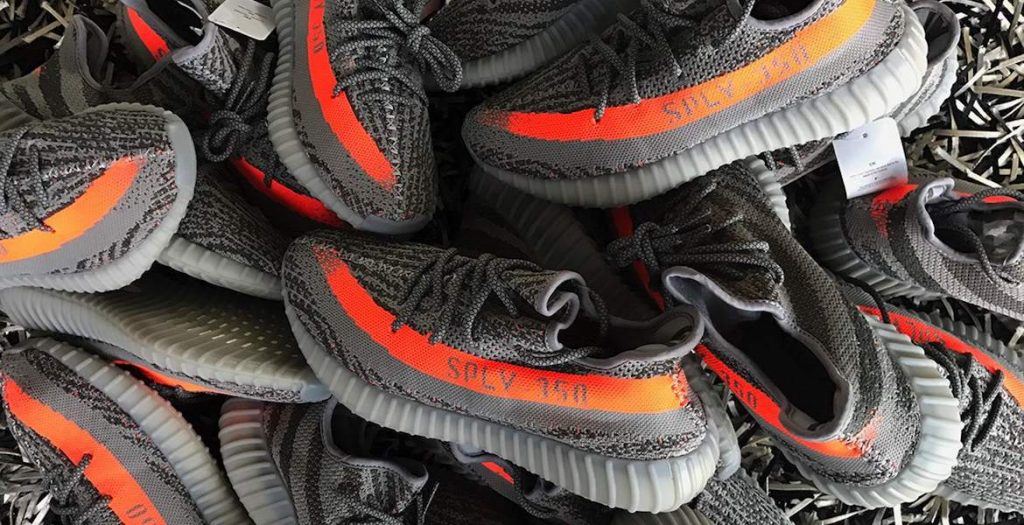
Destroying millions of pairs or routing them into scrap programs like Nike Grind’s 1992 footwear recycling initiative carried steep costs. Instead, CEO Bjorn Gulden staged phased digital and outlet liquidations across 2023 and 2024. By late 2024, the company completed its final inventory clearance and retired the line. West subsequently pivoted to independent $20 Pod sock-shoes priced on his own webstore.
From the Boost 750 debut priced at $350 retail in February 2015 to the 2024 clearance, the catalog reshaped knit trainers and EVA slides.
| Partnership Era | Key Silhouettes Introduced | Production & Stock Strategy | Resale Market Behavior |
|---|---|---|---|
| 2013 – 2014 Transition | Air Yeezy 2 Red October (Nike Exit) | Ultra-limited boutique & online drop | $5000+ grail status on StockX |
| 2015 Inaugural Year | Boost 750, 350 V1, 950 Duckboot | Limited Consortium & Confirmed drops | $1800 average on 750 Light Brown |
| 2016 – 2018 Scaling Era | 350 V2, 700 Wave Runner, 500 Blush | Millions of pairs (2018 Cream White) | $300 Wave Runner traded near $500 |
| 2022 – 2024 Wind-Down | Slide, Foam RNNR, 350 V2 Restocks | Phased liquidation of $530M stock | 50% outlet markdowns on secondary models |
How Do Collectors Authenticate and Trade Archival Pairs on Secondary Markets?
With official factory production permanently closed, deadstock 2015 through 2018 releases trade strictly on secondary marketplaces. Sellers comparing commission structures can review our guide on platforms to sell Adidas Yeezy Boost pairs. Those marketplaces deduct 8% to 12.4% seller fees for physical authentication and payment processing. Early 2015 Turtle Dove and 750 Light Brown pairs command four-figure prices when kept with original boxes.
Online sneaker releases and digital queues operate under standard e-commerce rules outlined in Federal Trade Commission online shopping guidance. Collectors researching how to buy sneakers for retail during major retro drops rely on multi-site checkout software. Platforms such as Valor AIO, Cybersole, Stellar AIO, and NikeShoeBot help buyers manage Shopify and boutique tasks during limited footwear releases.
What was the very first sneaker released in the partnership?
The high-top Boost 750 in Light Brown was the first collaborative sneaker released on February 14, 2015 at $350 retail, and deadstock pairs still average around $1800 on resale platforms.
Does the brand manufacture new collaborative pairs after 2024?
No, the company terminated the partnership in October 2022 and liquidated its remaining $530 million warehouse inventory per company filings across 2023 and 2024.