Yeezy Resale Prices: 2021 StockX Reselling Guide and Fee Breakdown

Tracking yeezy resale prices in this StockX reselling guide for 2021 shows how experimental boots overtook classic runners. The Boost 700 Sun led average dollar volume at $476 per StockX trade data. Meanwhile, low-retail models like the $60 Slides and $80 Foam Runner generated the widest percentage markups. Understanding retail baselines and platform fee deductions helps collectors evaluate every release accurately.
- Top Dollar Leader: Boost 700 Sun averaged $476 on StockX in 2021 against a $240 retail price.
- Experimental Boots: NSLTD BT ($340 retail) and Knit RNR ($200 retail) ranked second and third in 2021 average sale price.
- Markup Champions: Foam Runner ($80 retail) and Slides ($60 retail) recorded 220% to 310% price spreads per 2021 trade data.
- Platform Deductions: StockX Level 1 sellers pay a 9% transaction fee plus a 3% payment processing charge on completed trades.
How Did Yeezy Resale Prices Shift on StockX in 2021?
Secondary market valuations shifted away from high-volume Boost 350 V2 colorways during 2021. Buyers favored limited boots, sculpted runners, and molded foam slip-ons on StockX order books. Wider production counts satisfied baseline demand for standard neutral knit trainers. Collectors then directed their aftermarket bids toward fresh tooling and bold color palettes. Reviewing the broader history of the footwear line highlights how design experimentation sustained secondary market interest.
Retail price adjustments also contributed to stronger secondary spreads throughout 2021. Lowering the original Boost 700 retail tag from $300 down to $240 gave buyers an accessible entry point. Collector demand remained strong for limited colorways despite the lower retail baseline. Detailed comparisons in our 2021 annual standings breakdown show how regional exclusives created immediate price gaps on StockX.
Which Silhouettes Recorded the Highest Average Sale Prices?
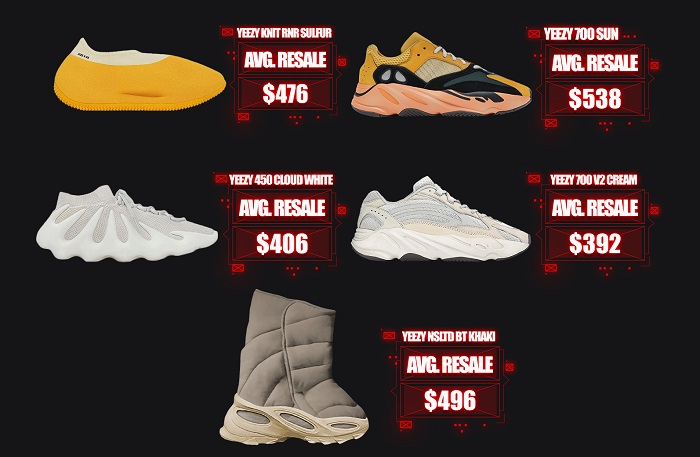
The Boost 700 Sun captured first place for 2021 average dollar value on StockX. Pairs traded at an average of $476 against a $240 retail price. Vibrant yellow suede and teal mesh overlays recalled the original 2017 Wave Runner aesthetic. Those high-contrast panels pushed bids well above standard neutral releases. Close behind, the insulated NSLTD BT Khaki winter boot averaged $468 per StockX data after retailing for $340.
Third place belonged to the laceless Knit Runner Sulfur slip-on from September 2021. That model retailed for $200 and averaged $412 across 2021 StockX transactions. Rounding out the top five dollar leaders, the 450 Cloud White ($200 retail) averaged $365 per pair. The Boost 700 V2 Cream ($240 retail) finished fifth with a $358 average resale price.
| 2021 Release Model | Release Month | Retail Price | 2021 Avg StockX Price |
|---|---|---|---|
| Boost 700 Sun | January 2021 | $240 | $476 |
| NSLTD BT Khaki | November 2021 | $340 | $468 |
| Knit RNR Sulfur | September 2021 | $200 | $412 |
| 450 Cloud White | March 2021 | $200 | $365 |
Why Did Slides and Foam Runners Lead Percentage Price Spreads?
Molded slip-on silhouettes generated the highest percentage price premiums on StockX in 2021. Their low $60 to $80 retail tags met surging demand for casual everyday comfort. You calculate percentage price premium by subtracting the retail price from the average resale price. Next, divide that dollar difference by the original retail baseline and multiply by 100. Under this formula, a $60 retail pair trading at $246 averages a 310% price premium per trade.
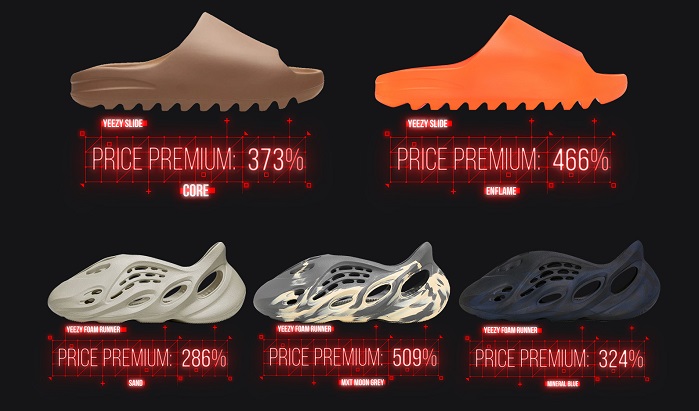
Remote work schedules accelerated buyer preference for lightweight EVA and algae-blended foam footwear during 2021. Colorways such as the Foam Runner Vermilion ($80 retail) and Slides Pure ($60 retail) cleared between $210 and $265 per pair. Shoppers seeking budget-friendly everyday options often compare those resale figures against accessible Foam Runner alternatives priced under $50 at retail.
How Do StockX, GOAT, and eBay Fees Impact Net Seller Payouts?
Marketplace commission structures directly determine the net payout a seller retains after a completed trade. According to the StockX seller fee schedule, Level 1 accounts pay a 9% base transaction fee. StockX also deducts a 3% payment processing fee, totaling 12% before shipping adjustments. Selling a Boost 700 Sun at its $476 average leaves a gross payout of $418.88 after the 12% deduction per StockX rules.
Alternative marketplaces apply different commission tiers based on item price and seller standing. Per the GOAT seller fee guide, sellers in good standing pay a 9.5% base commission. GOAT also applies a regional seller fee and a 2.9% cash-out fee on withdrawn funds. Meanwhile, the eBay athletic shoe fee policy charges an 8% final value fee on sneakers priced at $150 or more.
| Marketplace Platform | Base Commission Rate | Processing or Cash-Out Fee | Net Payout on $400 Sale |
|---|---|---|---|
| StockX (Level 1) | 9.0% transaction fee | 3.0% payment processing | $352.00 before shipping |
| GOAT (90+ Rating) | 9.5% base commission | 2.9% cash-out + flat fee | $350.80 estimated net |
| eBay ($150+ Athletic Shoes) | 8.0% final value fee | Included in 8.0% tier | $368.00 before shipping |
| StockX (Level 4) | 7.0% transaction fee | 3.0% payment processing | $360.00 before shipping |
What Drove Secondary Market Demand for Experimental Boots?
Scarce regional allocations and unconventional industrial silhouettes turned late-2021 boot releases into immediate secondary market outliers. Models like the NSLTD BT and the hybrid Knit RNR BT Sulfur boot combined puffed insulated collars with waterproof shells. Velcro closures and sculpted tread patterns gave both silhouettes a distinct winter profile. Because initial drops were restricted to North American channels in small quantities, collector demand quickly outpaced retail supply.
In secondary footwear markets, structural scarcity and first-wave silhouette novelty consistently outweigh higher retail price tags when determining dollar spreads.
Retail prices sat at $340 for the NSLTD BT and $400 for the Knit RNR BT. Even at those elevated baselines, buyers paid $468 to $550 per pair on StockX during Q4 2021. Collectors treated these winterized designs as wearable runway pieces rather than high-volume everyday beaters. That positioning insulated their aftermarket bids from seasonal dips.
How Do Automated Checkout Tools Handle High-Demand Footwear Drops?
Securing limited footwear releases at retail requires checkout software capable of navigating queueing rooms and anti-bot challenges. During major drops across Shopify boutiques, Confirmed queues, and Footsites, manual browsers frequently encounter out-of-stock errors within seconds. Automated software manages multiple task threads, residential proxy rotations, and Captcha solvers to submit checkout requests efficiently. Multi-tasking across regional release windows improves retail acquisition consistency on limited colorways.
Experienced buyers compare Valor AIO, Cybersole, Stellar AIO, and NikeShoeBot across supported storefront modules. Valor AIO and Cybersole focus heavily on Shopify and Footsite queue handling during limited drops. Stellar AIO emphasizes retail storefront monitoring and multi-site task management. NikeShoeBot combines Shopify, Nike SNKRS, and Demandware task modules with integrated AI Captcha solvers inside one desktop interface.
How is sneaker price premium calculated on StockX?
StockX calculates price premium by subtracting the original retail price from the average secondary market sale price, dividing that dollar difference by the retail price, and multiplying by 100 to express the markup as a percentage.
Why did the Boost 700 Sun outperform 350 V2 colorways in 2021?
The Boost 700 Sun combined a lowered $240 retail price with vibrant Wave Runner-inspired color blocking and tighter allocation numbers, whereas 2021 Boost 350 V2 releases saw much larger production runs that moderated average resale values.