Why Are Jordan 1s So Popular? 1985 History, $5,000 Ban & Legacy

Understanding why are jordan 1s so popular requires breaking down the legacy that began with Michael Jordan’s 1984 rookie contract. Following its April 1985 launch at $65 retail, the leather high-top generated over $100 million in first-year sales. Per league data, a $5,000 NBA uniform fine and Peter Moore’s design cemented its status.
- 1984 contract revenue: Topped $100 million in first-year sales against an initial $3 million four-year projection.
- NBA uniform fine: Built on a $5,000 per-game league fine issued in October 1984 for non-white basketball pairs.
- Retail price growth: Launched at $65 retail in April 1985 and lists at $180 retail for Retro High OG pairs in 2026.
- Athlete royalty terms: Introduced a 5% per-pair royalty negotiated by Deloris Jordan alongside a $500,000 annual base.
How Did the 1984 Rookie Deal Top $100 Million in First-Year Sales?
Signed in October 1984 for $500,000 per year, the rookie partnership sold over $100 million in footwear within 12 months.
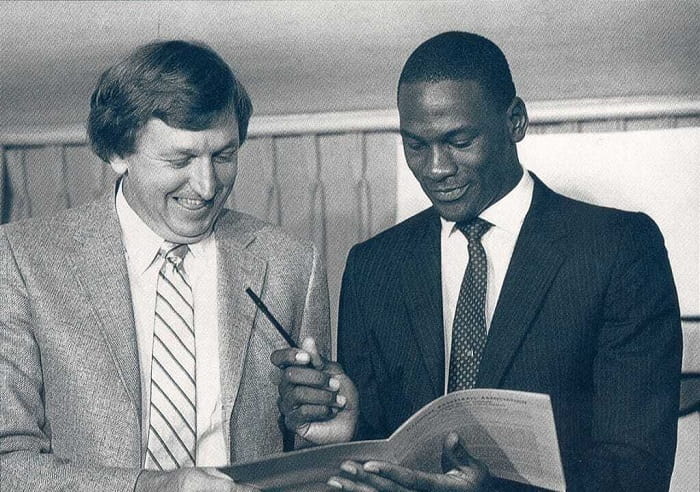
The Chicago Bulls drafted Michael Jordan third overall in 1984. At first, he favored Adidas for his pro footwear endorsement deal. However, German executives passed on offering a rookie signature line at that time. Meanwhile, a struggling basketball division at Nike offered $2.5 million across 5 years plus his own signature model. Readers exploring our complete Air Jordan history guide can trace how that contract reshaped athletic retail.
Executives originally hoped to sell $3 million worth of pairs by year 4 of the agreement. Instead, retail stores sold more than $100 million in signature pairs during the 1985 release year alone. That surge turned the line into a standalone division that now sponsors NBA and WNBA rosters.
Why Was the 1984 Nike Air Ship Fined $5,000 Before the 1985 Release?
Per league uniform rules, officials threatened a $5,000 per-game fine in October 1984 over black-and-red basketball pairs.
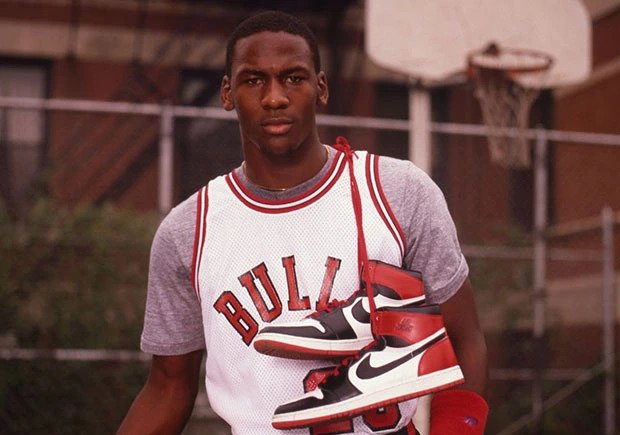
Because the signature model was not ready until Spring 1985, Jordan played his autumn 1984 preseason games in the 1984 Nike Air Ship silhouette. On October 18, 1984, he wore a black-and-crimson pair against the New York Knicks at Madison Square Garden. Per NBA uniform guidelines, court pairs had to be 51% white and match teammates’ footwear.
League officials sent a formal letter warning that non-compliant pairs carried a $5,000 fine per game. Marketing executives gladly covered the $5,000 penalty cost and filmed the 1985 “Banned” television spot around the controversy. In 2020, brand historians formally credited the Air Ship as the true preseason pair behind that $5,000 ban.
How Did Peter Moore Design the 1985 Low-Profile Sole and Wings Logo?
Creative director Peter Moore combined a thin heel Air-Sole unit with pivot-circle traction and a napkin-sketched Wings emblem.
Among iconic footwear designers, Peter Moore stood out for listening to Jordan’s exact on-court requests in 1984. The rookie guard wanted an exciting multi-color leather upper. He also asked for a sole that sat closer to the hardwood than thick 1980s center shoes. Moore trimmed foam out of the forefoot cupsole while keeping a 12-millimeter encapsulated Air pocket under the heel.
During a commercial flight from Portland, Moore noticed a child wearing replica pilot wings pinned to a shirt. He sketched a basketball flanked by feathered wings onto an airline cocktail napkin. That emblem anchored the ankle collar across all 13 original 1985 colorways, including Chicago, Bred, and Royal.
| Milestone Era | Flagship Edition | Original Retail MSRP | 2026 Aftermarket Range |
|---|---|---|---|
| April 1985 Original | 1985 OG Chicago / Bred | $65.00 retail | $4,500 to $15,000+ vintage |
| 1994 First Retro | 1994 Retro High Chicago | $80.00 retail | $950 to $1,600 StockX |
| 2015 Remastered OG | 2015 Retro High OG Chicago | $160.00 retail | $1,100 to $1,550 StockX |
| 2022–2026 Retro OG | Lost & Found / Modern OG High | $180.00 retail | $210 to $420 aftermarket |
How Did Deloris Jordan’s Royalty Deal Change Sports Endorsements?
Deloris Jordan insisted on a 5% royalty on every pair sold, turning athletes from flat-fee endorsers into revenue partners.
Before 1984, basketball players received fixed annual stipends of $10,000 to $100,000 to wear team-issue canvas or leather pairs. According to a Temple University study on sneaker industry history, Jordan’s mother Deloris pushed agent David Falk to demand a share of gross footwear sales. That 5% royalty clause earned Jordan millions as $65 pairs flew off store shelves in 1985.
Flat rubber cupsoles and durable leather overlays allowed 1985 basketball pairs to cross into skateboarding, hip-hop, and everyday street fashion.
Off the court, skateboarders like Lance Mountain adopted clearance pairs priced at $30 in 1986 for their ankle padding and flat boardfeel. Readers checking our guide on how to style Jordan retros see how 40 years of colorways pair with denim and cargo trousers.
What Are the Secondary Market Prices and Seller Fees on $180 Retros?
Secondary market prices on $180 Retro High OG releases range from $210 on general drops to $420+ on OG colorways.
Buying a pair at $180 retail plus 8% state sales tax equals $194.40 out of pocket. Per the eBay athletic shoe fee schedule, sneakers sold for $150 or more carry an 8% flat final value fee. Selling a deadstock OG colorway for $280 on eBay deducts $22.40 in commission. That transaction leaves a $257.60 net payout.
According to StockX seller fee documentation, Level 1 accounts pay a 9% transaction fee plus 3% payment processing and $4 shipping. On that same $280 sale, StockX deducts $37.60 and pays out $242.40 net. Original 1985 colorways like Chicago and Bred hold the strongest long-term collector bids.
| Marketplace Platform | Gross Sale Price | Commission & Processing | Net Seller Payout |
|---|---|---|---|
| eBay Authenticity Guarantee | $280.00 sale | 8.0% flat ($22.40 fee) | $257.60 net payout |
| StockX Level 1 Exchange | $280.00 sale | 9.0% + 3.0% + $4 ($37.60) | $242.40 net payout |
| GOAT Standard Listing | $280.00 sale | 9.5% + 2.9% + $5 ($39.72) | $240.28 net payout |
| Local Peer-to-Peer Meet | $265.00 sale | 0.0% cash ($0.00 fee) | $265.00 net payout |
How Can Collectors Secure Retro High OG Releases at Retail?
Securing $180 Retro High OG drops at retail requires combining boutique raffle entries with 10:00 AM EST SNKRS draw submissions.
Mid-top and general-release low-top pairs restock regularly at mall chains. By contrast, OG high-tops with Nike Air tongue tags sell out on launch morning. According to Nike SNKRS draw guidelines, 10:00 AM EST releases use a 10-minute randomized draw window. Checking our directory on where to buy Jordans at retail helps collectors track authorized tier-zero stores.
- SNKRS draw entries: Submit verified account entries within the first 3 minutes of the 10:00 AM EST Saturday draw.
- Store reservation apps: Enter Foot Locker FLX, Champs, and Hibbett mobile reservations 72 hours prior to release morning.
- Multi-site checkout software: Tools such as Valor AIO, Cybersole, and NikeShoeBot automate checkout tasks across Shopify boutiques, Footsites, and SNKRS.
- Size liquidity focus: Men’s sizes 10 through 12 carry 30% higher collector demand than smaller adult pairs.
What was the original retail price of the high-top in April 1985?
The original high-top launched in April 1985 at a $65 retail price, which was $15 to $20 higher than competing basketball shoes.
Which sneaker did the NBA actually fine $5,000 in October 1984?
The league issued its October 1984 uniform warning over a black-and-red Nike Air Ship worn during preseason games before the signature model was finished.