Jordan 3 Fire Red: 1988 OG vs 2022 Nike Air Retro & Price Guide

The Jordan 3 Fire Red returned on September 10, 2022, for $210 retail (DN3707-160). It restored the 1988 Nike Air heel tab after 34 years. When a Tinker Hatfield classic comes back in 2022 and more OG colorways follow, collectors compare elephant print, sizing, and resale fees.
- 1988 to 2022 lineage: Debuted in 1988 ($100 MSRP), retroed with Jumpman heels in 2007 and 2013, and restored Nike Air in September 2022 ($210 MSRP).
- 2022 companion drop: Preceded by the Jordan 3 Cardinal Red ($200 retail) in February 2022, inspired by the 2011 Air Jordan 7 Cardinal.
- Grail benchmarks: Sits alongside the OG White Cement (2011/2013), 2018 JTH Super Bowl ($650 resale), and 2010/2013 Doernbecher ($773 resale).
- Aftermarket range: The 2022 Fire Red retro trades between $220 and $295 across StockX, GOAT, and eBay in 2026.
Why Is the 1988 Jordan 3 Fire Red One of Four Essential OG Colorways?
Released in 1988 at $100 retail, the Jordan 3 Fire Red is one of four original colorways. It helped debut visible heel Air and elephant print.
Michael Jordan wore the Fire Red during the opening half of the 1988-1989 Chicago Bulls season. He averaged 32.5 points per game that year while wearing the silhouette at Chicago Stadium. That on-court run cemented its place among must-have classic basketball sneakers. Alongside the White Cement, Black Cement, and True Blue, it formed the inaugural quartet designed by legendary Nike designer Tinker Hatfield.
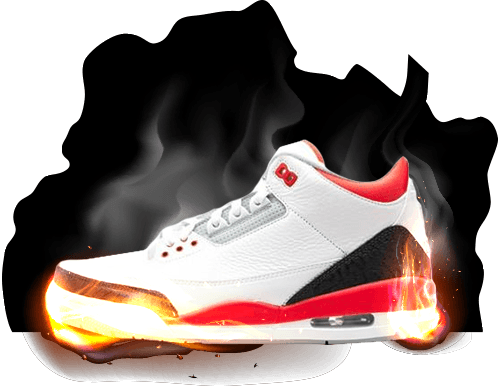
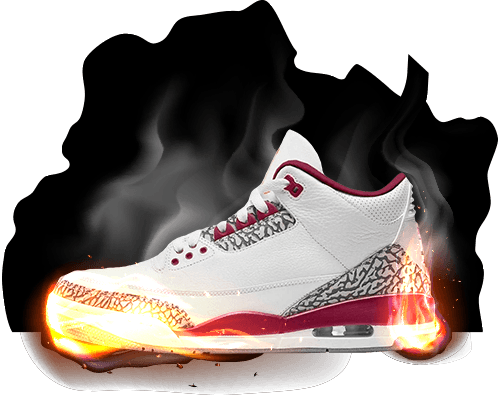
The 1988 Fire Red stood out from the White Cement with a high-gloss Fire Red polyurethane collar wrap. Darker charcoal-and-iron elephant print panels framed the toe cap and heel counter. Bold Nike Air lettering anchored the rear pull tab.
How Does the 2022 Nike Air Retro Differ From the 2007 and 2013 Releases?
The September 10, 2022 retro ($210 retail) restored the 1988 Nike Air heel tab missing on the 2007 and 2013 retros.
For 19 years after 1988, the colorway stayed in the vault until its first retro in March 2007 ($125 retail). A second retro followed in August 2013 ($160 retail). Both the 2007 and 2013 versions replaced the OG Nike Air heel branding with a Jumpman logo. They also used jet-black elephant print overlays and a boxy toe cap.
Nine years after the 2013 drop, Jordan Brand re-engineered the Fall 2022 release (DN3707-160) to match 1988 blueprints. Designers lowered the toe-box slope and softened the Neutral Grey tone of the elephant print. Bringing back the Fire Red Nike Air heel tab satisfied longtime OG purists.
How Does the $200 Jordan 3 Cardinal Compare With the Fire Red Retro?
Released in February 2022 for $200 retail, the Jordan 3 Cardinal translates the 2011 Air Jordan 7 Cardinal palette onto Hatfield’s shoe.
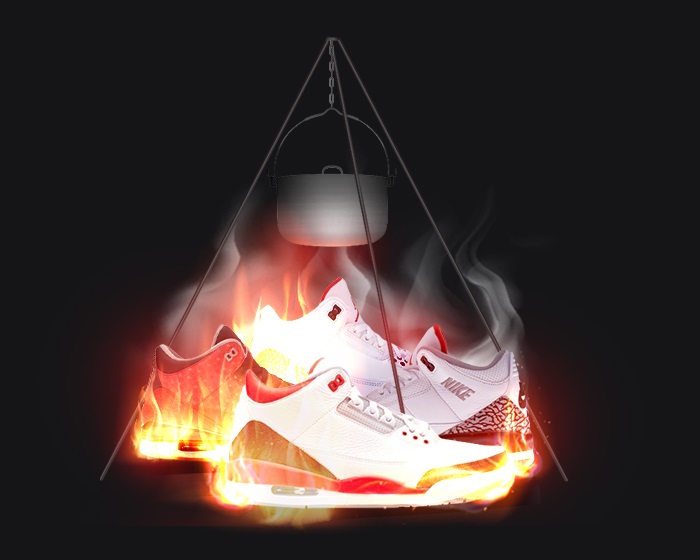
First leaked in late 2021 ahead of its February 19, 2022 launch (CT8532-126), the Cardinal Red offered a warm-toned alternative. It pairs a tumbled white leather upper with Light Curry bronze Jumpman tongue embroidery. Deep Cardinal Red paint covers the inner lining, bottom eyelets, and midsole heel. Classic grey cement elephant print wraps the mudguard and heel.
The Fire Red uses an OG Nike Air heel tab and $210 MSRP. By contrast, the $200 retail Cardinal features a raised heel Jumpman. Collectors who study the long-term benefits of collecting sneakers often pair both 2022 releases. Together they contrast 1988 OG blocking with cross-model 1992 and 2011 color tributes.
How Do the White Cement, 2018 JTH Super Bowl, and Doernbecher 3 Rank?
Beyond the Fire Red, the top three collector Air Jordan 3s are the White Cement, the $650 JTH, and the $773 Doernbecher.
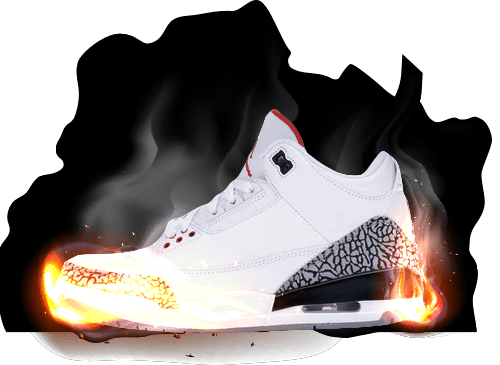
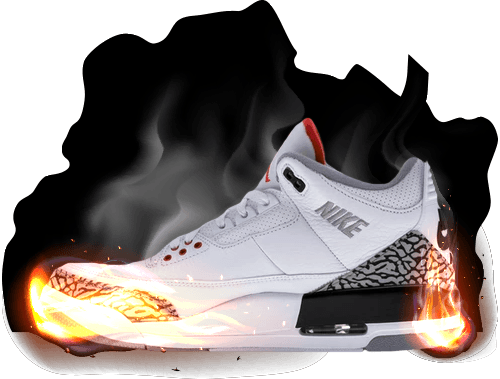
First, the 1988 White Cement became famous during Jordan’s free-throw-line dunk in the 1988 Slam Dunk Contest. It returned in 2011 ($150 MSRP), 2013 ’88 Dunk Contest ($200 MSRP), and 2023 Reimagined ($210 MSRP). Second, Justin Timberlake shock-dropped the 2018 Air Jordan 3 JTH Super Bowl ($200 MSRP) during his February 2018 halftime show. That pair trades near $650.
Third, patient designer Cole Johanson created the diamond-lasered crimson Air Jordan 3 Doernbecher in 2010 ($160 MSRP). It returned in a 2013 retro ($160 MSRP). According to market records on the StockX 2013 Jordan 3 Doernbecher page, deadstock pairs average $773 on the aftermarket.
| Air Jordan 3 Edition | Release Years | Retail MSRP | Aftermarket Price Benchmark |
|---|---|---|---|
| AJ3 OG Fire Red (Nike Air) | 1988 / 2007 / 2013 / 2022 | $210 (2022 retro) | $220 to $295 StockX / GOAT |
| AJ3 Cardinal Red (CT8532-126) | February 2022 (2021 leak) | $200 retail | $195 to $260 StockX / GOAT |
| AJ3 JTH Super Bowl LII | February 4, 2018 | $200 retail | $650 average resale ask |
| AJ3 Retro Doernbecher (Cole) | Nov 2010 / July 2013 | $160 retail | $773 average resale ask |
What Are the Resale Prices and Seller Fees on Fire Red and Grail Pairs?
Selling a 2022 Fire Red at $250 nets $230.00 on eBay (8% fee). Selling a $773 Doernbecher 3 nets $711.16 on eBay.
According to the eBay athletic shoe fee schedule, sneakers sold for $150 or more carry a flat 8% final value fee. By contrast, the StockX seller fee schedule deducts a 9% base fee plus 3% processing and $4 shipping. Meanwhile, the GOAT seller commission structure takes 9.5% plus $5 and a 2.9% cash-out fee.
On high-value grails like the $650 JTH Super Bowl or $773 Doernbecher 3, that 4% to 4.5% commission gap matters. Sellers keep $28 to $36 more per pair on eBay compared with StockX or GOAT. Even on a $250 Fire Red sale, eBay saves $14.00 over StockX ($230.00 vs $216.00 net payout).
| Model & Gross Sale Price | eBay Net (8% Fee) | StockX Level 1 Net | GOAT Standard Net |
|---|---|---|---|
| 2022 AJ3 Cardinal ($230 sale) | $211.60 net payout | $198.40 net ($31.60 fee) | $197.28 net ($32.72 fee) |
| 2022 AJ3 Fire Red ($250 sale) | $230.00 net payout | $216.00 net ($34.00 fee) | $214.86 net ($35.14 fee) |
| 2018 AJ3 JTH Super Bowl ($650) | $598.00 net payout | $568.00 net ($82.00 fee) | $566.16 net ($83.84 fee) |
| 2013 AJ3 Doernbecher ($773) | $711.16 net payout | $676.24 net ($96.76 fee) | $674.22 net ($98.78 fee) |
How Does the Air Jordan 3 Fit and Where Can Collectors Buy OG Retros?
The 2022 Air Jordan 3 Fire Red fits true to size thanks to its sleek 1988 toe-box last and padded collar.
Compared with the bulkier 2007 and 2013 retros, the 2022 mold trims internal foam thickness around the ankle. Both standard and slightly wide feet can order their normal men’s size without forefoot pinching.
Inspect the polyurethane midsole on 2007 or 2013 retros before wearing, as older foam can crumble under load.
When OG retros launch on official sneaker release apps at 10:00 AM EST, buyers prepare with our complete sneaker bot setup guide. Tools like Valor AIO, Cybersole, Stellar AIO, and NikeShoeBot support checkout tasks across Nike and Shopify.
- Heel tab check: Pick the 2022 DN3707-160 release over 2007 or 2013 pairs for fresh foam and Nike Air branding.
- Elephant print care: Clean textured grey toe and heel panels with a dry suede brush instead of soaking them.
- Storage climate: Store pairs at 68°F to 72°F with 50% humidity to prevent crimson midsole paint cracking.
- Size liquidity: Men’s sizes 10.5 to 12 command $25 to $40 premiums over sizes 8 to 9.
Which retro years featured the original Nike Air logo on the heel tab?
Only the original 1988 release and the September 10, 2022 retro feature the Nike Air heel tab. The 2007 and 2013 retros used a Jumpman logo.
Why does the 2018 JTH Super Bowl edition have a Swoosh on the side?
Tinker Hatfield’s original 1987 sketches for the Air Jordan 3 included a lateral Swoosh before he removed it for 1988. The 2018 JTH edition revived that sketch.