Nike Epic React Flyknit Guide: 2018 Release Specs, Foam Tech & Resale Data

Released on February 22, 2018 at $150 retail, the Nike Epic React Flyknit proved that proprietary in-house foam will rule the running world for years. After debuting inside 2017 basketball models, React cushioning entered distance running as the lightest, softest foam the brand had ever built. Testing confirmed 13% greater energy return than Lunarlon foam across four OG launch colorways. Below are the engineering specs, colorway details, and aftermarket numbers.
- 2017-2018 Foam Origins: In-house React foam debuted in 2017 inside the React Hyperdunk and Jordan Super.Fly before launching on the Epic React Flyknit on February 22, 2018 at $150 retail.
- Lab Performance Gains: Measured 5% lighter, 11% softer, and 10% higher in energy return than the LunarEpic Low Flyknit 2 ($140 retail) at 8.4 oz (men’s US 10).
- 4 Launch Colorways: Released in College Navy (AQ0067-400), White/Racer Blue-Pink Blast (AQ0067-101), plus NikePlus exclusives White/Racer Blue (AQ0067-100) and Black/Racer Blue (AQ0067-001).
- Resale & Fee Arithmetic: Deadstock OG pairs trading at $180 yield $154.40 net on StockX (9% Level 1 fee) or $165.60 net on eBay (8% fee on $150+ footwear).
What Is Nike React Foam and How Did It Evolve From 2017 to 2018?
Chemists and mechanical engineers at Beaverton spent three years testing over 400 chemical combinations. Their goal was replacing traditional compression-molded EVA foam. The resulting synthetic rubber and thermoplastic elastomer (TPE) blend debuted in June 2017 inside two basketball shoes. Those models were the React Hyperdunk 2017 and the Jordan Super.Fly 2017. On February 22, 2018, the compound made its unencapsulated running debut at $150 retail.
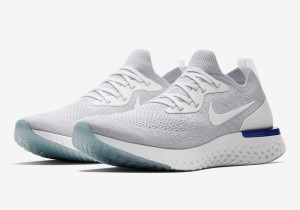
Arriving right alongside the lifestyle-focused 2018 Air Max 270 release, the road runner targeted four simultaneous athletic metrics. It balanced pillowy softness, high energy return, low weight, and 500-mile durability. Previously, EVA and Lunarlon foams forced designers to trade impact softness for structural longevity.
According to official Nike React lab testing data, the 2018 runner measured 5% lighter and 11% softer than the 2017 LunarEpic Low Flyknit 2 ($140 retail). It also delivered 10% greater energy return per stride.
How Does In-House React Cushioning Compare to Adidas Boost and HOVR?
The biggest commercial distinction between React and its 2018 foam rivals lies in chemical supply-chain ownership. Rival sportswear brands licensed their flagship midsole compounds from external chemical conglomerates. Adidas licensed Expanded Thermoplastic Polyurethane (eTPU) Boost pellets from German chemical giant BASF. Under Armour developed HOVR foam with Dow Chemical, while Puma debuted its beaded NRGY and Jamming platforms.
Beaverton chemists formulated React entirely in-house, avoiding third-party chemical licensing fees and external production caps. That vertical integration allowed the brand to price the 2018 Flyknit runner at $150 retail per catalog data. It undercut the $180 retail baseline of the Adidas UltraBoost 4.0 by $30.
At 8.4 ounces (239 grams) for a men’s US size 10, the single-piece build weighed 2.5 ounces less than an 11.0-ounce UltraBoost. Runners gained high rebound without carrying heavy eTPU capsules over marathon distances.
What Engineering Specs Define the One-Piece Flyknit and Midsole Unit?
Minimalist component integration explains how the February 2018 silhouette achieved an 8.4-ounce weight while increasing underfoot foam volume. The upper uses a single-piece Flyknit bootie modeled after the Flyknit Racer. It wraps the arch and instep seamlessly without a separate tongue. A low-profile TPU heel clip locks the rearfoot over the wider midsole shelf.
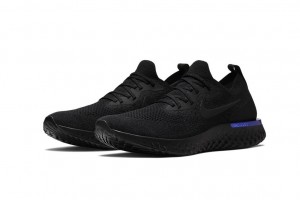
Eliminating cement carrier frames, mid-foot shanks, and full-length rubber outsoles allowed a single molded block of React foam to serve as both midsole and road-contact outsole.
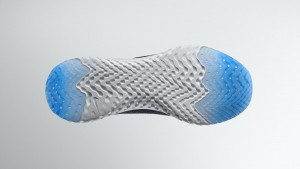
Designers used computational fluid geometry to carve deep grooves where runners need compression. Shallower ridges support areas where the foot requires firmer torsional stability. Because React resists abrasion far better than EVA, the shoe omits a full rubber outsole.
Only two thin translucent rubber segments sit beneath the forefoot toe-off zone and heel strike pad for wet-pavement grip. The table below compares the 2018 runner against its main foam competitors.
| Running Silhouette (2017-2018) | Foam Chemistry & Owner | Retail Price | Men’s US 10 Weight & Offset |
|---|---|---|---|
| Nike Epic React Flyknit (2018) | In-House TPE/Synthetic Rubber | $150 | 8.4 oz (239g) / 10mm drop |
| Nike LunarEpic Low Flyknit 2 (2017) | Dual-Density Lunarlon / IU Carrier | $140 | 8.8 oz (249g) / 10mm drop |
| Adidas UltraBoost 4.0 (2018) | BASF Licensed eTPU Boost Pellets | $180 | 10.9 oz (310g) / 10mm drop |
| Under Armour HOVR Phantom (2018) | Dow Chemical Olefin HOVR Core | $130 | 10.6 oz (301g) / 8mm drop |
Which Four Colorways Dropped in February 2018 at the $150 Retail Price?
The initial February 2018 rollout centered on four distinct colorways priced at $150 retail each. Two general-release editions led the global retail launch on February 22, 2018. Those pairs were “College Navy/Racer Blue-Pink Blast” (AQ0067-400) and “White/Racer Blue-Pink Blast” (AQ0067-101). Both featured a bright pink heel stabilizer clip and blue midsole accent shelf.
Per 2018 Sneaker News NikePlus release coverage, two additional monochromatic editions launched exclusively for logged-in NikePlus app members. Those member-only releases were “White/Racer Blue” (AQ0067-100, dubbed “8-Bit”) and “Black/Racer Blue” (AQ0067-001). Logged-in members received early access to reserve their size before public stores received pairs.
That 2018 running platform quickly crossed into high-demand lifestyle footwear. It spawned the translucent 2018 React Element 87 ($160 retail) alongside icons like the 2018 Off-White x Air VaporMax.
How Do StockX and eBay Seller Fees Affect React Running Resale Payouts?
General-release React runners were produced in wide numbers after February 2018. However, deadstock pairs of the OG 2018 NikePlus exclusives (AQ0067-100 and AQ0067-001) still trade on secondary marketplaces. Early React Element 87 colorways also command strong collector bids. Sellers offloading unworn archival pairs calculate platform fees to determine exact net payouts.
According to the official StockX seller fee schedule, Level 1 sellers pay a 9% base commission. StockX also deducts a 3% payment processing fee and a $4 shipping charge on completed orders.
According to the official eBay athletic shoe fee policy, authenticated sneakers priced at $150 or more incur an 8% flat fee. eBay adds no extra payment processing surcharge on qualifying footwear. The table below compares retail baselines, aftermarket asks, and net payouts across four 2018 React releases.
| 2018 React Release | Style Code | Retail / Resale Ask | Net Payout (StockX L1 vs. eBay 8%) |
|---|---|---|---|
| Epic React College Navy OG | AQ0067-400 | $150 retail / $165 ask | $141.20 StockX / $151.80 eBay |
| Epic React White Racer Blue (8-Bit) | AQ0067-100 | $150 retail / $195 ask | $167.60 StockX / $179.40 eBay |
| Epic React Black Racer Blue | AQ0067-001 | $150 retail / $180 ask | $154.40 StockX / $165.60 eBay |
| React Element 87 Sail Light Bone | AQ1090-100 | $160 retail / $270 ask | $233.60 StockX / $248.40 eBay |
How Do SNKRS Draws and Checkout Bots Handle Limited Running Releases?
Flagship running and lifestyle innovations such as Undercover React collaborations and Alphafly racers launch through online ballots and boutique queues. According to the official Nike SNKRS Draw guide, high-demand releases open a 10-minute entry window at 10:00 AM EST. Automated email confirmations notify winners minutes after the draw closes.
Collectors studying how to buy sneakers for retail and following our sneaker bot setup guide prepare multiple regional tasks for simultaneous boutique drops. Clean residential proxies and isolated billing profiles prevent per-IP checkout throttles during peak traffic.
Buyers comparing the best sneaker bots for multi-store footwear launches evaluate established platforms. Leading options include Valor AIO, Cybersole, Stellar AIO, and NikeShoeBot. Pre-warming sessions 15 minutes before launch ensures tasks clear queue checkpoints smoothly.
How does the 2018 Flyknit running silhouette fit for wide-footed runners?
Because the one-piece Flyknit bootie wraps the midfoot snugly without a separate tongue gusset, standard-width runners can wear true to size while wide-footed runners typically go up half a US size.
Which basketball shoes first used React foam in 2017 before the 2018 running release?
React foam debuted in June 2017 inside the React Hyperdunk 2017 Flyknit (worn by Draymond Green during the 2017 NBA Finals) and the Jordan Super.Fly 2017 (endorsed by Blake Griffin).