What Changed in Yeezy Prices, Style & Hype From 2015 to 2026?

Yeezy prices shifted dramatically after the February 2015 Adidas launch as production scaled through 2018 and 2019. Understanding what changed across style and hype explains why early 350 V2 pairs traded above $1,000 per market data. Restocked colorways later settled near $220 to $300 across secondary exchanges. Discontinued archival pairs now hold distinct aftermarket tiers shaped by size scarcity.
- Partnership Launch: Debuted in February 2015 with the Boost 750 ($350 retail) after Kanye West’s public $53 million debt disclosure and $1 billion creative pitch.
- 2018 Supply Expansion: Multi-wave restocks of the 350 V2 Zebra and Cream White narrowed resale spreads from $1,200 down to $260-$320 per market data.
- Retail Price Peak: Chunky dad-shoe silhouettes like the Boost 700 Wave Runner carried a $300 retail price tag before later colorways adjusted to $240-$260.
- 2019 Style Pivot: Translucent monofilament stripes, 3M reflective threads, and May 2019 Glow cages ($250 retail) revitalized collector demand.
How Did the 2015 Launch Shape Early Yeezy Prices and Hype?
The February 2015 launch established Yeezy prices at the top of the secondary market. Designers combined celebrity creative authority with full-length Boost midsole cushioning. Among modern sneaker brand partnerships, leaving Nike’s Air series gave Kanye West unprecedented design control. In early 2016, West publicly stated he carried $53 million in personal debt. He also asked Mark Zuckerberg to commit $1 billion toward his creative ideas.
Early releases between 2015 and 2016 followed a strict scarcity formula. The February 2015 Boost 750 Light Brown (B35309) retailed for $350 at select boutiques. Verified pairs immediately traded above $1,500 per secondary market records. Four months later in June 2015, the Primeknit Boost 350 Turtle Dove (AQ4832) launched at $200 retail. Tiny boutique allocations kept 2015 and 2016 resale asks 400% to 600% above retail.
Why Did 2018 Mass Restocks and $300 Retail Tags Compress Resale?
By 2018, secondary markups compressed sharply because the brand expanded factory production. Executives worked to fulfill West’s promise that everyone who wanted a pair could buy one. The February 2017 Boost 350 V2 Zebra (CP9654, $220 retail) initially traded above $1,200 per market data. Following multiple global restocks across 2018 and 2019, Zebra resale averages settled between $275 and $340 per market records.
In September 2018, the 350 V2 Triple White (CP9366, $220 retail) released in over 1 million pairs. At the same time, retail MSRP climbed on complex multi-panel silhouettes. The Boost 700 Wave Runner (B75571) carried a $300 retail price tag. That high MSRP narrowed the spread between retail checkout cost and secondary asks. Even with softer secondary spreads, Adidas reported strong 2018 footwear revenue worldwide.
How Did 2019 Glow and Reflective Designs Refresh the Lineup?
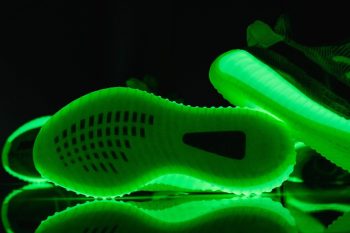
The 2019 release calendar revived collector enthusiasm by replacing solid SPLY-350 side lettering. Designers introduced translucent monofilament stripes and 3M reflective Primeknit weaves across the 350 V2. After earthy tan and grey palettes dominated 2018, high-visibility materials stood out in low light. Released in May 2019 for $250 retail, the Boost 350 V2 Glow (EG5293) used neon green Primeknit. A photoluminescent TPU midsole cage glowed brightly in the dark.
One month later in June 2019, the Boost 350 V2 Black Static dropped in two versions at $220 retail. The Non-Reflective edition (FU9006) released in wider numbers across global chains. Meanwhile, the Reflective tier (FU9007) interwove 3M reflective yarn throughout the black upper and laces. That dual-tier strategy restored high resale spreads on limited Reflective SKUs while keeping Non-Reflective pairs accessible.
Did Budget Lookalikes Like the Tubular Shadow Dilute Exclusivity?
Mainline budget silhouettes diluted visual exclusivity by copying signature ribbed soles and burrito tongues at $100 retail. The Adidas Tubular Shadow Knit launched in late 2016 and 2017 across mall stores. Its speckled tan-and-grey knit pattern closely resembled the 2015 Boost 350 V1 Moonrock (AQ2660). Casual shoppers bought the $100 EVA foam alternative rather than paying $800+ on resale markets.
A similar overlap affected the mainline NMD R1 and UltraBoost families in 2018. Dozens of tonal colorways hit mall shelves simultaneously during that cycle. Industry analysts noted that chasing short-term volume over distinct product positioning always erodes hype. In response, the design team pivoted toward sculpted EVA foam models. Standouts included the 2019 Bone White 500 and the 2020 Foam Runner priced at $75 to $90 retail.

| Model Edition | Release Year | Retail Price | Resale Price Range |
|---|---|---|---|
| Boost 750 Light Brown (B35309) | 2015 | $350 | $1,200 to $1,850 |
| Boost 350 V2 Zebra (CP9654) | 2017 / 2018 | $220 | $275 to $340 |
| Boost 700 Wave Runner (B75571) | 2017 / 2018 | $300 | $340 to $430 |
| Boost 350 V2 Glow (EG5293) | 2019 | $250 | $380 to $510 |
How Do Import Tariffs and Platform Fees Affect Yeezy Prices?
Baseline retail tags and net resale payouts follow international footwear customs duties and marketplace commissions. According to US HTS Chapter 64 footwear tariff data, imported rubber-soled athletic shoes incur up to a 20% customs duty. Complex multi-material models like the $300 Boost 700 require leather, suede, mesh, and Boost tooling. Those landed duty and freight costs directly push retail MSRP upward.
On the secondary market, sellers compare fee tiers across major authentication exchanges before listing Deadstock pairs. Per the GOAT seller fee structure, sellers in good standing pay a 9.5% base commission plus a $5 flat fee. The platform also deducts a 2.9% cash-out fee on payouts. By comparison, the eBay authenticated sneaker fee schedule charges an 8% flat fee on athletic shoes sold for $150 or more.
Selling a Deadstock Boost 700 Wave Runner for $380 on eBay incurs a $30.40 fee (8%), leaving $349.60 net compared to $330.10 after GOAT’s 9.5% commission and cash-out fees.
How Do Collectors Secure Limited Footwear Restocks at Retail?
Securing limited Reflective colorways and archival restocks at their $220 to $300 retail price requires preparation. Readers following our sneaker release blog track style codes and size allocations days before launch timers expire. Studying how to buy sneakers at retail helps collectors prepare separate billing profiles for queue-based drops. Clean proxy subnets prevent rate-limit blocks during multi-hour waiting rooms.
Because manual browser sessions rarely clear splash queues during limited Reflective launches, many collectors use All-in-One sneaker bots. When comparing multi-site software, operators evaluate Valor AIO, Cybersole, Stellar AIO, and NikeShoeBot across regional drops. Reviewing our complete botting setup guide helps buyers pair residential proxies with pre-warmed store accounts.
| Model Edition | Sale Price | eBay Net (8% Fee) | GOAT Net (9.5% + $5 + 2.9%) |
|---|---|---|---|
| 350 V2 Zebra (CP9654) | $300 | $276.00 | $258.85 |
| 700 Wave Runner (B75571) | $380 | $349.60 | $330.10 |
| 350 V2 Glow (EG5293) | $440 | $404.80 | $382.50 |
| 350 V2 Static Reflective (FU9007) | $480 | $441.60 | $417.45 |
How do Boost 350 V2 sneakers fit compared to standard athletic shoes?
The Primeknit upper and sloped toe box on the 350 V2 run snug across the forefoot. Collectors almost universally go up 0.5 size from their true measurement, or a full 1.0 size on tight translucent-stripe 2019 releases.
Why did later Boost 700 colorways drop from $300 to $240 at retail?
After the original 2017 and 2018 Wave Runner established the silhouette’s tooling molds at $300 retail, amortized production costs allowed later 700 V1, V2, and MNVN releases to launch at $220 to $240 MSRP.