How Do CAPTCHAs Work? reCAPTCHA, hCaptcha & Turnstile Breakdown
CAPTCHAs on sneaker sites work by scoring each visitor’s browser, network, and behavior signals. Low-risk shoppers go straight through, uncertain ones get a challenge, and clearly automated ones get blocked. Google reCAPTCHA, hCaptcha, and Cloudflare Turnstile all work this way, but they differ in how often they show a visible challenge, and on a hyped release, they are only one layer of a bigger anti-bot stack.
Sneaker sites use CAPTCHA and bot-detection systems to tell human shoppers apart from automated traffic, including sneaker bots. During high-demand releases, these systems become part of the checkout process itself, deciding whether a visitor can continue, needs to complete a challenge, or is blocked entirely.
- reCAPTCHA v3 returns a score from 0.0 to 1.0, and Google’s reCAPTCHA v3 documentation suggests 0.5 as a starting threshold.
- Turnstile has 3 widget modes, and none of them uses image puzzles, according to Cloudflare’s Turnstile documentation.
- Bots made up 53% of all web traffic in 2025, according to the Thales 2026 Bad Bot Report.
What Is a CAPTCHA?
A CAPTCHA is a test that separates people from automated software, and the name spells that out: Completely Automated Public Turing test to tell Computers and Humans Apart. Its basic purpose is to decide whether a request is coming from a person or a script.
The familiar image grid (pick every traffic light) is only one type. Modern systems evaluate signals in the background and may decide a visitor is legitimate without showing them a visible challenge at all.
This is particularly useful for sneaker retailers. A popular release can generate huge amounts of traffic in a short period, and the Thales 2026 Bad Bot Report found bad bots alone made up 40% of all web traffic in 2025. Retailers need to filter that automated share without blocking the genuine customers who make up the rest.
How Does CAPTCHA Work on Sneaker Sites?
CAPTCHA on a sneaker site is a risk check that runs when a shopper loads a protected page or hits a protected action such as add-to-cart or checkout. The service collects signals about the request and the browser session around it. Depending on the implementation, these can include:
- the browser environment
- interaction patterns such as movement, typing and timing
- network activity and IP reputation
- other provider-specific risk signals
The system then produces an assessment of the request. A low-risk visitor continues normally, while suspicious activity can trigger additional verification or be blocked.
The exact signals and decision-making process vary between providers and individual websites. Retailers can also combine these checks with other anti-bot technologies, so passing the challenge does not mean every other bot-detection layer has been passed too.
Google reCAPTCHA
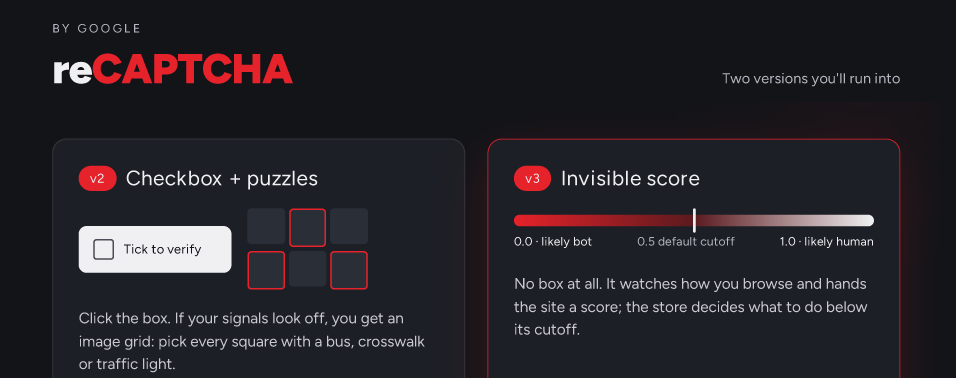
Google reCAPTCHA is Google’s CAPTCHA service and one of the most widely deployed systems of its kind on the web. Earlier versions became well known for challenges such as identifying traffic lights, buses, or crosswalks in images. Modern versions work with much less visible interaction.
reCAPTCHA v2 presents a checkbox, plus an image challenge when it wants more proof. v3 works differently: according to Google’s reCAPTCHA v3 documentation, it returns a score from 0.0 to 1.0 for each request without interrupting the visitor, and Google suggests 0.5 as a default starting threshold.
For sneaker sites, this lets retailers treat the score as one signal in a broader anti-bot system. The table below is our own illustration of how a site using that 0.5 threshold might read four example scores. Each retailer sets its own rules.
hCaptcha
hCaptcha is an independent CAPTCHA service that websites use to detect automated traffic. It runs separately from Google, on its own challenge and risk-assessment infrastructure. Like reCAPTCHA, it can present visual challenges when additional verification is necessary.
It also offers risk-based modes that don’t challenge every visitor the same way. According to hCaptcha’s documentation, its “99.9% Passive” mode on Pro and Enterprise plans only challenges users rated as higher risk. A fully Passive mode for Enterprise customers never shows a visual challenge. hCaptcha also notes that going fully passive gives up some protection compared with its active challenge modes.
The same documentation separates two ideas that often get mixed up. “Invisible” means there is no checkbox, while “passive” means no visible challenge is ever shown.
For sneaker releases, hCaptcha serves the same broad purpose as the other systems: adding another layer of protection against automated traffic while letting most real shoppers through untouched.
Cloudflare Turnstile
Cloudflare Turnstile is a CAPTCHA alternative designed to confirm a visitor is legitimate without routinely asking them to solve an image puzzle. According to Cloudflare’s Turnstile overview, it first runs small non-interactive JavaScript challenges in the browser to gather signals, then decides whether any interaction is needed.
Cloudflare’s widget documentation lists three modes. Managed is the recommended default, and when it does ask for something, it shows a checkbox with no images or text to decipher. Non-Interactive shows a loading widget the visitor never has to touch. Invisible shows nothing at all.
This makes it particularly useful for websites that want bot protection without constantly interrupting legitimate users. Turnstile can also be used on its own, so a retailer can add its verification without moving the entire site onto Cloudflare’s broader security products.
reCAPTCHA vs. hCaptcha vs. Turnstile
reCAPTCHA, hCaptcha, and Turnstile share the same broad objective, but their approaches differ. The table summarizes each one, based on the provider documentation linked in the sections above.
The important distinction is that modern systems are not simply asking, “Can you solve this puzzle?” They are designed to decide whether a request looks legitimate from many signals at once, with the puzzle as a fallback.
What is the difference between reCAPTCHA and hCaptcha?
The main difference between reCAPTCHA and hCaptcha is who runs them. reCAPTCHA is Google’s service, while hCaptcha is operated independently. Both provide challenges and bot detection, but each uses its own verification and risk-assessment systems, and hCaptcha’s fully passive scoring is reserved for its Enterprise tier.
Is Cloudflare Turnstile a CAPTCHA?
Turnstile is a CAPTCHA alternative. It does the same job of telling people from bots, but Cloudflare built it to verify users with minimal visible interaction. It runs its checks in the background and, in Managed mode, falls back to a single checkbox rather than a traditional image-based challenge.
Why Do Sneaker Sites Use CAPTCHA?
Sneaker sites use CAPTCHA because limited releases attract extremely high levels of automated traffic. Without protection, automated software can repeatedly send requests, create accounts, interact with product pages or attempt checkouts much faster than an ordinary shopper.
These checks give retailers a way to identify suspicious activity and add friction only when it is needed. They are usually just one component of a larger anti-bot system, which retailers can build from:
- rate limiting and queues
- account controls
- device and browser signals
- IP reputation, which is why proxy matters on drop day
- behavioral analysis
Solving a CAPTCHA is not the same as passing a retailer’s entire anti-bot system. That is why a clean solve on its own says very little about how a release will go.
What Happens When a CAPTCHA Is Triggered?
A triggered CAPTCHA means the site wants more evidence before letting a request continue. What the shopper sees depends on the retailer and the provider: a checkbox, an interactive challenge, a request to verify again, or nothing at all if the background check is enough.
If the system considers the activity suspicious enough, the retailer may restrict the request or prevent the user from continuing.
The CAPTCHA service does not necessarily make the final decision on its own. A retailer can use the verification result as one input into its own security systems, alongside things like request rate, account history and network reputation. This is also why two visitors can experience the same website differently. One may browse normally, another may receive a verification challenge, and a third may run into extra restrictions or a release queue.
Does Passing a CAPTCHA Mean a Bot Is Undetected?
Passing a CAPTCHA does not mean a bot is undetected, because it only clears one check among several. One of the biggest misconceptions about sneaker-site CAPTCHA systems is that they are the entire anti-bot solution.
In practice, modern retailers use multiple layers. The challenge helps flag suspicious visitors, while other systems examine request patterns, account activity, device characteristics, network reputation, and behavior. This layered approach matters because automated software keeps evolving, and a defense built on a single visible challenge is easier to work around than one that weighs many signals.
The scale shows why. Using the 40% bad-bot share from the Thales 2026 Bad Bot Report as a rough illustration, a release page taking 1,000,000 requests would see about 400,000 from bad bots. Real drop-day ratios are likely higher, and no single puzzle is built to screen that volume alone.
The Bottom Line on Sneaker-Site CAPTCHAs
reCAPTCHA, hCaptcha, and Cloudflare Turnstile all help websites separate legitimate visitors from automated traffic, but they get there in different ways. Modern verification has moved well beyond simple image puzzles. Risk scores, background browser checks and combined signals let retailers add protection while sparing genuine shoppers unnecessary challenges.
For sneaker sites, a CAPTCHA is best understood as one layer in a larger anti-bot system, not a single test that decides whether someone is human. As automated traffic keeps evolving, retailers will keep pairing these checks with additional detection and security tools to protect high-demand releases. For the wider picture of how bots, proxies, and release formats fit together, see our sneaker bot guide.