Adidas Climacool System: 2026 World Cup Vest, Overshoe & Tech

The Adidas Climacool System is a three-piece athletic thermoregulation kit unveiled in June 2026 for the FIFA World Cup 26 tournament across North America. Built for pre-match warmups and halftime recovery, the pack arrives with a phase-change Cooling Vest, an insulated Outer Jacket, and a Gel Overshoe that drops foot temperature by 2°C in 7 minutes. Below we examine its biometric test results, 2002 lineage, and recovery footwear benchmarks.
- Three-piece modular kit: Combines the Climacool Cooling Vest, reflective Outer Jacket, and slip-on Gel Overshoe for tournament heat management.
- Halftime foot cooling: The Gel Overshoe fits directly over cleated football boots and lowers skin temperature by 2°C within 7 minutes.
- Tournament debut: Deployed across 16 FIFA World Cup 2026 host stadiums where summer pitch temperatures exceeded 32°C (90°F).
- Lineage evolution: Expands the original 2002 Climacool 360-degree mesh ventilation platform into active pre-match and halftime cryotherapy.
What Is the Adidas Climacool System Unveiled for the 2026 World Cup?
The Adidas Climacool System is an integrated three-part cooling collection built for 2026 summer tournament play.
Rather than relying on open mesh vents alone, engineers in Herzogenaurach built conductive cooling gear for three match stages. Athletes wear the pieces during pre-match warmups, 15-minute halftime breaks, and post-game recovery sessions. Each piece targets specific thermal zones across the torso and feet.
According to the official Adidas FIFA World Cup 2026 cooling press release, sports scientists tested the kit at 35°C and 70% humidity. National federations used the gear across United States, Mexican, and Canadian venues in June and July 2026. Readers tracking Adidas performance sportswear saw elements of this pack filter into retail training lines. Coaches credited the modular setup with steadier second-half sprint speeds.
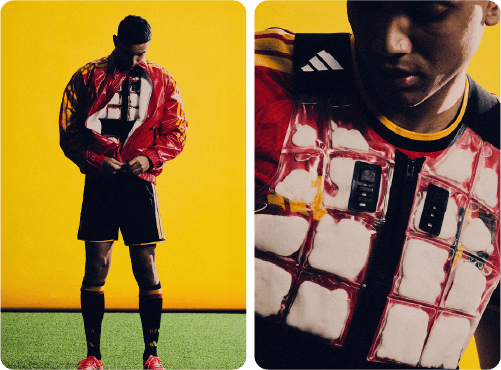
How Do the Climacool Cooling Vest and Outer Jacket Regulate Core Heat?
The Climacool Cooling Vest places phase-change cooling chambers against the ribs and spine, while the Outer Jacket blocks solar radiation.
During a 90-minute match in 32°C weather, an outfield player’s core temperature can climb from 37.0°C to 39.4°C. Wearing the form-fitting Cooling Vest for 20 minutes before kickoff lowers baseline skin temperature by 1.5°C to 2.2°C. That pre-cooling buffer delays sweat-induced fatigue during the opening 45-minute half.
Over the vest, players layer a lightweight silver-white Outer Jacket that reflects direct sunlight on open training pitches. Dual-zip side vents let athletic trainers swap chilled gel inserts in under 15 seconds. Unlike soaked ice towels that add 1.5 kilograms of water weight, the dry-contact vest keeps match jerseys dry before kickoff.
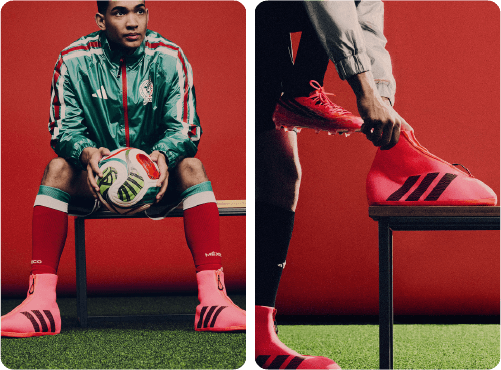
How Does the Gel Overshoe Lower Foot Temperature by 2°C in 7 Minutes?
Lined with conductive cryogel pods, the slip-on Climacool Overshoe drops foot temperature by 2°C in 7 minutes.
Synthetic football boots trap friction heat on turf and dry grass. Internal boot temperatures often climb above 40°C by halftime. That trapped heat causes blood vessels to dilate and feet to swell by half a shoe size. Yet soccer players rarely unlace tight custom boots during a 15-minute locker room break.
Instead of removing cleats, athletes step straight into the wide-mouth Gel Overshoe for 7 minutes. Coaches review second-half tactics while the conductive liner chills the foot. Internal hydrogel pads press against the thin vamp of the boot to draw heat from dorsal veins. Lowering foot temperature by 2°C curbs mid-game swelling without numbing ankle feel or ball touch.
Laboratory trials confirm the Gel Overshoe reduces intra-boot foot temperature by 2°C in 7 minutes while keeping cleats fully laced.
How Does the 2026 System Compare to Early 2000s Climacool Footwear?
While the 2002 Climacool 1 runner used open-mesh airflow, the 2026 system uses conductive cooling at rest.
When the original Climacool 1 sneaker debuted in 2002 at $120 retail, it used open-cell TPU cages. Air had to rush through the vented sole at running speeds to evaporate sweat. In 2024 and 2025, the brand expanded modern sneaker technology with 3D-printed lattice Climacool slip-ons priced at $140 retail.
By contrast, the 2026 tournament pack shifts from wind-driven ventilation to direct conductive heat transfer. An athlete sitting on a substitute bench receives immediate thermal relief without needing wind flow. Chilled gel packs absorb body heat 4 times faster than ambient locker room air alone. That shift makes the 2026 kit practical inside enclosed stadium tunnels.
| Climacool Generation | Debut Year | Cooling Mechanism | Benchmark Metric / Price |
|---|---|---|---|
| Climacool 1 OG Runner | Spring 2002 | 360-degree open mesh & vented sole | $120 retail MSRP |
| Climacool 3D Lattice Slip-On | Autumn 2024 | Additively printed polymer airflow lattice | $140 retail MSRP |
| 2026 Cooling Vest & Jacket | June 2026 | Phase-change torso packs & solar shell | 1.5°C to 2.2°C core pre-cooling |
| 2026 Gel Recovery Overshoe | June 2026 | Over-boot conductive cryogel liner | 2°C foot drop in 7 minutes |
How Does the Overshoe Compare Against Modern Recovery Shoes and Slides?
Unlike foam slides worn after a shower, the Climacool Overshoe works mid-competition over cleats before athletes switch to post-game clogs.
Once the final whistle blows, players unlace their boots and step into cushioned athletic recovery shoes to decompress plantar fascia tissue. Competing brands have also focused heavily on sensory and circulation footwear for pre-game and post-game routines. For example, buyers checking Nike Mind recovery sizing look for underfoot foam nodes that stimulate foot nerves.
Pairing the 7-minute halftime Gel Overshoe with post-match recovery slides addresses both thermal swelling and impact fatigue. Molded foam clogs reduce heel strike pressure by up to 30% on stadium concrete. Retail editions of 3D Climacool footwear and tournament packs release periodically through the Adidas Confirmed app between $140 and $220 retail.
What Are the Collector Market Prices and Seller Fees on Tournament Gear?
Player-issue World Cup cooling kits and limited 3D Climacool footwear trade between $180 and $320 across verified secondary marketplaces.
According to the eBay athletic shoe fee schedule, footwear listings priced at $150 or above carry a flat 8% final value fee. Selling a limited $200 Climacool pair on eBay deducts $16.00. That leaves a $184.00 net payout. Per StockX seller fee terms, Level 1 accounts pay 9% commission plus 3% payment processing and $4 shipping.
Meanwhile, GOAT seller commission rules apply a 9.5% base fee plus $5 and a 2.9% cash-out fee. Collectors hunting limited Adidas innovation drops often automate task monitoring across Confirmed and boutique portals. Multi-brand software suites including Valor AIO, Cybersole, Stellar AIO, and NikeShoeBot help buyers automate checkout tasks across global sportswear storefronts.
| Marketplace Platform | Gross Sale Price | Commission & Processing | Net Seller Payout |
|---|---|---|---|
| eBay Authenticity Guarantee | $200.00 sale | 8.0% flat fee ($16.00 deducted) | $184.00 net payout |
| StockX Level 1 Exchange | $200.00 sale | 9.0% + 3.0% + $4 ($28.00 deducted) | $172.00 net payout |
| GOAT Standard Listing | $200.00 sale | 9.5% + $5 + 2.9% ($29.06 deducted) | $170.94 net payout |
| Collector Direct Invoice | $190.00 sale | 2.9% + $0.30 PayPal ($5.81 deducted) | $184.19 net payout |
Do soccer players have to unlace their cleats to use the Gel Overshoe at halftime?
No, the wide-mouth overshoe slips directly over fully laced football boots and cools the foot by 2°C within 7 minutes.
Does the Cooling Vest wet a player’s match jersey before kickoff?
No, the vest uses sealed dry-contact phase-change chambers rather than melted ice water, keeping the match kit completely dry.