What Makes a Great Shopify Bot? Core Features & Suite Comparison

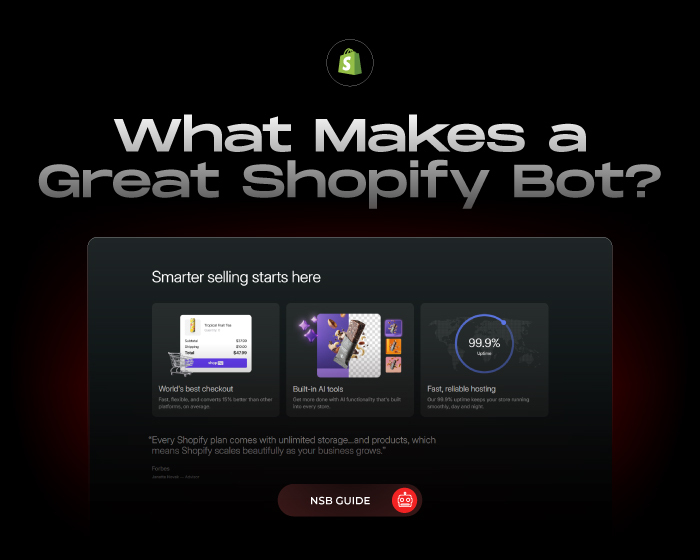
A great Shopify bot combines low-latency product monitors, keyword filters, solver harvesters, and automated queue management. Understanding what makes a great checkout tool is the secret sauce for success across over 150 independent boutiques. Multi-site licenses are priced from $300 to $400 upfront plus $30 to $50 monthly renewals. Below we compare core modules, latency math, and annual costs.
- Monitor polling intervals: Boutique product monitors scan JSON endpoints every 500 to 1,500 milliseconds using rotating ISP proxies.
- Checkpoint challenge window: Pre-warmed Gmail harvesters solve hCaptcha and reCAPTCHA v2 prompts in 1.5 to 3.0 seconds.
- Storefront scale: Over 150 tier-zero boutiques including Kith, Concepts, Undefeated, and Palace run on Shopify architecture.
- Annual license costs: Competing suites like Valor AIO ($949.88 year 1) and Stellar AIO ($660 to $900 year 1) charge recurring fees.
What Core Technical Features Define a Reliable Boutique Checkout Suite?
Four core engineering modules separate top boutique checkout software from basic browser autofill extensions.
Stores built on the Shopify e-commerce platform share a standard cart, queue, and payment token structure. Unlike Nike SNKRS draw guidelines that give buyers 10 minutes to enter, boutique drops use first-come, first-served inventory. Limited footwear and limited edition retail collectibles frequently sell out in 3 to 8 seconds.
To compete inside that window, desktop software splits work between monitor threads and checkout threads. Monitor tasks watch product JSON endpoints and password pages without burning checkout proxies. Once stock appears, checkout tasks submit cart payloads directly via HTTP requests. That architecture skips heavy browser images and scripts. Reviewing Shopify bot pros and cons helps buyers evaluate request-mode versus browser-mode modules.

How Do Positive and Negative Keyword Filters Prevent Wrong-Item Checkouts?
Positive and negative keyword rules ensure automated tasks cart the exact sneaker model rather than matching apparel.
Boutique administrators often change product titles or scramble URL handles 30 seconds before a 10:00 AM EST launch. If a user targets an Air Jordan 4 Retro, a weak filter might cart a Jordan hat priced at $35 retail. Because most boutiques enforce strict final-sale rules on launch items, accidental purchases lock up your budget.
Properly structured task groups combine 2 to 3 positive keywords with 4 to 6 negative exclusions. For example, setting `+jordan,+retro,+4,-tee,-hat,-sock,-gs,-ps` restricts tasks to adult footwear pairs. Operators also set minimum and maximum price guards, such as $140 to $230 retail. That price filter skips accessories priced at $40 automatically before payment submits.

How Do Solver Harvesters and Throttle Queue Monitors Handle Anti-Bot Walls?
Integrated solver harvesters and queue token trackers move tasks through anti-bot checkpoints and virtual waiting rooms.
During major collaborations, storefronts activate Bot Protection checkpoints alongside edge security rules. According to Cloudflare bot management documentation, edge firewalls inspect TLS handshakes, IP reputation, and request velocity. Only verified sessions receive a valid queue token. Tasks that fail a challenge prompt never reach the shipping rate calculation step.
Modern software embeds dedicated solver windows where operators log into 2 to 4 aged Google accounts early. Background harvesters pre-generate valid tokens or route image challenges to solving APIs in under 2.5 seconds. Once past the checkpoint, built-in queue monitors track exact exit timestamps. Those monitors hold tasks in line and submit payment details the millisecond a checkout slot opens.
| Storefront Protection Layer | Trigger Condition | Required Software Module | Target Response Window |
|---|---|---|---|
| Password Page Lock | 15 to 60 mins pre-drop | 24/7 Keyword Monitor | 500 to 1,200 ms detection |
| Bot Protection Checkpoint | High-demand launch start | Aged Gmail Solver Harvester | 1.5 to 3.0 sec solve time |
| Throttle Waiting Queue | Concurrent cart surge | Queue Poll & Exit Tracker | Under 250 ms post-queue |
| 3D Secure Card Prompt | Final payment submission | Pre-Authorized Virtual Card | 0 ms (auto-approved bank) |
How Do Cybersole, Valor AIO, Makebot, and Other Suites Compare on Price?
Leading multi-site suites are priced between $300 and $400 upfront, with 12-month costs spanning $505 to $950.
Before selecting an all-in-one checkout software package, buyers should compare first-year renewal fees and store coverage. According to FTC online shopping rules, recurring software subscriptions require transparent billing schedules. Cybersole is priced at £300 upfront (~$380 retail) plus £100 (~$125) every 6 months across 250+ stores.
Valor AIO costs $399.99 for the first 30 days and $49.99 monthly afterward, totaling $949.88 in year 1. Stellar AIO retails at $300 upfront with $30 to $50 monthly renewals. Meanwhile, Makebot focuses on specialized boutique and collector drops. Collectors comparing cross-platform suites also evaluate NikeShoeBot for Windows and macOS support across Shopify, Nike SNKRS, and Footsites.
| Software Platform | Primary Store Coverage | Upfront Retail Price | Year 1 Cumulative Cost |
|---|---|---|---|
| Cybersole (CyberAIO) | 250+ Shopify, Footsites, Supreme | £300 (~$380 retail) | ~$505 (includes 1 renewal) |
| Valor AIO | Shopify, US SNKRS, Footsites, JD | $399.99 (first 30 days) | $949.88 (11 x $49.99) |
| Stellar AIO | Shopify, Amazon, Target, Walmart | $300 retail license | $630 to $850 total |
| Makebot | Shopify Boutiques & Collectibles | $300 to $350 retail | $650 to $790 total |
Why Does Proxy Latency Between Virginia Data Centers and Storefronts Matter?
Locating proxies and virtual servers in Ashburn, Virginia cuts round-trip HTTP request times to 1 to 15 milliseconds.
Primary North American storefront servers operate inside Northern Virginia cloud clusters, so physical distance impacts checkout order. A home connection on the West Coast experiences 65 to 90 milliseconds of network latency per request. Across the 6 sequential HTTP calls required to cart, calculate shipping, and pay, that delay adds 450 milliseconds.
Pairing a Virginia virtual private server with static Ashburn ISP proxies reduces total 6-step checkout latency by over 400 milliseconds compared to home Wi-Fi.
Reading our guide on how to bot Shopify stores explains how to separate monitor proxies from checkout subnets. Assigning 25 to 50 static ISP proxies to monitor tasks and 1 IP per 2 checkout tasks prevents rate bans.
How Should Operators Configure Tasks 60 Minutes Before a Boutique Drop?
Completing a 4-part verification routine 60 minutes before launch eliminates billing declines and dead proxy errors.
Even experienced operators lose checkouts when a virtual card expires or a shipping rate token fails to load. Walking through our checkout automation setup guide ensures every profile, proxy group, and solver window is active before 10:00 AM EST. Pre-calculating shipping tokens on an in-stock item from the same boutique saves 1 full round-trip request during the live drop.
- Pre-fetch shipping rates: Run 1 test task up to the payment screen 45 minutes early to cache the store’s $15 to $20 shipping token.
- Warm solver sessions: Open 3 to 4 harvester windows and play 10 minutes of YouTube video to refresh Google cookies.
- Set monitor delays: Configure monitor delays between 1,000 and 1,500 milliseconds overnight, then lower to 600 milliseconds 5 minutes before launch.
- Stagger task modes: Split tasks 50% in fast request mode and 50% in safe preload mode to cover unexpected checkpoint changes.
What is the difference between preload mode and fast mode on boutique drops?
Preload mode carts an in-stock dummy item early to pre-calculate shipping rates before swapping in the launch item. Fast mode carts the target item directly when no checkpoint is active.
How many tasks should you run per payment card on a single boutique?
Most operators run 1 to 2 checkout tasks per unique virtual card and address jig to prevent duplicate-order cancellations from store fraud filters.