Stellar Bot Review: Retail Sites, $300 Price and Setup Guide

Evaluating Stellar bot (officially known as Stellar AIO) reveals what it takes to become a good retail checkout tool. Built for Windows and macOS, the software automates checkout queues across 18+ big-box and specialty storefronts per platform documentation. Its standard license pairs a $300 initial retail price with a $30 monthly renewal fee.
- Retail Storefront Scope: Supports 18+ retail modules across US and Canadian stores including Amazon, Best Buy, Target, Walmart, Newegg, AMD, and Pokemon Center.
- License & Renewal Structure: Listed at a $300 initial retail license price followed by a $30 monthly renewal fee ($630 total over 12 months).
- Cross-Platform Dashboard: Runs natively on Windows and macOS with task grouping, multiple checkout modes, and real-time checkout analytics.
- Anti-Bot & Queue Handling: Manages per-IP rate limits, server-side queue tokens, and residential proxy rotation across high-traffic flash sales.
What Is Stellar Bot and What Does It Take to Become a Good Retail Bot?
Traditional footwear automation focuses on SNKRS and Footsites. By contrast, dedicated retail bots target big-box e-commerce storefronts that replenish electronics, trading cards, and collectibles around the clock. Stellar IO (commonly called Stellar AIO) rose to prominence during the 2020 to 2022 console and GPU shortages. Engineers built the software to monitor 24/7 inventory feeds rather than just 10:00 AM EST sneaker drops.
Becoming a reliable retail checkout tool requires handling persistent account sessions, two-factor login cookies, and sudden SKU inventory flickers. Buyers comparing our guide to the best sneaker bots with big-box automation look for clean user interfaces and 24/7 Discord support. Per Federal Trade Commission online shopping rules, automated ticket buying is restricted under the BOTS Act. Meanwhile, general retail goods follow individual storefront terms of service.
How Do Task Grouping and Checkout Modes Work Inside Stellar AIO?
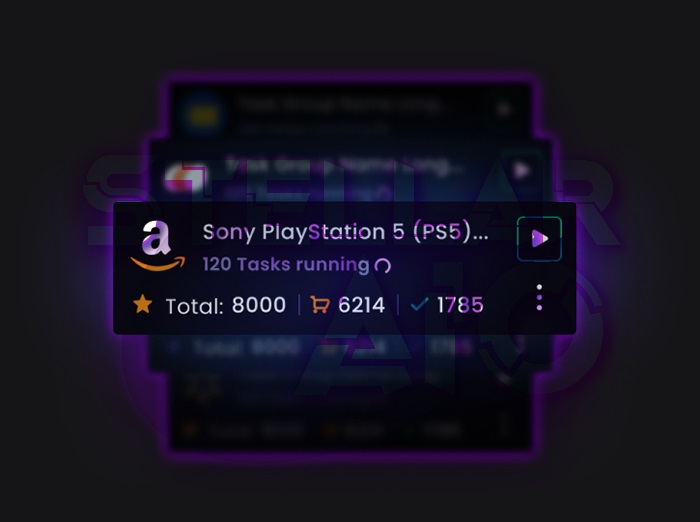
Anyone studying how checkout bots work notices that big-box retailers use different cart flows than footwear boutiques. Inside the Stellar AIO dashboard, operators organize hundreds of concurrent SKU monitors into separate task groups by retailer. Grouping tasks lets a user assign dedicated proxy subnets, saved store accounts, and shipping profiles to Amazon. Those settings stay completely separate from Target or Best Buy tasks.

Each supported store module offers multiple checkout modes tailored to how that specific site releases inventory. Normal mode follows standard browser-like cart steps. Request-based modes submit direct HTTP POST payloads the moment a monitor pings. Built-in analytics panels log completed checkouts alongside card declines so users can adjust task delays immediately. Clear visual counters track daily task activity across every group.
Which 18 Big-Box and Collectible Retail Sites Does Stellar IO Support?
Hardware buyers researching how to buy a graphics card or gaming console at retail MSRP rely on Stellar IO’s electronics modules. In the United States and Canada, the platform supports Amazon, AMD Direct, Best Buy US and CA, GameStop US and CA, and Newegg. Additional general-merchandise modules cover Target, Walmart US and CA, Academy Sports, Office Depot, and Tesla Shop merchandise.
Collectible and trading-card collectors use a second tier of specialized modules inside the same application. Stellar supports sports card and vinyl releases on Panini, Topps, Fanatics, and Funko Shop. Toy and animation drops are covered through Pokemon Center, Shop Disney, and Toys R Us Canada. Custom boutique storefronts are also supported, as explained in our Shopify bots pros and cons guide. That 18-site list covers every major North American retail category.
How Do Cloudflare and Shopify Rate Limits Affect Retail Checkout Tasks?
Running 24/7 inventory monitors across 18 retail chains requires careful network request pacing. Without proper delays, IP addresses get throttled before stock appears. According to Cloudflare Bot Management documentation, edge web application firewalls inspect TLS handshakes, IP reputation scores, and request velocity. If a task group polls a product page too aggressively from one IP, the firewall serves a 429 rate-limit challenge.

Similarly, per Shopify storefront rate-limit documentation, high-concurrency flash sales enforce per-IP queue throttling and checkout token validation. To stay below those thresholds, Stellar operators separate “monitor proxies” from “checkout proxies.” Monitor proxies watch for stock changes at 2,500ms to 3,500ms intervals. Checkout proxies fire only after the monitor detects live inventory.
Separating 24/7 monitoring proxies from checkout tasks protects residential proxy bandwidth. Operators can watch Amazon, Target, and Best Buy inventory feeds around the clock.
How Much Does Stellar Bot Cost at $300 Initial and $30 Monthly?
Direct retail licenses for Stellar AIO carry a $300 initial purchase price that includes the first month of access. After the first 30 days, users pay a $30 monthly renewal fee per official pricing. Over a full 12-month calendar year (initial $300 month plus 11 renewal months at $30 each), maintaining an active direct key costs $630 in license fees. Proxy and server expenses are billed separately.
Direct $300 license drops on the official website sell out quickly. Because of that demand, prospective users either join the official waitlist or browse secondary bot marketplaces. In addition to the license itself, operators budget $35 to $45 per month for ISP and residential proxy plans. The table below outlines the typical first-year operating budget for a Stellar AIO retail setup.
| Stellar AIO Cost Component | Official Billing Cadence | Unit Price Benchmark | 12-Month Cumulative Cost |
|---|---|---|---|
| Initial Stellar AIO License Key | One-Time Upfront (Includes Month 1) | $300 Initial MSRP | $300 (Month 1 Included) |
| Monthly License Renewal Fee | Recurring Monthly (Months 2 to 12) | $30 Per Month | $330 (11 Renewal Months) |
| ISP Monitor Proxy Subnet (25 IPs) | Recurring Monthly Proxy Plan | $45 Per Month | $540 (12 Months of 24/7 Monitors) |
| Residential Checkout Proxy Data | Monthly Bandwidth Pool (3GB) | $35 Per Month | $420 (12 Months of Flash Drops) |
How Do Retail Bots Compare to Multi-Site Sneaker Checkout Platforms?
Choosing the right automation software depends on whether a buyer primarily targets big-box electronics or limited footwear releases. Stellar AIO specializes in account-based retail modules like Amazon, Walmart, and Best Buy. Meanwhile, sneaker collectors prioritize platforms built specifically for Nike SNKRS, Adidas Confirmed, Footsites, and Tier-0 Shopify boutiques. Running the right tool for each store category prevents wasted proxy data.
Leading multi-site platforms such as Valor AIO, Cybersole, Stellar AIO, and NikeShoeBot each serve distinct segments of the e-commerce landscape. Operators who focus on limited sneakers and streetwear rely on NikeShoeBot’s dedicated Shopify, Footsites, and Nike modules alongside Discord support guides. The table below compares the core storefront focus and operating system support across all four platforms.
| Checkout Platform | Primary Storefront Focus | Operating System Support | Core Task Architecture |
|---|---|---|---|
| Valor AIO | Shopify, Footsites, Finish Line, JD | Windows & macOS Native | Drop-window footwear queue tasks |
| Cybersole | Shopify, Supreme, European Boutiques | Windows (macOS via Server) | Custom module & Shopify automation |
| Stellar AIO | Amazon, Target, Best Buy, Walmart, Shopify | Windows & macOS Native | Continuous big-box SKU inventory monitors |
| NikeShoeBot | Shopify, Nike SNKRS, Footsites, Retail | Windows & macOS Native | All-in-one sneaker & streetwear tasks |
Does Stellar AIO work on both Windows and Mac computers?
Yes, Stellar AIO provides native desktop installers for both Windows and macOS operating systems. Many 24/7 retail operators also run their tasks on a remote Windows virtual private server (VPS) for uninterrupted uptime.
Why do Amazon and Target tasks require saved store accounts inside a retail bot?
Big-box retailers require logged-in customer sessions with pre-saved shipping addresses and default payment cards. That account setup allows one-click checkout requests to complete before low-stock items sell out.