The Jordan 11 Holiday Tradition: History, 2018-2024 Retros & Resale Data

The Jordan 11 holiday lore explains how a March 1995 playoff prototype evolved into the sneaker industry’s biggest annual winter tradition. Tinker Hatfield’s patent leather icon debuted during the 94-95 NBA season and starred in the 1996 Space Jam film. Its 2009 retro officially started the yearly release calendar, leading to 6 straight drops from 2018 to 2023 and the 2024 Legend Blue.
- Origin Timeline: Debuted on court in March 1995 during the 94-95 season, followed by the 2000 Space Jam release and the 2009 retro that started the annual holiday ritual.
- 2018–2023 Six-Year Streak: Featured 6 consecutive winter blockbusters including the 2018 Concord, 2019 Bred, 2020 25th-anniversary Jubilee, 2021 Cool Grey, 2022 Cherry, and 2023 Gratitude.
- Columbia / Legend Blue Lineage: First worn in the 1996 NBA All-Star Game, retroed in 2001 and 2014 ($331 StockX average), and returned in 2024 for $230 retail.
- Production Scale: Annual fourth-quarter releases exceed 1,000,000 pairs globally across full-family sizing yet consistently sell out on Nike SNKRS and Footsites.
When Did the Jordan 11 Holiday Tradition Officially Start?
The annual winter release tradition started in 2009 when the brand retroed the Space Jam colorway. Fifteen years earlier in March 1995, Michael Jordan returned during the 94-95 NBA season wearing the Concord prototype. Tinker Hatfield’s design introduced a wrap-around patent leather mudguard, ballistic nylon mesh, and a carbon fiber shank plate. That combination delivered unmatched lateral stability during postseason cuts.
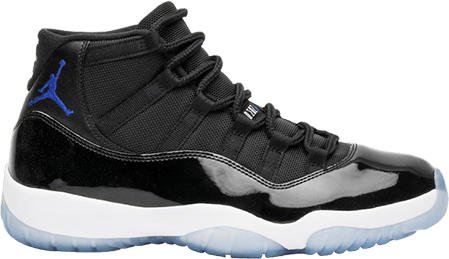
Hatfield blended formal tuxedo shine with high-level basketball support. Actors and musicians soon wore the official Air Jordan 11 silhouette with tailored suits at awards shows. Within the wider Air Jordan catalog, no other numbered signature model achieved the same crossover status. Reserving one high-top patent leather release for December each year since 2009 turned the drop into a seasonal ritual.
How Did the 1996 Space Jam Shape the 2000 and 2009 Winter Drops?
The black-and-blue Space Jam colorway worn in the 1996 Warner Bros. film created the blueprint for winter sneaker releases. Michael Jordan wore the pair during the 1995 NBA Playoffs and in the 1996 movie. However, buyers waited five years until December 13, 2000 ($125 retail) for the first public release. Midnight campout lines formed outside shopping malls across North America during that launch.
When the Space Jam 11 colorway returned on December 23, 2009 ($175 retail), every subsequent year followed suit. Cool Grey dropped in 2010, Concord in 2011, Bred in 2012, Gamma Blue in 2013, and Legend Blue in 2014. Contract factories listed on the Nike Global Manufacturing Map scaled up fourth-quarter output. That production increase met surging global holiday demand.
Which 6 Holiday Retros Released Between 2018 and 2023?
Between 2018 and 2023, the brand delivered 6 consecutive holiday releases. Those drops alternated between 1995 OG remasters and modern anniversary editions. In 2018, the Concord returned ($220 retail) with high-cut patent leather and “45” heel tabs. The 2019 Bred ($220 retail) followed in true 1996 Playoff form. In 2020, the Jubilee celebrated 25 years of the silhouette with silver eyelets ($220 retail).
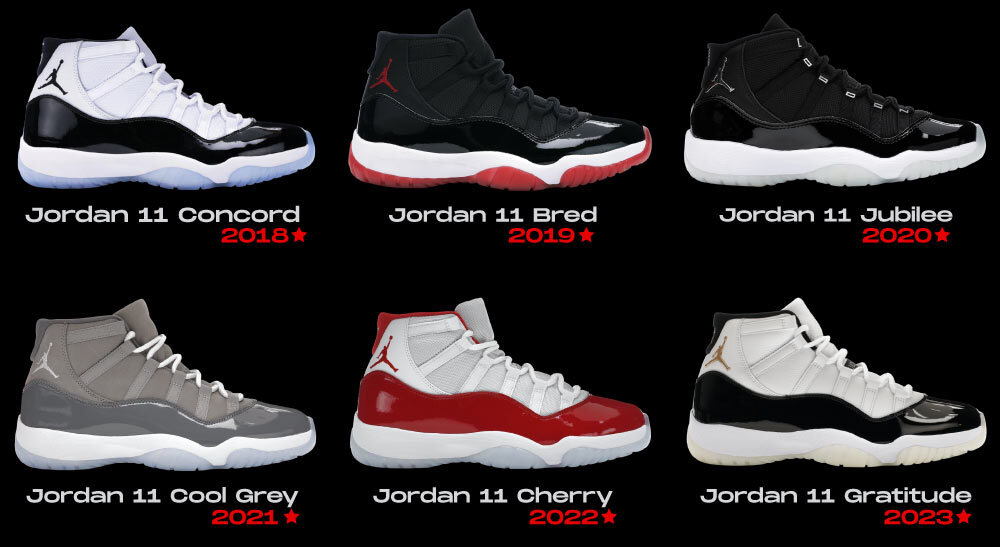
The streak continued in 2021 with the Cool Grey 11 retro ($225 retail) and in 2022 with the Varsity Red Cherry ($225 retail). In 2023, the DMP-inspired Gratitude ($230 retail) completed the six-year run. Each release combined men’s, Grade School, Preschool, and Toddler sizing. Those full-family runs anchored fourth-quarter retail traffic across global physical and online storefronts.
| Release Year | Colorway Edition | Retail Price | Key Design Detail |
|---|---|---|---|
| 2018 & 2019 | Concord (2018) & Bred (2019) | $220 | High-Cut OG Patent & 45 / 23 Heels |
| 2020 | Jubilee (25th Anniversary) | $220 | Metallic Silver Jumpman & Eyelets |
| 2021 & 2022 | Cool Grey (2021) & Cherry (2022) | $225 | Nubuck Grey & Varsity Red Patent |
| 2023 & 2024 | Gratitude (2023) & Legend Blue (2024) | $230 | Tumbled Leather & 1996 All-Star Blue |
Why Did the 1996 Columbia Return as the 2024 Legend Blue?
The white-and-blue colorway worn during the February 1996 NBA All-Star Game returned in 2024. That release celebrated ten years since its 2014 retro. Originally nicknamed the Columbia after North Carolina collegiate colors, the shoe appeared on court once during that 1996 All-Star MVP game. Its first retro arrived in January 2001 ($125 retail).
When the colorway returned in 2014 ($200 retail), designers updated the official shade name to Legend Blue. According to StockX’s 2014 Legend Blue market data, deadstock pairs from 2014 average $331 on the secondary market. For the 2024 holiday release ($230 retail), the brand restored the taller 1996 patent leather cut alongside smooth white leather uppers.
“Michael Jordan laced up the white-and-blue Columbia high-top only once during the 1996 All-Star Game. Yet that single three-hour broadcast turned the colorway into a thirty-year winter staple.”
How Do GOAT and StockX Fees Impact Holiday Retro Payouts?
Reselling deadstock holiday 11s requires accounting for platform commissions across GOAT, StockX, and eBay. Per the GOAT seller fee schedule, U.S. sellers in good standing pay a 9.5% base commission plus a $5 flat fee. GOAT also deducts a 2.9% cash-out fee on direct deposit transfers to connected domestic bank accounts. Original shoeboxes and tissue paper are mandatory for authentication.
StockX deducts a 7.0% to 9.0% transaction fee plus 3.0% payment processing and $5 shipping. On a 2014 Legend Blue selling at its $331 StockX average, a Level 1 seller pays $45 in combined fees, netting $286. Listing that same $331 pair on eBay (which charges 8.0% over $150) yields $304 net. Holding deadstock pairs for 24 months widens the price spread for patient sellers.
| Holiday Edition | Gross Resale Price | GOAT Standard Net (9.5% + $5 + 2.9%) | eBay Net (8% Over $150) |
|---|---|---|---|
| 2023 Gratitude (CT8012-170) | $280 | $241 | $258 |
| 2021 Cool Grey (CT8012-005) | $315 | $272 | $290 |
| 2014 Legend Blue (378037-117) | $331 | $286 | $304 |
| 2018 Concord (378037-100) | $410 | $355 | $377 |
How Do Collectors Secure Annual Holiday Retros on SNKRS?
Securing the annual winter retro at retail requires preparing for November Shock Drops and the Saturday SNKRS launch. As explained in Nike’s SNKRS Draw help guide, high-demand releases use a randomized entry window. Buyers submit size and payment details before winners receive email confirmation. Foot Locker, Champs, and Dick’s Sporting Goods also run simultaneous online queues.
Collectors who study how to buy sneakers for retail and compare the best sneaker bots evaluate Valor AIO, Cybersole, Stellar AIO, and NikeShoeBot. Clean residential proxies and aged SNKRS accounts maximize checkout coverage across men’s sizes 9 through 12. Separate virtual cards also prevent duplicate billing errors during peak drops. Reviewing a complete sneaker bot setup guide keeps tasks ready for release weekend.
Which winter release had the highest production run?
The 2018 Concord, 2019 Bred, and 2021 Cool Grey each exceeded 1,000,000 pairs globally across full-family sizing. All three editions still sold out on launch weekend.
Why was the Columbia colorway renamed Legend Blue in 2014?
The brand introduced the Legend Blue shade name in 2014 to establish a proprietary color trademark. It preserved the light Carolina blue hue worn during the 1996 NBA All-Star Game.