Adidas Samba: 1949 History, OG vs Classic Specs, and Pricing

The Adidas Samba is a low-profile indoor soccer trainer created by Adi Dassler in 1949 for icy European pitches. After moving from 1970s futsal courts and 1990s skate parks into fashion, the silhouette claimed its time in the spotlight in 2022 and 2023. Core OG pairs retail at $100, while limited collaborations trade from $180 to $420 on secondary platforms.
- Origin Year: Engineered by Adi Dassler in 1949 with a three-suction-cup gum outsole built for frozen soccer fields.
- Retail Pricing: Core OG colorways retail at $100 per pair, while decon and collaborative releases list from $120 to $200.
- Cultural Milestones: Adopted by five-a-side footballers in the 1970s, skateboarders in the 1990s, and luxury runways in 2022.
- Key Collaborators: Grace Wales Bonner, Pharrell Williams Humanrace, Sporty & Rich, and Jason Dill (Fucking Awesome).
How Did Adi Dassler Design the 1949 Adidas Samba for Icy Pitches?
Adi Dassler engineered the first generation of this trainer in 1949 for frozen German soccer grounds. Winter football matches required reliable grip on hard frost where standard metal studs failed to penetrate. According to Sneakerjagers archival documentation, the 1949 boot paired kangaroo leather uppers with a vulcanized gum rubber outsole. Three recessed suction cups beneath the forefoot allowed players to pivot sharply on ice.

Ahead of the 1950 World Cup in Brazil, the brand named the model after the Brazilian dance rhythm. That naming choice connected European winter engineering with South American football flair. By 2023, the model reached 74 years of continuous production across global factories. Only the Stan Smith has recorded higher cumulative unit volume in company history.
How Did the Silhouette Evolve Through the 1970s and 1990s?
The footwear design shifted from a high-cut winter boot into a low-cut indoor trainer during the 1970s. Designers added the signature T-toe suede overlay, flat gum soleplate, and extended fold-over futsal tongue. Those updates protected the instep and improved close ball control during five-a-side gymnasium matches. British football casuals soon wore the low-top shoe in stadium terraces across England.
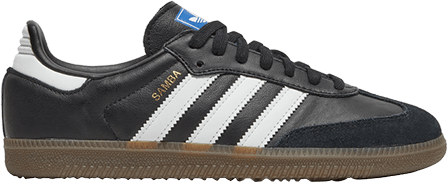
During the 1990s, street skateboarders adopted the indoor shoe for its flat vulcanized gum soleplate. The thin cupsole delivered responsive boardfeel while the suede T-toe resisted griptape abrasion. That organic 1990s skate crossover inspired the Busenitz Pro and the dedicated ADV skate version. Readers can check our Nike Dunk High vs Low comparison to see how court shoes adapt to skateboarding.
Why Did the Trainer Dominate Streetwear in 2022 and 2023?
High-fashion collaborations and celebrity styling pushed the terrace classic to peak demand during 2022 and 2023. British designer Grace Wales Bonner reworked the archival build with crochet stitching, pony hair uppers, and fold-over tongues. Those limited Wales Bonner releases traded above $350 per pair on secondary marketplaces. Pharrell Williams followed with monochromatic Humanrace editions crafted from leather and long leather tongues.
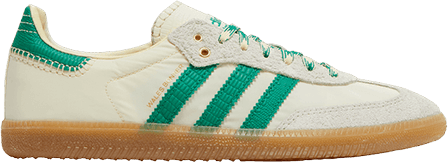
Our Yeezy partnership termination report explained why the German brand refocused on heritage terrace footwear in late 2022. Playful capsules like the Adidas Forum Low Grinch release also kept archival court models in focus. Standard Cloud White and Core Black OG pairs sold out repeatedly at $100 retail throughout 2023. Fashion editors named the low-profile trainer the defining footwear silhouette of 2023.
| Edition / Collaboration | Release Period | Retail Price | Key Construction Detail |
|---|---|---|---|
| Original Winter Pitch Boot | 1949 Debut | Archival Issue | Kangaroo leather upper with 3 outsole suction cups |
| Samba Classic Indoor | 1970s Era | $90 | Extended fold-over futsal tongue and EVA midsole |
| Samba ADV Skate | 1990s / Modern | $100 | Double-layered Adituff toe reinforcement and molded sockliner |
| Wales Bonner Collaborative | 2022 – 2023 | $180 – $200 | Pony hair panels, crochet 3-Stripes, satin lining |
How Do Samba OG, Classic, and Velour Variants Compare?
Current inline versions differ primarily in tongue length, midsole cushioning, and upper leather grading. The OG edition replicates the 1970s street look with a short tongue and gold foil branding at $100 retail. By contrast, the Classic version keeps the extended ribbed futsal tongue and an EVA midsole wedge at $90 retail. Indoor soccer players favor the Classic priced at $90, while casual wearers prefer the OG listed at $100.
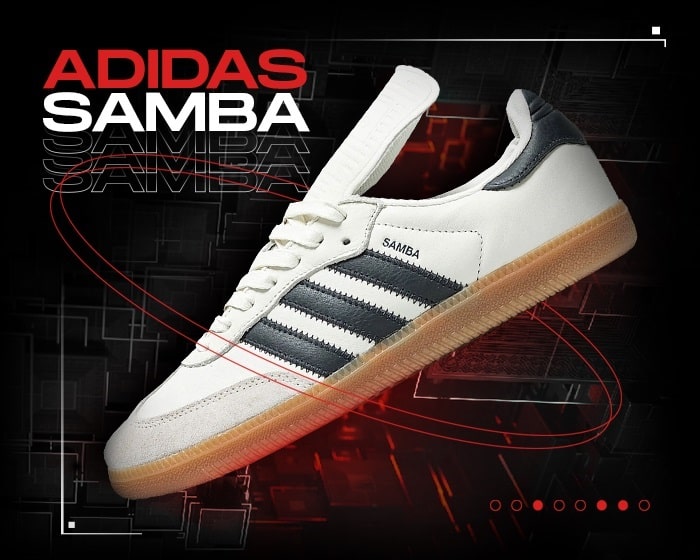
Seasonal inline drops add vegan synthetic uppers, velour panels, and collapsible Decon leather heels priced from $110 to $150 retail. Leather-upper shoes enter the United States under HTS code 6403.99 with an 8.5% to 10% tariff per Shoemakers Academy tariff schedules. Those import duties and material grades separate $90 synthetic builds from $150 Decon leather pairs.
The easiest way to tell the OG from the Classic is the tongue: the OG sits flush against the ankle, while the Classic extends high over the laces.
What Are the Net Payouts on Collaborative Pairs After Fees?
Secondary market premiums on limited terrace drops depend on colorway scarcity and platform fee deductions. Restocked Cloud White OG pairs trade near their $100 retail price on secondary exchanges. Meanwhile, limited Wales Bonner Pony Leo and Sporty & Rich releases clear between $260 and $420 per pair. Sellers calculating net payouts must deduct marketplace commissions before listing pairs.
According to the StockX seller fee schedule, Level 1 accounts pay a 9% transaction fee plus a 3% processing fee. StockX also deducts a $5 domestic shipping charge from each completed seller payout. Similarly, the GOAT seller commission table deducts a 9.5% base commission plus a 2.9% cash-out fee. The table below outlines net seller payouts across four notable terrace releases after standard deductions.
| Release Colorway | Retail Price | Average Resale Ask | Net Payout (After ~12.4% Fees) |
|---|---|---|---|
| Samba OG Cloud White (B75806) | $100 | $105 | $87 |
| Pharrell Humanrace (Cloud White) | $180 | $215 | $183 |
| Sporty & Rich White Green | $120 | $260 | $223 |
| Wales Bonner Pony Leo | $200 | $420 | $363 |
How Do Buyers Size and Secure Limited Colorways at Retail?
Selecting the proper size requires accounting for the narrow midfoot last inherited from 1970s futsal boots. Most buyers with narrow or medium feet order true to size for a snug fit. Wide-footed wearers order 0.5 size up to avoid lateral pressure across the suede T-toe overlay. You can check US, UK, and EU conversions in our complete Adidas size guide before ordering.
Limited collaborations drop through the Confirmed app alongside Shopify boutiques such as Kith, Bodega, and Concepts. Collectors studying how to buy sneakers for retail prepare billing profiles ahead of draw windows. Multi-site checkout software such as Valor AIO, Cybersole, Stellar AIO, and NikeShoeBot automates boutique tasks during high-traffic drops. Running residential proxies alongside automated tasks helps collectors secure limited collaborative sizes at retail.
Does the OG model fit true to size for wide feet?
The OG silhouette uses a narrow heritage soccer last that fits true to size for narrow and medium feet. Buyers with wide feet should order 0.5 size up to avoid lateral pressure along the suede T-toe overlay.
What is the difference between the Samba OG and the Gazelle Indoor?
The OG trainer pairs a smooth leather upper with a contrasting suede T-toe and a flat dark gum outsole, whereas the Gazelle Indoor features an all-suede upper, a wider toe box, and a translucent gum cupsole wrapper.