Music and Sneakers: A History of Artist Shoe Deals

Music and sneakers have been a business pairing since 1986, when Adidas signed Run-DMC to a deal that Guinness World Records lists as the first sneaker endorsement for people outside sport. Before that, brands sold shoes through players: the Basketball Hall of Fame says Converse added Chuck Taylor’s signature to its five-pronged star in 1932, and Nike’s history page puts the Air Jordan 1’s public release in April 1985. More artist deals followed, and we sourced every step below.
- 29 May 1986: Run-DMC released “My Adidas”, according to Guinness World Records.
- $1.6 million: the value Guinness World Records says the Adidas deal had when it was signed in mid-1986.
- 18 April 2003: Reebok released the S. Carter, according to Complex.
- 25 October 2022: Adidas ended its partnership with Ye, according to its own press release.
Who was Chuck Taylor, and why is his name on the shoe?
Chuck Taylor was a professional basketball player turned Converse ambassador, and his name is on the All Star because, according to the Basketball Hall of Fame, Converse added his signature to the shoe in 1932. In the summer of 1921, the same biography says, he walked into a Chicago Converse sales office complaining of sore feet and persuaded executives to create a shoe especially for basketball.
The biography calls him a two-time All-State selection in high school and a journeyman jump shooter for eleven professional seasons. With his signature on the star, Converse sent him on the road to promote the shoe, where he also ran clinics and demonstrations. It lists the Chuck Taylor All-Star as the official shoe of the Olympics from 1936 to 1968.
The Hall of Fame says the line became the best-selling basketball shoe in history, not bad for a visit that began with sore feet. Our sneaker tech round-up looks at what goes into a pair.
The Air Jordan 1 tied one player to one shoe
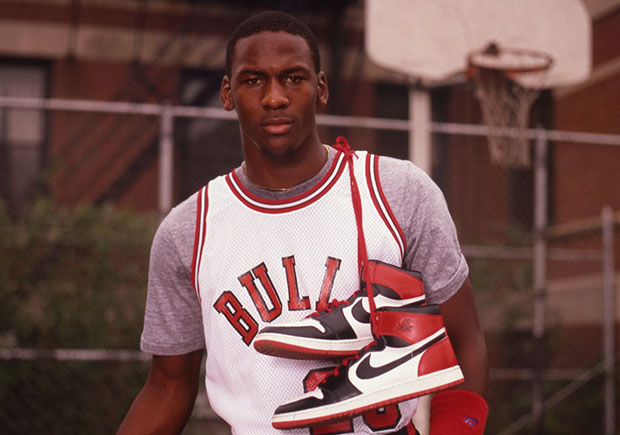
The Air Jordan 1 was the black, red and white basketball shoe that Nike tied to Michael Jordan’s rookie season. In its own archive notes, Nike says training camp was only weeks away in September 1984, so its designers reworked existing tooling, recoloured it and added the wings logo.

Nike notes that a league letter dated 25 February 1985 cited Jordan’s shoes for breaking uniform rules, and that it released them to the public in April 1985 with an ad campaign about the controversy.
Nike’s page says the most famous retelling has Jordan fined $5,000 every time, with Nike paying the bill. The page calls the reality “a little more nuanced”: it says Jordan first wore a black-and-red pre-Air Jordan shoe called the Nike Airship in the 1984 to 1985 pre-season, and that he rotated a number of different shoes through his rookie year. Our guide to everything Air Jordan covers the line in full.
Was the Air Jordan 1 really banned by the league?
Nike’s own history page says the reality is “a little more nuanced” than the popular story. It says the league letter citing Jordan’s shoes is dated 25 February 1985 and that the Nike Airship was the original outlawed shoe.
When did music and sneakers cross paths?
Music and sneakers formally crossed paths in 1986, when Run-DMC released “My Adidas” and the brand answered with an endorsement deal. Guinness World Records says the group released the single on 29 May 1986, that it paid tribute to the low-top Superstar, and that it reached No. 5 on Billboard’s Hot R&B/Hip-Hop Songs chart.
An essay on the album hosted by the Library of Congress says the Adidas offer came only after the track was out, and calls it “the first ever struck with non-athletes”. Guinness adds that co-manager Lyor Cohen invited Adidas executive Angelo Anastasio to the group’s Madison Square Garden show on 19 July 1986, where the group asked the 40,000 fans present to hold up their Adidas sportswear. The deal itself, signed in mid-1986, was worth $1.6 million, per Guinness.
Why did sneaker brands start signing musicians?
Musicians gave sneaker brands a route into a market beyond sport, and the sources we read describe it that way. Guinness World Records says the Run-DMC deal “opened up a new non-sporting market in urban streetwear for Adidas”, and the Library of Congress essay calls it “a very early marker of what would become hip-hop’s huge influence on global fashion”.
Complex made the same point in 2016, writing that sportswear companies had aligned themselves with athletes for nearly 100 years, that entertainers getting their own shoes was a new concept, and that Jay-Z’s Reebok deal “proved that you didn’t have to be able to slam dunk or win Wimbledon to sell shoes”. Reebok’s director of entertainment marketing, Damion Presson, told Complex that the approach later became oversaturated and the company stepped away from the music space.
What did Jay-Z’s Reebok S. Carter do in 2003?
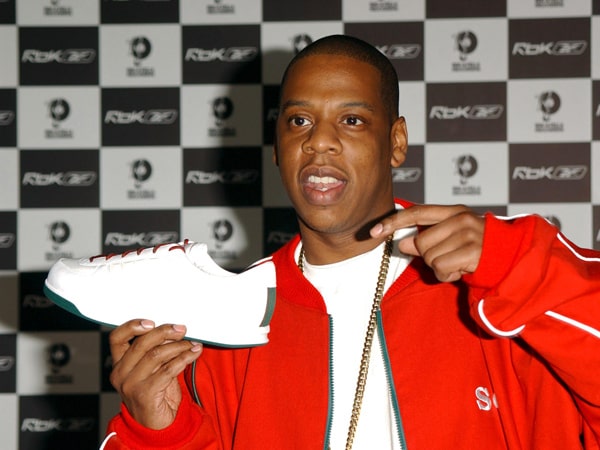
According to Complex, the S. Carter, Jay-Z’s first shoe with Reebok, sold 10,000 pairs in a matter of hours after its release on 18 April 2003, and it started a shift in how brands handle footwear endorsements. The same article says the design copied the Gucci Tennis ’84, a low-top luxury shoe, and was not anything special or memorable. By Complex’s account, then, the shoe was plain and the deal was what mattered.

Complex also notes that Jay-Z was not the first rapper with his own pair, naming the Run-DMC collection with Adidas in the late 1980s, and that 50 Cent and G-Unit got Reeboks too. It lists Pharrell, Daddy Yankee, Nelly, Lupe Fiasco and Paul Wall among the artists Reebok signed later. Our write-up of the Reebok G-Unit G6 return covers one of those lines.
Was Jay-Z the first rapper with his own sneaker?
No. Complex wrote in 2016 that Jay Z was not the first rapper to get his own sneaker, and it named the Run-DMC collection with Adidas in the late 1980s as an earlier example.
What happened between Kanye West and the sneaker brands?
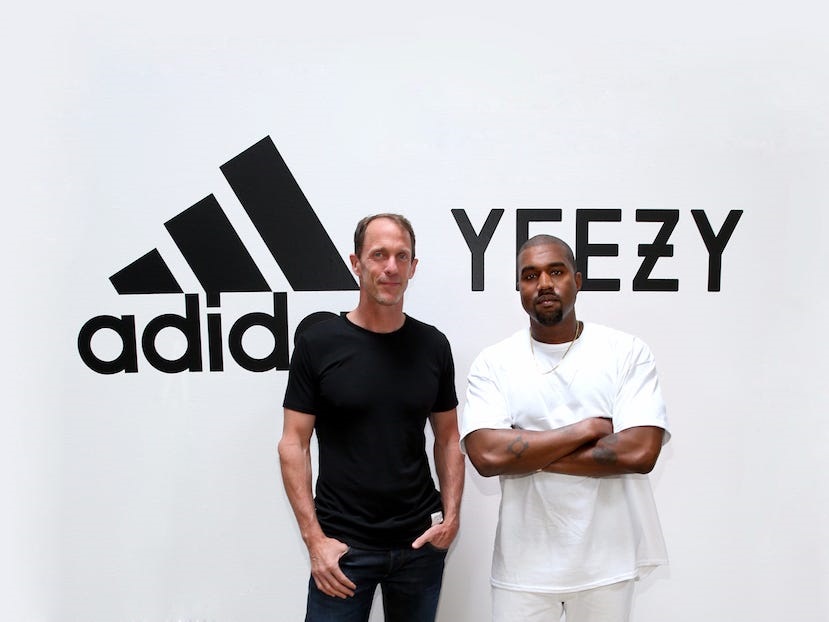
Kanye West, whom Adidas’s own statement calls Ye, moved from Nike to Adidas, and Adidas ended that partnership in 2022. Complex says his two Nike models, the Air Yeezy 1 and 2, launched in 2009 and 2012, and that he left Nike for Adidas “through much turmoil”. According to CNN, Adidas partnered with West from 2013 and expanded the relationship in 2016, which Adidas itself called “the most significant partnership ever created between a non-athlete and an athletic brand”.

On 25 October 2022, the Adidas press release said the company had taken the decision to end the partnership after a thorough review. It also said:
adidas will stop the adidas Yeezy business with immediate effect.
We quote only that line and leave the rest of the release to its link. Our report on the Yeezy termination has the news as it broke.
How did Beyoncé and Travis Scott fit the same pattern?
Beyoncé and Travis Scott each worked with a shoe brand through a line that carried their own label. The Adidas annual report for 2019 says Adidas and Beyoncé announced a multi-layered partnership in April 2019 and that the first products were released in January 2020. The Fader reported on 24 March 2023, citing the Wall Street Journal, that the two were no longer working together on Ivy Park, a split our Adidas and Ivy Park post covered.
The Wikipedia article on Travis Scott says he announced a collaboration with Nike on 30 April 2019 to release his Cactus Jack Air Jordan 1 that May. Its list of his Nike collaborations opens with two releases from 2017 and runs, as of 6 October 2026, to releases dated 2026. We use that list for years only, and Nike’s own pages are the place to check any single pair.
What does the timeline of artist and sneaker deals look like?
The table below puts the deals in this article in date order, with the page we read for each one. Working from those dates, 54 years passed between the 1932 signature on the Converse star and the 1986 Run-DMC deal, which is 1986 minus 1932.
Another 17 years passed before the 2003 S. Carter, and the Adidas partnership with West ran for about nine years, from 2013 to 2022. Where a source gives only a month or a year, the table does the same.
Date What happened Source 1932 Converse added Chuck Taylor’s signature to its star Basketball Hall of Fame April 1985 Air Jordan 1 released to the public Nike 29 May 1986 Run-DMC released “My Adidas” Guinness World Records Mid-1986 Run-DMC signed with Adidas, a $1.6 million deal Guinness World Records 18 April 2003 Reebok released the S. Carter Complex 2009 and 2012 Air Yeezy 1 and 2 launched with Nike Complex 2013 Adidas partnership with West began CNN April 2019 Adidas and Beyoncé announced their partnership Adidas annual report 2019 25 October 2022 Adidas ended its partnership with Ye Adidas press release March 2023 Report that Ivy Park and Adidas had ended their relationship The Fader Sources can differ on small details, so each date follows the page named beside it, and the table repeats only what the sections above already sourced. Chuck Taylor’s 1932 signature is the earliest entry, and the March 2023 report on Ivy Park is the latest.
Which Run-DMC album carried “My Adidas”?
According to the Library of Congress essay, the song is on Raising Hell, released in May 1986, whose 12 tracks run just under 40 minutes.
Tagged