Tom Sachs Nike Mars Yard 3.0: 2025 Specs, $275 Retail, and ISRU Challenges

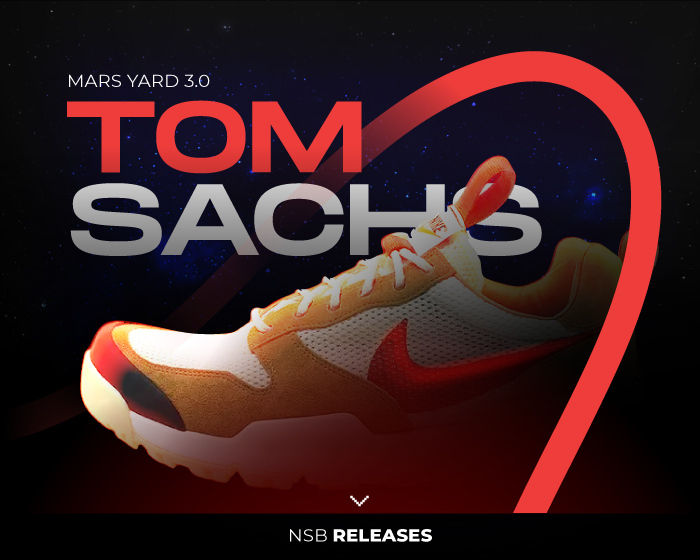
Released on September 5, 2025 for $275 retail, the Tom Sachs Nike Mars Yard 3.0 completes the NikeCraft trilogy after the partnership resumed in late 2024. Seeing this third chapter happening in 2025 brings a black TPU toecap, React foam cushioning, and weekly ISRU qualification challenges. Below, we examine the 2023-2025 timeline, hardware upgrades, and resale data.
- September 2025 Launch & Price: Released on September 5, 2025 at $275 retail in Natural, Sport Red, and Maple Brown with a new black rubberized TPU toecap.
- 2023-2024 Partnership Arc: Paused in May 2023 following studio workplace reports and officially reinstated in October 2024 ahead of the 2025 calendar.
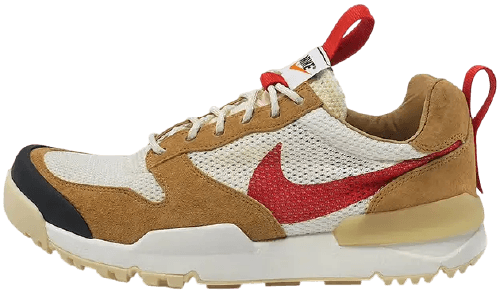
- 3.0 Hardware Upgrades: Adds a black TPU toe bumper, an extended lace-keeper tongue pull tab, a silkscreened red Swoosh, and a full-length React foam midsole.
- Trilogy Resale Benchmarks: Follows the 2012 Mars Yard 1.0 ($8,000+ resale) and 2017 Mars Yard 2.0 ($4,500+ resale), with eBay charging an 8% fee on $150+ sales.
What Happened Between Nike and Tom Sachs From 2023 to 2025?
The 2025 release calendar delivered major headlines, from Jordan Brand’s 40th anniversary lineup to the debut of NikeSKIMS activewear. Yet few announcements surprised collectors more than the return of New York sculptor Tom Sachs. In March 2023, workplace complaints first surfaced in Curbed’s investigation into Tom Sachs’ studio culture. Public scrutiny quickly prompted a formal corporate review in Beaverton.
In May 2023, we reported that Nike paused its Tom Sachs partnership and halted planned General Purpose Shoe restocks. After an 18-month studio restructuring, the brand confirmed in October 2024 that the NikeCraft partnership was back. Wear-test samples of the 3.0 were already underway for the September 2025 rollout. Collectors worldwide immediately began tracking the third installment of the space-inspired series.
What Design Upgrades Define the Tom Sachs Nike Mars Yard 3.0?
At first glance, the September 5, 2025 release ($275 retail) preserves the signature NASA-inspired color blocking of its predecessors. Off-white open-weave polyester mesh forms the breathable base, paired with Maple Brown hairy suede overlays and Sport Red accents. However, Sachs treated the 3.0 as an iterative engineering upgrade shaped by years of studio wear-testing.
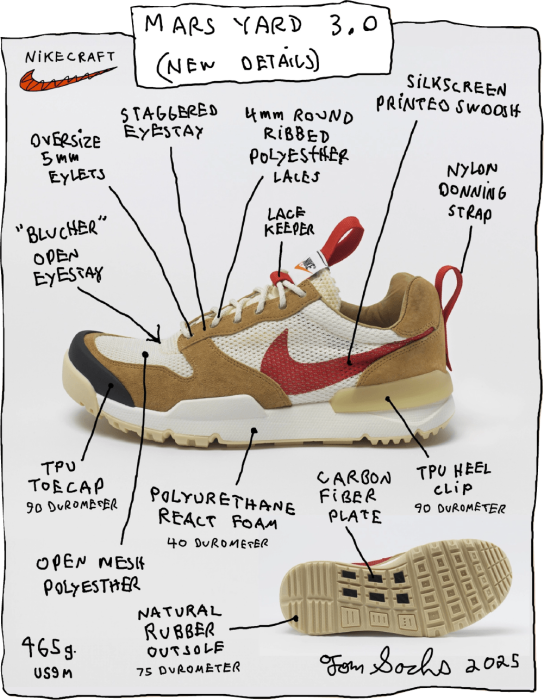
The most visible addition is a black rubberized TPU toecap that reinforces the front bumper against workshop abrasion. On the tongue, the red nylon pull tab is elongated so it loops down as a functional lace keeper. Furthermore, the side Sport Red Swoosh is silkscreened rather than stitched. Underneath, a polyurethane-encapsulated React foam midsole and carbon-fiber midfoot plate upgrade daily comfort.
“Mars Yards have always been hard to get; if you want them, you have to work for them.” – Tom Sachs
How Does the 3.0 Compare to the 2012 1.0 and 2017 2.0 Editions?
Every chapter in the Mars Yard trilogy solved a structural weakness discovered on the previous generation. Released in May 2012 for $385 retail, the original Mars Yard 1.0 (537327-106) used aerospace Vectran airbag fabric. That material came directly from the Mars Excursion Rover program. While historically iconic, Vectran proved too rigid and cracked along forefoot flex points during daily wear.
To fix that tearing issue, the July 2017 Mars Yard 2.0 (AA2261-100, $200 retail) replaced Vectran with polyester tricot mesh. It also swapped the outsole tread for urban SFB lugs. Eight years later, the 2025 Mars Yard 3.0 ($275 retail) reinforced the toe box with black TPU. It also added a TPU heel clip and dual cork-and-mesh insoles for studio durability.
| Trilogy Edition | Release Date & Retail | Upper & Toe Construction | Aftermarket Resale Benchmark |
|---|---|---|---|
| Mars Yard 1.0 (537327-106) | May 2012 ($385 retail) | Vectran fabric & suede toe | $7,500 – $11,000+ |
| Mars Yard 2.0 (AA2261-100) | July 2017 ($200 retail) | Polyester tricot mesh & suede | $4,200 – $6,500+ |
| Mars Yard Overshoe (AH7767-101) | May 2019 ($550 retail) | Dyneema waterproof shroud | $480 – $750 |
| Mars Yard 3.0 (2025 Trilogy) | Sept 5, 2025 ($275 retail) | Open mesh + Black TPU toecap | $1,200 – $2,200+ |
How Did the Weekly ISRU Challenges Determine Purchase Eligibility?
Rather than releasing the $275 retail shoe through a standard first-come checkout, Sachs revived his “Space Camp” philosophy. He created a multi-week qualification series called In-Situ Resource Utilization (ISRU). The program took its name from NASA’s practice of using local planetary materials during space missions. Weekly challenges appeared on the official NikeCraft Instagram account leading up to September 5, 2025.
Participants completed weekly creative, organizational, and physical endurance assignments to score points on the global ISRU leaderboard. Tasks included “Output Before Input” drawing logs, knolling studio tools, and running timed outdoor miles. Top-ranked participants unlocked invoice links to buy the shoe at its $275 retail price. Remaining stock then hit select channels and the Nike SNKRS Draw. That merit-based rollout rewarded dedicated fans over casual resellers.
How Do Resale Valuations and eBay and StockX Fees Compare on NikeCraft?
The 2012 Mars Yard 1.0 trades above $8,000 and the 2017 Mars Yard 2.0 commands $4,500+ per market data. Because of that pedigree, the September 2025 Mars Yard 3.0 immediately became one of the highest-valued releases of the year. Even at a $1,500 aftermarket sale price, the shoe trades at more than five times its $275 retail price. Deadstock pairs with full box inserts command the highest bids.
On four-figure sales, platform commission structures create a major difference in net payout. Per eBay athletic shoe fee schedules, sneakers sold for $150 or more incur a flat 8% final value fee. Selling at $1,500 on eBay deducts $120 and yields $1,380 net. By contrast, StockX seller fee schedules charge Level 1 sellers 12% total, returning $1,320 net on $1,500.
| NikeCraft Release & Sale Price | Original Retail | eBay Net (8% Fee >= $150) | StockX Net (12% Level 1) |
|---|---|---|---|
| Mars Yard 3.0 at $1,200 | $275 | $1,104.00 (+$829.00 spread) | $1,056.00 (+$781.00 spread) |
| Mars Yard 3.0 at $1,500 | $275 | $1,380.00 (+$1,105.00 spread) | $1,320.00 (+$1,045.00 spread) |
| Mars Yard 3.0 at $2,000 | $275 | $1,840.00 (+$1,565.00 spread) | $1,760.00 (+$1,485.00 spread) |
| Mars Yard 2.0 (2017) at $4,500 | $200 | $4,140.00 (+$3,940.00 spread) | $3,960.00 (+$3,760.00 spread) |
How Can Collectors Secure 2025 Grail Sneaker Releases at Retail?
Weekly ISRU leaderboard challenges gated the primary allocation of the September 5, 2025 drop. Still, boutique raffles, shock restocks on store.tomsachs.org, and major 2025 launches rely on rapid online checkout. Readers following our sneaker release blog track every boutique domain and SNKRS draw window ahead of launch morning. Fast execution remains essential when stock is scarce across all sizes. Preparing verified accounts early prevents last-minute login errors.
When preparing for high-demand Shopify, SNKRS, and Footsite releases, experienced collectors compare multi-site checkout suites. Leading options include Valor AIO, Cybersole, and Stellar AIO alongside NikeShoeBot. Running low-latency task groups with clean residential proxies helps tasks enter draws and Shopify queues at retail. Pre-saving billing profiles also eliminates manual typing delays on drop morning.
Why did Tom Sachs add a black rubberized TPU toecap to the 3.0 version?
Wear-testing of the 2012 and 2017 editions showed that studio floor friction wore through the front suede bumper. The black TPU overlay protects the toe box from punctures and scuffs.
What does “I.S.R.U.” stand for in the 2025 NikeCraft rollout?
ISRU stands for “In-Situ Resource Utilization,” an aerospace term for using local materials found on a mission. Tom Sachs adapted the concept for his weekly qualification challenges.