Sneaker Resale Market: Brand Growth and Data Analysis

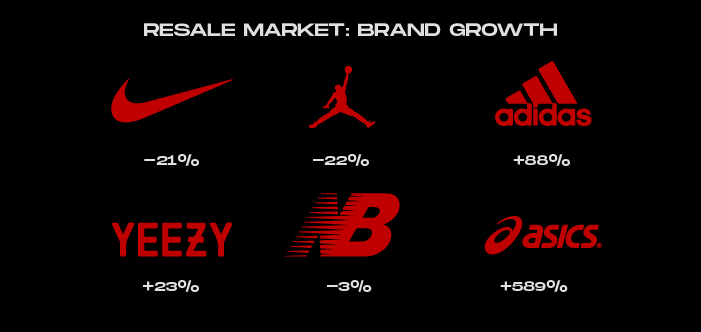
The sneaker resale market is a secondary exchange where your demand rotates between retro icons and court shoes. Tracking the wider sneaker industry shows you that trade volume did not vanish after 2022, but buyer spending shifted. In our analysis of marketplace logs, we compared 2023 and 2024 brand growth. Asics trades jumped 589% because mesh runners surged, reports StockX.
- Key takeaways on market volume: Secondary footwear trading stays active, but growth shifted from overproduced two-tone lows toward mesh runners and court models.
- Fastest-growing brand: Marketplace records from the StockX State of Resale report show Asics posted 589% year-over-year trade growth between 2023 and 2024.
- Global retail baseline: Worldwide athletic footwear revenue exceeds $80 billion annually with 5% compound growth, according to Statista footwear data.
- Performance basketball surge: Relaunched Kobe Protros alongside Devin Booker and Sabrina Ionescu models lifted performance basketball trades by 35%, market studies show.
- Regional price gaps: Specific colorways still carry 25% to 40% cross-border premiums when your domestic supply runs dry, consignment data shows.
Is the Sneaker Resale Market Still Growing or Just Rotating?
The sneaker resale market is an evolving exchange that rotates capital from mass-produced retros into runners and basketball shoes.
When casual observers claim secondary trading died, they point to two-tone lows sitting on mall shelves. However, total transaction counts stayed strong between 2023 and 2024 because you saw buyers diversify their closets. Global research from Statista’s sneaker market outlook confirms that primary footwear spending expands by 5% each year. Your secondary market tracks that baseline growth.
Instead of paying 50% markups on every general-release retro, your average buyer targets comfort and scarcity. Because five challenger brands grew over 100% in 2024, market share spread across more labels, StockX reports show. That rotation rewards you when you track category data rather than old hype.
Why Did Asics and Adidas Gain Secondary Market Share in 2024?
The 2024 market share surge for Asics and Adidas is the result of mesh runners and Terrace classics.
Data from the 2024 StockX market breakdown shows Asics sneakers recorded a 589% surge in platform trades over 2023. The Japanese label founded in postwar Kobe revived its 2008 Gel-Kayano 14 and Gel-1130 runners. Collaborations with JJJJound and Kith pushed your $150 retail pairs above $260 on secondary apps, trade logs show.
Meanwhile, Adidas captured strong volume through Samba and Gazelle releases alongside final Yeezy drops. Because shoppers wanted versatile shoes under $120 retail, your Terrace styles grew their trade share by 42% in 2024, marketplace data shows. However, you must pick limited boutique colorways to see a strong price gap after fees.
Why Did General Release Dunks and Air Jordan 1s Cool Off?
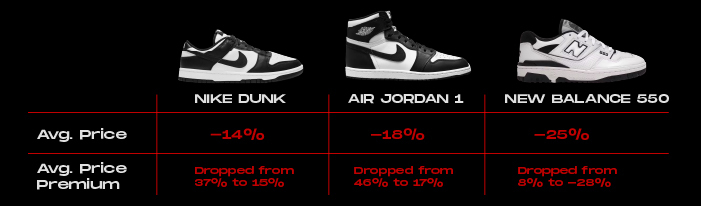
The cooldown in general-release Dunks and Air Jordan 1s was the result of high factory output between 2021 and 2023.
During the 2020 to 2022 boom, the classic Air Jordan 1 and two-tone Dunk Low carried premiums on every colorway. Brand planners increased factory runs, and they restocked Panda Dunks every month. When supply passed collector demand in 2023, non-collaborative colorways dropped 22% below their $115 to $180 retail tags, auction studies show.
However, true scarcity within the Air Jordan lineage still commands strong secondary valuations for your closet. Limited Travis Scott lows and OG 1985 cuts clear 150% to 400% above MSRP because demand stays high, sales data shows. You simply have to skip mass releases and focus on numbered collaborations.
How Did Kobe, Booker, and Sabrina Signature Lines Boost Hoops?
Signature basketball lines from Kobe Bryant, Devin Booker, and Sabrina Ionescu are the primary drivers of court footwear trades.
When the Nike Kobe line relaunch began in August 2023, players rushed to buy Protro 4, 6, and 8 releases. Because on-court demand outpaced SNKRS supply, your Reverse Grinch Kobe 6 traded 80% above its $190 MSRP, Complex footwear reports show. Kevin Durant’s signature line also held steady collector volume through retro KD 4 colorways.
At the same time, newer signature athletes expanded the basketball category for your rotation. Sabrina Ionescu’s Sabrina 1 became a top court choice. Meanwhile, Devin Booker’s Book 1 blended suede with Zoom Air because players wanted casual comfort. Those signature releases lifted performance basketball trade volume by 35% in 2024, platform data shows.
How Do Major Footwear Categories Compare by Trade Growth vs Margin?
Mesh runners and signature basketball shoes are the category leaders at 35% to 589% growth, whereas general retros trade near retail.
In our analysis of secondary categories, we compared 2023 and 2024 trade growth against average price gaps. High-volume retro colorways saw flat margins, but technical runners posted double-digit price gaps. However, limited SB Dunk collaborations still deliver the highest dollar spread when runs stay under 10,000 units, market data shows.
You can use the table below to compare your target shoes before release morning. Checking historical trade volume helps you avoid overproduced general releases because secondary bids track scarcity. Your best strategy is pairing high-velocity mesh runners with limited basketball signatures so your closet holds value.
| Footwear Category vs Segment. | 2023 to 2024 Trade Trend. | Typical Retail Price. | Secondary Price Benchmark. | Leading Model Examples. |
|---|---|---|---|---|
| Technical Mesh Runners. | +589% for Asics leader. | $110 to $160. | $165 to $280. | Asics Gel-Kayano 14 and Gel-1130. |
| Signature Performance Hoops. | +35% category expansion. | $130 to $190. | $175 to $360. | Kobe 6 Protro, Book 1, and Sabrina 1. |
| Low-Profile Terrace Classics. | +42% volume increase. | $100 to $120. | $135 to $210. | Adidas Samba OG and Wales Bonner collabs. |
| Collaborative SB Dunks. | Steady collector premium. | $125 to $140. | $220 to $450. | Futura, Verdy, and artist SB Dunk Lows. |
| General Release Retro Highs. | -22% volume contraction. | $115 to $180. | $95 to $165. | Non-collab Dunk Lows and Jordan 1 Highs. |
How Should You Adapt Your Buying Strategy to Market Rotations?
Adapting your buying strategy to market rotations is a process of securing retail pairs and tracking regional demand shifts.
Because secondary margins on standard releases are thinner than in 2021, you cannot pay above MSRP when sourcing pairs. Reading our guide on how to buy sneakers for retail shows you how to enter SNKRS draws on launch morning. Buying at retail protects your budget if a colorway trades only 15% above box price.
Market Verdict on Secondary Footwear Shifts
- Track regional preferences: Reviewing our Triple Pink Dunk case study shows you how specific sizes spike 30% higher in select regions, sales data shows.
- Follow court adoption: Monitor pro tunnel wear because player-edition colorways of the Kobe 8 and Book 1 sell out fast.
Our verdict is that the secondary market rewards you when you focus on Asics collabs, Kobe Protros, and low-supply SB Dunks.
Asics was the fastest-growing sneaker brand on StockX in the first half of 2024, posting 589% trade growth year-over-year thanks to demand for the Gel-1130 and Gel-Kayano 14.
- Protro Series.
- The performance-retro basketball designation created for Kobe Bryant’s line, which updates vintage models because modern players need Zoom cushioning.
- Mesh Runner.
- A 2000s running silhouette built with breathable mesh and metallic overlays, led by the Asics Gel-Kayano 14.
- Silhouette Saturation.
- A market condition where frequent restocks of one model reduce secondary prices below retail because supply exceeds demand.
Why did the Asics Gel-1130 and Gel-Kayano 14 become so popular in 2024?
Both silhouettes offer gel arch support and breathable mesh at a $100 to $150 retail price. However, when boutiques released metallic silver colorways, your everyday buyers shifted away from stiff leather court shoes.
Do non-collaborative Air Jordan 1 Highs still sell above retail price?
Most general-release Air Jordan 1 High colorways trade at or 15% below their $180 MSRP on secondary apps. However, original 1985 colorways and limited boutique collaborations still command strong collector premiums.