Why Running Sneakers Became Everyday Shoes

Running sneakers are performance shoes that people now wear well beyond the road, and the sales data backs that up. According to Circana, as reported in Running Insight on 5 May 2023, just over 60 percent of US running-shoe unit sales in 2022 went to uses other than sport, including casual, everyday, weekend and work wear. Circana’s release of 17 August 2026 reported running-shoe dollar and unit sales both up 13 percent in the first half of 2026.
- Everyday use: according to Circana, just over 60 percent of 2022 US running-shoe unit sales were for uses other than sport.
- Pandemic swing: Circana reports that US footwear units fell 16 percent in 2020 and rose 14 percent in 2021.
- Latest reading: Circana reported dollars and units both up 13 percent for running shoes in the first half of 2026.
- Racing rules: World Athletics announced a 40 mm sole limit for competition shoes without spikes on 31 January 2020.
What are running sneakers, and who wears them now?
Running sneakers are shoes built around cushioning, support and low weight for people who run, and a growing share of them is bought for something else. According to Circana’s Beth Goldstein, writing in Running Insight on 5 May 2023, one third of US running-shoe unit sales in 2022 were attributed primarily to athletic, sport or exercise use, five points lower than in 2019.
According to the same column, just over 60 percent of those unit sales went to other uses, including casual or everyday use, weekends and work, up three points on 2019. Circana also put 5 percent down to equal use for all. More than half of these pairs, then, are bought for something other than sport. So the figures read less like a comeback and more like a change in how the shoes get used.
“Of course, we cannot discount the performance aspect of running footwear, but I don’t think anyone can argue against the fashion element becoming increasingly important in buying decisions.” Beth Goldstein, Circana, Running Insight, 5 May 2023.
Why did running sneakers take off after 2020?
The rise of running sneakers after 2020 sits inside a pandemic swing in the whole footwear market. Circana’s Consumer Tracking Service shows US footwear units fell 16 percent in 2020, rose 14 percent in 2021 and fell 5 percent in 2022. Goldstein wrote that the category followed a similar pattern: participation rose during the pandemic and the category gained market share, although by May 2023 those gains had declined.
She tied the fashion pull to the same period, because outdoor and fitness activities grew and so did the appeal of gear that looks like it belongs to them. She also attributed the rise of Hoka, On and other non-promotional brands to fashion and comfort for everyday use as well as performance.
In her May 2023 column, Goldstein put the buyers the category had gained since 2020 at approximately eight million, according to Circana’s Checkout data. Our guide to the most comfortable sneakers covers the comfort side of that story.
How have the sales numbers moved since 2020?
The sales numbers show a sharp swing in 2020 and 2021, a softer 2022 and gains for running shoes in the 2025 and 2026 readings. The table lines up each reading with its date and its Circana release, and it marks which rows cover all US footwear and which cover a single category.
Period Scope Measure Reading Source 2020 All US footwear Units sold -16% Circana via Running Insight, 5 May 2023 2021 All US footwear Units sold +14% Circana via Running Insight, 5 May 2023 2022 All US footwear Units sold -5% Circana via Running Insight, 5 May 2023 2022 Adult running Revenue against 2021 +5% Circana via Running Insight, 5 May 2023 2022 Adult running Revenue against 2019 +17% Circana via Running Insight, 5 May 2023 2022 Adult running Units against 2019 -8% Circana via Running Insight, 5 May 2023 January to August 2025 Adult running Units sold, comparison base not stated +4% Circana via Running Insight, 26 November 2025 January to August 2025 Adult running Dollars, comparison base not stated +8% Circana via Running Insight, 26 November 2025 June to August 2025 Running footwear, back-to-school Dollars against 2024 +14% Circana via Running Insight, 26 November 2025 First half of 2026 All US footwear Dollars +1% Circana release, 17 August 2026 First half of 2026 Performance footwear Dollars +6% Circana release, 17 August 2026 First half of 2026 Running shoes Dollars and units +13% each Circana release, 17 August 2026 Two readings should be kept apart. For 2022, Goldstein reported in her May 2023 column adult running revenue 17 percent above 2019 while units were 8 percent below, and she read that as price increases keeping revenue growing while unit demand slowed. By 2025 the mix had changed: her 26 November 2025 column reported units up 4 percent and average selling price up 4 percent through August 2025, which gave the 8 percent growth in dollars.
The specialist brands started in very different places
Saucony, New Balance, Salomon and On are four specialist brands that began in very different places and at very different times. Saucony says on its About Us page that it was founded in 1898 and grew from a local factory into a global brand in the suburbs of Boston. New Balance says on its Who We Are page that it has been independent since 1906 and began as an arch support company.
Amer Sports, which lists Salomon among its brands, describes Salomon as born in 1947 in the French Alps. On says on its About page that it started in the Swiss Alps, when retired athlete Olivier Bernhard glued pieces of garden hose to the outsole of a prototype, and that Caspar Coppetti and David Allemann came on board in 2010. For a brand outside that list, our guide to the best ASICS running shoes is the place to start.
What did the Nike Alphafly 3 add in 2024?
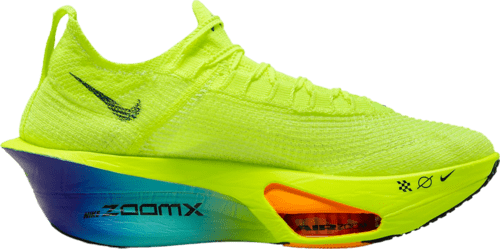
The Nike Alphafly 3 is a carbon-plated marathon racing shoe that Nike made available to the public in January 2024. Nike’s newsroom release of 29 November 2023, headlined Marathon Speed for All Runners, gave 4 January 2024 as the start of availability for the Prototype colourway at nike.com, on the Nike app and at select running specialty stores.

The release describes a wider full-length carbon fiber Flyplate, dual Air Zoom units in the forefoot and a new Atomknit 3.0 upper, and it calls the shoe the lightest and most tested Alphafly Nike has made.
Nike’s product page, read on 6 October 2026, lists the men’s shoe at approximately 218 g (7.7 oz) in US size 10 with an 8 mm heel-to-toe drop. Nike’s launch release names no price, so we leave one out and stick to what the brand states: the plate, the weight and the date.
What do racing rules say about running shoes?
World Athletics, the governing body for athletics, set limits on competition shoes for elite athletes in an announcement dated 31 January 2020. According to its press release, a shoe’s sole had to be no thicker than 40 mm, or 30 mm for a shoe with spikes, and a shoe could not contain more than one rigid embedded plate or blade.
The same release said that from 30 April 2020 any shoe had to have been available for purchase on the open retail market, online or in store, for four months before it could be used in competition. A shoe that was not openly available to all counted as a prototype and was not permitted.
The release covers competition shoes for elite athletes, so it says nothing about what anyone wears on a weekend. Rule books get revised, so check World Athletics for its current regulations before relying on these limits.
Is the trend for running sneakers still going in 2026?
Circana’s data says the trend has continued into 2026. Its release of 17 August 2026, Performance Shoe Sales Pick Up the Pace, said running shoes continued to lead gains, with category dollar and unit sales both up 13 percent in the first half of 2026. The same release put total US footwear dollars up 1 percent and performance footwear dollars up 6 percent.
In her November 2025 column, Goldstein wrote that two thirds of the growth in adult running shoe sales over the previous 12 months came from wearers under 35. She also cited Circana’s Future of Footwear survey, in which 65 percent of consumers aged 18 and over used social media to learn about footwear brands.
These are US figures and past growth, so we read them as a record of what happened and not as a forecast. Our 2024 sneaker trends post, our guide to the best winter running shoes and the rest of our blog cover the wider picture.