Jordan 1 Chicago Guide: 1985-2025 Retro History, Retail Specs & Resale

The Jordan 1 Chicago stands as the foundational white, red, and black colorway from Michael Jordan’s 1985 rookie year. Coming back in full glory across 1994, 2013, 2015, and 2025, it remains a basketball icon. Deadstock 2015 pairs trade at $950 resale per StockX data, while 2025 ’85-cut specs sit at $250 retail. Below is the complete retro timeline, construction comparison, and fee breakdown.
- 1985 Origin: Debuted in White / Varsity Red / Black at $65 retail to match the Chicago Bulls home court uniforms.
- Core Retro Timeline: Reissued in 1994 ($80 retail), 2013 ($140 retail with Jumpman branding), and 2015 ($160 retail with Nike Air).
- 2015 OG Benchmark: The 2015 Retro High OG (555088-101) trades at an average resale price of $950 per StockX market data.
- 2025 Anniversary Specs: Slated for the Fall 2025 40th-anniversary window at a $250 retail tier in high-cut ’85 specifications.
How Did the 1985 Chicago Colorway Launch the Air Jordan 1 Legacy?
Peter Moore designed the Air Jordan 1 in 1985 for Michael Jordan’s rookie season. While the Jordan 1 Banned dominated television commercials, Jordan wore the white-based Chicago colorway across most 1985 games. Its crisp white leather quarters satisfied the NBA’s 51% white uniform rule per league archives.
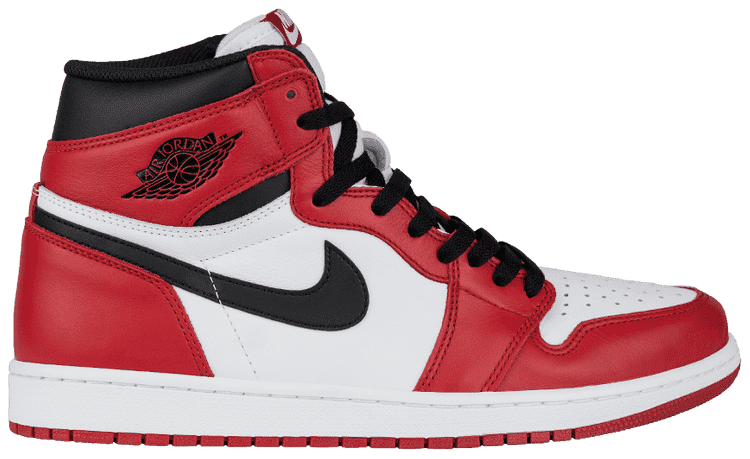
Varsity red leather overlays framed the toe cap, eyestays, heel counter, and ankle flaps. A jet-black leather Swoosh and black padded collar anchored the upper against a white nylon tongue.
Collectors who study classic red Jordans treat the 1985 color blocking as the ultimate Bulls blueprint. Jordan even laced up a 1985 pair during his final Madison Square Garden game in 1998. He scored 42 points in that appearance despite the tight fit of the vintage pair.
How Do the 1994, 2013, and 2015 Chicago Retros Differ in Construction?
After 1985, Jordan Brand released three core smooth-leather retros in 1994, 2013, and 2015. The first retro arrived in 1994 for $80 retail after Michael Jordan’s first retirement. Nineteen years later, the 2013 retro (332550-163 at $140 retail) placed Jumpman logos on the tongue and heel.
Two years after 2013, the May 2015 Retro High OG (555088-101 at $160 retail) restored original details. It brought back the woven Nike Air tongue tag and blank heel counter. According to the Nike Global Manufacturing Map, over 500 contract factories across 41 countries maintain these footwear standards. Soft full-grain leather uppers gave the 2015 edition a faithful vintage hand feel.
The table below compares release years, style codes, branding details, and pricing across the primary Chicago releases.
| Release Edition | Style Code | Branding Spec | Retail vs. Resale Benchmark |
|---|---|---|---|
| 1985 Original High | 4281 | Nike Air tongue / flat sole | $65 retail / $15,000+ archival |
| 1994 Retro High | 130207-101 | Nike Air tongue / retro box | $80 retail / $1,400 resale |
| 2013 Retro High | 332550-163 | Jumpman tongue & heel | $140 retail / $520 resale |
| 2015 Retro High OG | 555088-101 | Nike Air tongue / blank heel | $160 retail / $950 resale |
| 2025 ’85 Cut Anniversary Spec | 40th Anniversary | High ’85 cut / thicker leather | $250 retail tier |
What Did the Fall 2025 40th-Anniversary $250 Release Plan Entail?
During the Jordan Brand 40th anniversary in 2025, calendars tracked a Fall 2025 return at $250 retail. That $250 retail price aligns with the premium High ’85 cut introduced on the 2025 Bred ’85. Thicker full-grain cowhide and a straighter heel distinguish the $250 retail ’85 build from standard retros.
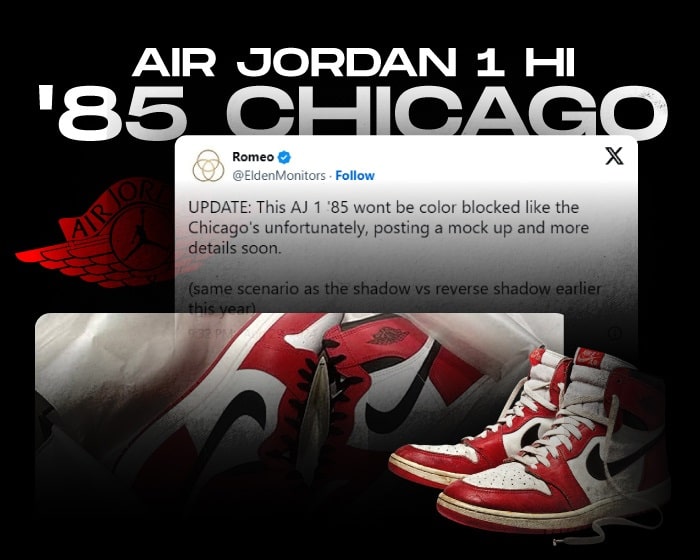
Wait times between unaged, smooth-leather Nike Air Chicago retros stretched from 1994 to 2015 and into the 2025 40th-anniversary cycle, turning every decade’s release into a generational event.
The November 2022 Lost & Found (DZ5485-612) used cracked black leather collars and pre-yellowed midsoles. Because of that vintage treatment, purists waited ten years after 2015 for factory-fresh white and red panels. Styling tips in our guide on how to wear Jordans pair varsity red leather with relaxed denim.
Why Does the 2015 Retro High OG Command $950 on the Secondary Market?
On the secondary market, the 2015 Chicago Retro High OG on StockX averages $950 resale per market records. That $950 valuation represents nearly six times its original $160 retail tag from May 30, 2015. Three structural reasons explain why the 2015 pair holds a higher price than the 2013 retro.
First, the 2015 release was the last smooth-leather edition with unaged white midsoles and Nike Air branding. Second, the April 2020 broadcast of The Last Dance sparked a global surge in demand for 2015 pairs.
Third, ten years of regular wear reduced the surviving supply of unworn 2015 pairs. Collectors pay a premium for deadstock boxes with black, red, and white lace bags attached. Unlaced factory condition remains the strict standard on authenticated marketplaces.
How Do GOAT Seller Fees Affect a $950 Resale Payout?
Collectors selling a deadstock 2015 pair at $950 or a $250 retail pair must calculate fees first. According to the official GOAT seller fee schedule, US sellers in good standing pay a 9.5% commission plus $5. Transferring the proceeds to a bank account adds a 2.9% cash-out fee on the remaining balance.
On a $950 sale of the 2015 Retro High OG, GOAT deducts $90.25 in commission (9.5%) and $5. Subtracting the 2.9% cash-out fee ($24.79) from $854.75 produces a net payout of $829.96.
Against the 2015 retail price of $160, that $829.96 net payout equals a $669.96 net spread. Authentication specialists inspect box labels, stitching density, and sole stars before releasing seller payouts. The table below compares GOAT seller payouts across four historical Chicago editions.
| Chicago Edition & Retail | Resale Ask | GOAT Commission (9.5% + $5) | Net Payout After 2.9% Cash-Out |
|---|---|---|---|
| 1994 Retro High ($80 retail) | $1,400.00 | $138.00 | $1,225.40 ($1,145.40 net spread) |
| 2015 Retro High OG ($160 retail) | $950.00 | $95.25 | $829.96 ($669.96 net spread) |
| 2013 Jumpman Retro ($140 retail) | $520.00 | $54.40 | $452.10 ($312.10 net spread) |
| 2025 ’85 Spec Tier ($250 retail) | $500.00 | $52.50 | $434.52 ($184.52 net spread) |
How Can Collectors Secure Retail Pairs Across SNKRS and Boutiques?
Buying an OG colorway at retail requires tracking both Nike SNKRS ballots and tier-zero boutique allocations. Our guide on where to buy Jordans maps out authorized stockists across North America, Europe, and Asia. According to the official Nike SNKRS Draw rules, randomized 10-minute draws notify winning entries via email after closing.
When Shopify boutiques and regional retailers release OG colorways simultaneously, buyers rely on multi-site checkout software. Leading platforms include Valor AIO, Cybersole, Stellar AIO, and NikeShoeBot.
Pairing clean residential proxies with pre-verified billing profiles helps tasks navigate splash queues and bot protection layers. Running tasks across both Men’s US 9-11 and Grade School sizes maximizes checkout opportunities. Pre-solving captcha tokens ten minutes before the 10:00 AM EST drop reduces checkout friction.
Why did the 2013 retro feature a Jumpman logo instead of Nike Air?
In January 2013, Jordan Brand released the 332550-163 edition under its standard Retro line. As a result, it placed a Jumpman logo on both the tongue tag and heel counter.
How does the $250 High ’85 cut differ from the $180 Retro High OG cut?
The $250 retail High ’85 specification uses thicker full-grain leather, a straighter 1985 heel profile, and a firmer polyurethane insole. It also features a slightly larger midfoot Swoosh modeled after 1985 archival pairs.