Jordan 9 Powder Blue: 2024 Release Specs, 1994 OG History & Resale

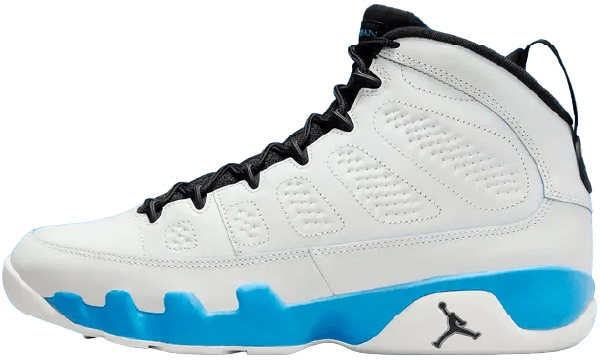
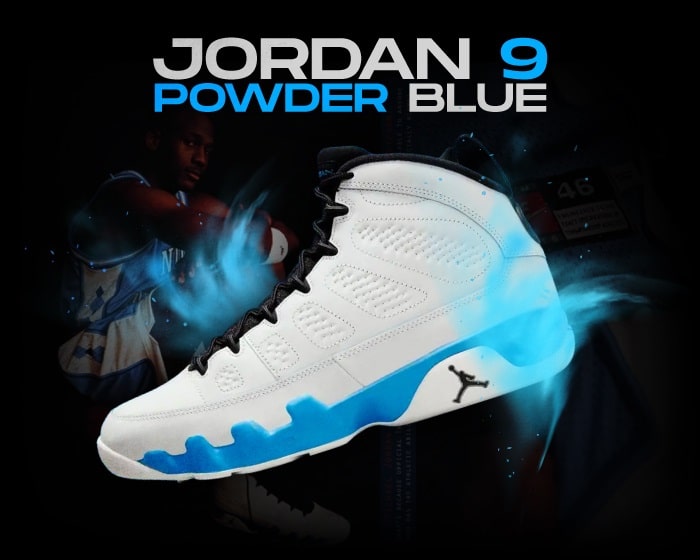
The Jordan 9 Powder Blue (style code FQ8992-101) is a 30th-anniversary retro sneaker from March 23, 2024. Priced at $210 retail, it brings back the 1994 OG vibes with Summit White leather and Dark Powder Blue trim. Tinker Hatfield created the silhouette during Michael Jordan’s first retirement. Below we examine its 1994 heritage, 2010 comparison, and resale math.
- Release date and MSRP: Dropped on March 23, 2024, at $210 men’s retail (style code FQ8992-101) in full family sizing.
- Three-edition lineage: Debuted in 1994 ($125 retail), retroed in 2010 ($150 retail, reaching $800 resale), and returned in 2024.
- Authentic 1994 details: Restores the clean 1994 heel tab without stitched #23 embroidery while keeping the original tongue shape.
- Aftermarket price band: Early 2024 pairs ranged between $300 and $700 before settling between $215 and $285 across sizes.
When Did the Jordan 9 Powder Blue Release and What Was Retail Price?
The 30th-anniversary retro launched on March 23, 2024, at $210 men’s retail under style code FQ8992-101.
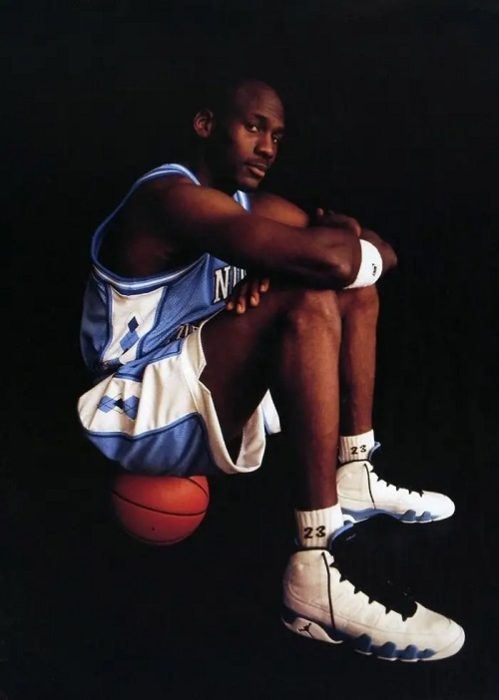
Dressed in Summit White, Black, and Dark Powder Blue, the colorway honored Michael Jordan’s Chapel Hill alma mater. Alongside the $210 adult run, stores carried grade-school pairs at $160 retail. Preschool sizes released at $100 retail, and toddler pairs dropped at $85 retail. Every pair arrived in the throwback black-and-red 1994 cardboard box.
Collectors who track the complete Air Jordan numbered lineage waited 14 years after June 2010 for this colorway. According to the GOAT product archive for FQ8992-101, the 2024 edition restored the slimmer toe box profile. It also brought back vibrant Carolina blue midsole paint and the original four-row eyelet spacing.
Why Did the 1994 Original Debut During Michael Jordan’s Baseball Hiatus?
Released in early 1994 after Michael Jordan retired in October 1993, it was the first model he never wore in an NBA game.
Jordan stepped away from the Chicago Bulls to play Minor League Baseball for the Birmingham Barons. Executives briefly debated pausing the signature line. Instead, Tinker Hatfield designed a rugged basketball boot celebrating Jordan as a global cultural icon. While Jordan wore cleated Black/White PEs on baseball diamonds, the University Blue colorway stayed on hardwood courts.
During the 1993-1994 NBA season, Kendall Gill, Mitch Richmond, Penny Hardaway, and Latrell Sprewell wore special colorways. This 1994 Powder Blue edition stood out alongside the White/Black/True Red, Olive, and Charcoal originals. That quartet forms the four foundational 1994 colorways in the archival catalog.
How Does the 2024 Retro Compare to the 1994 OG and 2010 Release?
Only three editions have released across 30 years: the 1994 original ($125 retail), the 2010 retro ($150 retail), and the 2024 retro ($210 retail).
Both the 1994 original (style 130182-101) and the 2024 retro (style FQ8992-101) feature a clean Dark Powder Blue heel strip. Neither pair carries stitched heel numbers. By contrast, the June 5, 2010 retro (style 302370-103) added white #23 embroidery across the heel counter. Prior to 2024, deadstock 2010 pairs climbed as high as $800 on resale exchanges.
Early pre-release pairs of the 2024 edition traded between $300 and $700 before post-launch supply normalized resale prices. The 2024 build also corrected the bulky 2010 toe box and restored the black cambered tongue mesh from 1994. Collectors praise the 2024 release as the closest match to the 1994 original.
| Release Edition & Style Code | Launch Date | Retail MSRP | Heel & Aftermarket Notes |
|---|---|---|---|
| 1994 OG (130182-101) | Spring 1994 | $125 retail | Clean heel; $650 to $1,200 archival |
| 2010 Retro (302370-103) | June 5, 2010 | $150 retail | Stitched #23 heel; peaked near $800 |
| 2024 Retro Men’s (FQ8992-101) | March 23, 2024 | $210 retail | Clean 1994 heel; $215 to $285 resale |
| 2024 Retro GS (FQ8992-101 GS) | March 23, 2024 | $160 retail | Youth sizing; $145 to $190 resale |
What Materials and Multilingual Outsole Graphics Define the Design?
Smooth Summit White cowhide leather wraps the perforated upper while glossy Dark Powder Blue polyurethane covers the midsole.
Inside the collar, a black Huarache-inspired neoprene inner sleeve hugs the midfoot and ankle. Single-pull speed-lacing metal eyelets allow wearers to tighten the entire forefoot with one motion. On the heel, a thermoplastic globe emblem framing a leaping Jumpman reinforces the international theme.
Turn the shoe over and the sculpted white rubber outsole displays multilingual words alongside rising-sun channels. The left and right soles translate concepts like dedicated, intense, sport, freedom, athletic, force, and graceful. Languages include Japanese, Russian, German, Spanish, French, and Swahili. Our styling guide on wearing retro Jordans recommends pairing white-and-blue uppers with relaxed denim or charcoal cargo pants.
What Are the Aftermarket Prices and Seller Fees on $210 Pairs?
While pre-release pairs traded between $300 and $700, post-launch deadstock pairs average $215 to $285 depending on men’s size.
Larger men’s sizes (11.5 through 14) command the highest premiums near $260 to $285. Before listing a pair at $260, check platform fee deductions carefully. Under the eBay sneaker selling fee schedule, sneakers sold for $150 or more incur an 8% flat fee ($20.80). That leaves $239.20 net.
According to the StockX seller fee documentation, a Level 1 seller pays 9% commission ($23.40) plus 3% payment processing ($7.80) and $4 shipping. Those $35.20 in total fees net $224.80. Per the GOAT seller commission terms, a 9.5% base fee plus $5 and 2.9% cash-out fee leaves $223.62 net.
On a $260 sale price, eBay’s 8% tier returns $239.20 net, saving $14.40 to $15.58 compared to StockX Level 1 and GOAT standard fees.
| Resale Marketplace | Gross Sale Price | Total Fee Deduction | Net Seller Payout |
|---|---|---|---|
| eBay 8% Authenticity Tier | $260.00 sale | 8.0% flat ($20.80 fee) | $239.20 net payout |
| StockX Level 1 Seller | $260.00 sale | 9.0% + 3.0% + $4 ($35.20) | $224.80 net payout |
| StockX Level 4 Seller | $260.00 sale | 7.5% + 3.0% + $4 ($31.30) | $228.70 net payout |
| GOAT Standard (90+ Rating) | $260.00 sale | 9.5% + $5 + 2.9% ($36.38) | $223.62 net payout |
How Does the Speed-Lacing Bootie Fit and Where Can Collectors Buy Pairs?
The internal neoprene dynamic-fit sleeve runs snug around the midfoot, so standard feet fit true to size while wide feet go up 0.5 size.
The one-piece leather mudguard and stitched rand have minimal lateral stretch during the first 5 wears. Wide-footed wearers appreciate the extra forefoot width of a half size up. Collectors preparing for retro restocks can review our step-by-step retail sneaker buying guide. You can also explore our overviews of all-in-one sneaker checkout bots and Shopify boutique automation tools.
- True-to-size fit: Standard and narrow feet can order their normal size and loosen the lower speed-lace loops before stepping into the neoprene sleeve.
- Wide-foot adjustment: Go up 0.5 size to prevent pinky-toe rubbing against the reinforced leather mudguard stitching.
- Checkout software options: Platforms such as Valor AIO, Cybersole, Stellar AIO, and NikeShoeBot support SNKRS, Shopify, and Foot Locker retro releases.
- Midsole care tip: Store pairs in low-humidity rooms (40% to 50% relative humidity) to prevent the painted polyurethane midsole from cracking over time.
Did Michael Jordan ever wear the 1994 University Blue colorway in an NBA game?
No, Michael Jordan was playing Minor League Baseball in 1994 when the original colorway launched, though he wore the White/Black original on his Chicago statue.
Why did the 2024 retro leave off the stitched 23 on the heel?
The 2024 release followed the exact 1994 original specification, which had a clean heel strip, whereas only the 2010 retro added the stitched 23 numerals.