Jordan 1 Low vs Jordan 1 Low Golf: Outsole, Waterproofing, and Sizing Guide

Settling the Jordan 1 Low vs Jordan 1 Low Golf debate comes down to three physical differences. Buyers compare outsole lug depth, upper water resistance, and woven tongue branding. While this long overdue comparison shows identical 1985 Peter Moore upper panels from afar, the fairway edition adds spikeless rubber traction teeth. Standard lifestyle pairs retail for $115 to $140, whereas course editions retail for $150 to $170.
- Outsole Tooling: Flat street pivot circle on the lifestyle model versus raised integrated spikeless traction lugs on the fairway model.
- Upper Weatherproofing: Breathable untreated leather or suede on standard pairs versus water-resistant sealed leather with a 1-year warranty on course pairs.
- Branding Markers: Nike Air or standard Jumpman tongue tags versus a dedicated “Jumpman Golf” woven tongue label and stamped heel Wings crest.
- Retail Price Tier: $115 to $140 USD for lifestyle releases compared to $150 to $170 USD for course-ready editions.
How Did the 1985 Basketball Icon Evolve Into a 2019 Fairway Staple?
The lifestyle silhouette debuted in the mid-1980s alongside the 1985 high-top as a low-cut court and casual option. Over four decades, that original design anchored the Air Jordan catalog across both 7-eyelet inline drops and 8-eyelet Retro OG releases. Michael Jordan spent thousands of hours on the links during and after his Chicago Bulls career. Adapting his first signature sneaker for 18 holes was therefore a natural evolution.
Early spiked high-top experiments arrived in 2017 before low-cut turf adaptations followed in 2019. Soon after, the modern spikeless Retro OG-cut fairway line expanded into a permanent seasonal staple. By keeping the 8-eyelet upper proportions intact, designers gave players a functional course shoe. It looks nearly indistinguishable from a streetwear grail inside the clubhouse or on pavement.
What Are the Exact Outsole and Traction Differences Underfoot?
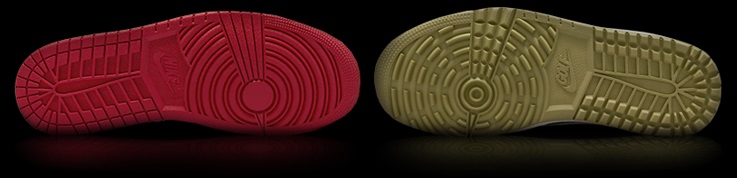
Turning both shoes over exposes the primary structural difference between pavement and turf engineering. The standard lifestyle version uses Peter Moore’s flat 1985 rubber cupsole. It features shallow concentric forefoot pivot rings and flat heel stars. That smooth profile maximizes surface contact on concrete sidewalks, hardwood floors, and asphalt courts.
While the standard cupsole uses flat 1.5-millimeter grooves for concrete grip, the course-ready outsole molds 3.5-millimeter aggressive rubber teeth into the same concentric pattern to anchor rotational swing torque on wet grass.
By contrast, the fairway model replaces those flat rings with raised, sharp-edged rubber teeth. Those lugs sit in the exact same circular forefoot layout as the original 1985 tread. These integrated spikeless teeth bite into damp fairways and bunker sand during a 110-mph driver swing. Players never need to wrench in replaceable plastic cleats. Because the rubber teeth flex on pavement, many wearers also use the turf version as a rainy-day street sneaker.
| Technical Feature | Standard Lifestyle Edition | Course-Ready Turf Edition | Practical On-Foot Impact |
|---|---|---|---|
| Historical Debut | 1985 original court launch | 2019 to 2022 spikeless expansion | Heritage basketball vs links utility |
| Outsole Tread Depth | 1.5 mm flat concentric rings | 3.5 mm raised spikeless rubber lugs | Rotational turf grip on wet grass |
| Upper Leather Treatment | Untreated porous leather or suede | Water-resistant sealed full-grain leather | Keeps socks dry in morning dew |
| Official Retail Price | $115 inline / $140 Retro OG | $150 standard / $170 collaborative | $10 to $35 premium for waterproofing |
How Do Waterproof Materials and Branding Tags Separate the Two Models?
Above the midsole, the two versions differ in their leather coatings and woven labels. Lifestyle releases use untreated tumbled leather, open-pore suede, or breathable canvas. Those untreated materials absorb water quickly during heavy rain showers. Course-ready pairs instead use weather-sealed full-grain leather and gusseted synthetic tongues. Nike backs that sealed upper with a 1-year waterproof warranty against early morning dew.
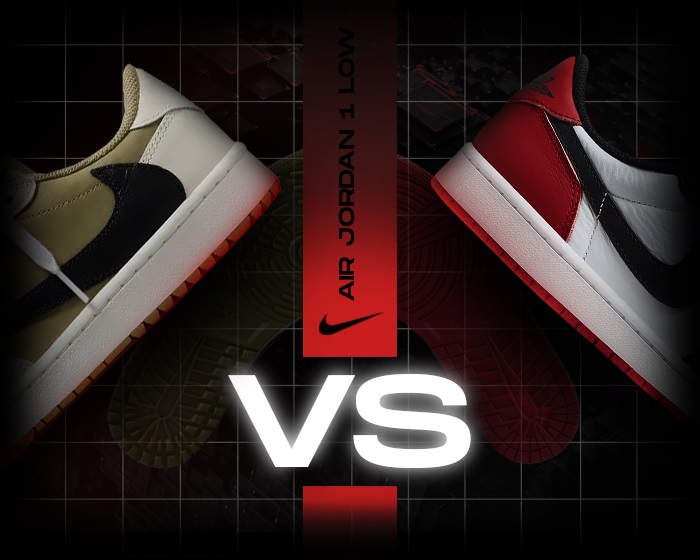
Visual branding cues also tell collectors which pair is which at a glance. An 8-eyelet Retro OG lifestyle pair features a woven “Nike Air” tongue tag. Meanwhile, the course counterpart displays a Jumpman silhouette with “GOLF” script on the tongue and insole. According to the Nike Global Manufacturing Map, specialized athletic footwear factories apply these waterproof membrane seals during upper lasting.
Which Version Offers Better Cushioning and Fit for All-Day Walking?
Walking an 18-hole course covers 5 to 6 miles over four hours on uneven ground. To handle that distance, the turf model packs denser foam padding around the Achilles collar. It also includes a thicker molded EVA sockliner underfoot. Both versions house an encapsulated Air-Sole unit inside the heel wedge. However, the turf edition feels slightly firmer and more stable under lateral midfoot loads.
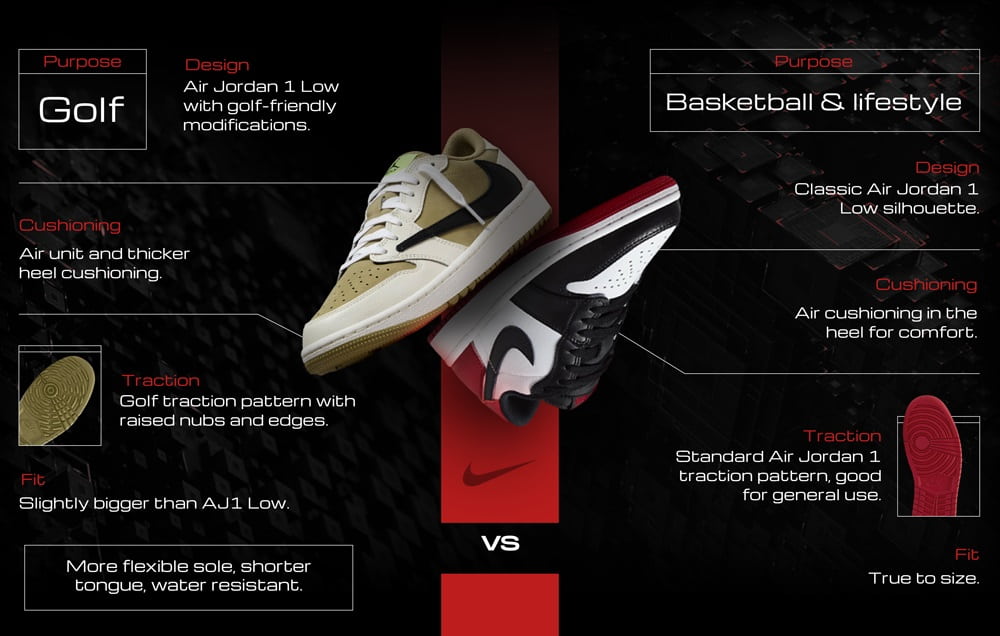
When checking how Jordan 1s fit across both models, the 8-eyelet turf edition runs 0.5 size long. That forefoot length matches the 8-eyelet Retro OG lifestyle cut. Narrow-footed buyers often size down 0.5 for a locked-in swing stance, whereas wide-footed players stay true to size. Readers exploring how to wear Jordans off the course can pair either model with tailored chinos or relaxed denim.
How Do Travis Scott Lifestyle and Fairway Editions Compare on Resale Markets?
Comparing collaborative releases across both categories illustrates how closely collector demand tracks between street and turf editions. The July 2022 Travis Scott Reverse Mocha lifestyle pair launched at a $150 retail price. It trades between $1,150 and $1,450 across adult sizes on secondary platforms. Fifteen months later, the October 2023 Travis Scott Neutral Olive Golf dropped at a $170 retail price and commands $750 to $950 on resale markets.
Even on non-collaborative colorways like Chicago, Shadow, and Wolf Grey, the $150 turf versions hold strong secondary value. Many collectors buy them as weather-resistant daily beaters at a fraction of OG lifestyle resale prices. When selling pairs on authentication platforms, GOAT seller commission guidelines deduct a 9.5% base commission plus a regional seller fee and a 2.9% cash-out fee.
| Colorway Matchup | Lifestyle Retail and Resale | Turf Edition Retail and Resale | GOAT 9.5% Base Commission |
|---|---|---|---|
| Travis Scott Collaborations | $150 retail / $1,300 avg ask | $170 retail / $850 avg ask | $80.75 to $123.50 base fee |
| Chicago Classic Blocking | $140 retail / $1,100+ (2016 OG) | $150 retail / $240 avg ask | $22.80 base fee on turf pair |
| Wolf Grey / Dior-Style | $115 retail / $145 avg ask | $150 retail / $195 avg ask | $18.53 base fee on turf pair |
| Shadow Black and Grey | $140 retail / $175 avg ask | $150 retail / $185 avg ask | $17.58 base fee on turf pair |
How Can Buyers Choose and Secure the Right Pair at Retail Price?
Buyers who walk dry city pavement every day and prefer softer untreated leather should choose the $115 to $140 lifestyle model. Shoppers who play 18 holes or walk in wet autumn weather should pick the $150 spikeless turf edition. It also gives collectors a way to wear iconic Chicago or Wolf Grey color blocking without paying four-figure vintage prices.
Limited colorways in both categories launch at 10:00 AM EST through the Nike SNKRS Draw system. Select pro-shop and boutique raffles also carry allocations. Reviewing how to buy sneakers for retail helps manual buyers prepare accounts before release morning. Collectors automating multi-site drops also use platforms such as Valor AIO, Cybersole, Stellar AIO, and NikeShoeBot alongside clean residential proxies.
Can you wear the spikeless turf version on concrete sidewalks without ruining the sole?
Yes, because the integrated traction teeth are molded from flexible rubber rather than hard plastic or metal cleats, they walk comfortably on concrete and gradually wear down into a flat tread.
Do the spikeless rubber lugs meet tournament dress codes at private country clubs?
Yes, the spikeless rubber outsole is fully green-friendly and approved for tournament and casual play at courses that prohibit metal spikes.