A New Jordan 12 Celebrates the Iconic Jordan Flu Game & Retro History

The Jordan Flu Game remains one of basketball history’s greatest footwear moments. A new Jordan 12 celebrates the iconic Bulls colorway with inverted red suede. Worn by Michael Jordan on June 11, 1997, the Black and Red shoe inspired retros in 2003, 2009, 2016, and the December 26, 2020 Reverse release.
- 1997 Finals Performance: Michael Jordan scored 38 points with a tie-breaking three-pointer on June 11, 1997, leading Chicago to a 90-88 Game 5 win over Utah.
- OG & Retro Lineage: First released in June 1997 at $135 retail ($600 vintage ask), followed by retros in 2003 ($500 ask), 2009 ($150 retail, $550 ask), and 2016 ($190 retail, $450 ask).
- 2020 Reverse Release: The Air Jordan 12 “Reverse Flu Game” (CT8013-602) launched on December 26, 2020, at $190 retail with a Varsity Red suede upper.
- Technical Cushioning: First Air Jordan silhouette to feature full-length Zoom Air paired with a woven carbon-fiber midfoot shank plate.
How Did the June 11, 1997 Jordan Flu Game Make NBA Finals History?
The legend began in Salt Lake City before Game 5 of the 1997 NBA Finals between Chicago and Utah. With the championship series tied 2-2, Michael Jordan woke up at 2:00 AM battling severe stomach illness. Team physicians doubted he could play after he missed the morning shootaround on June 11, 1997.
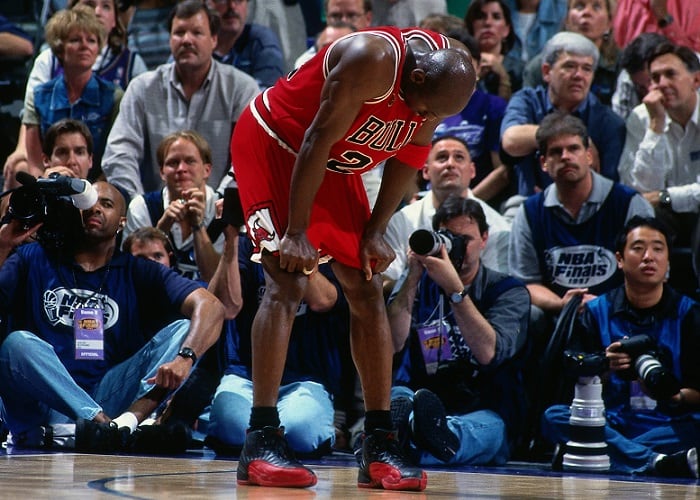
Despite visibly shaking on the bench during timeouts, Jordan played 44 of 48 minutes in his Black and Red 12s. He recorded 38 points, 7 rebounds, 5 assists, and 3 steals on the road. Late in the fourth quarter, he sank a tie-breaking three-pointer for a 90-88 Bulls win. Readers who study iconic sneaker nickname origins know that gritty victory permanently renamed the Black and Varsity Red colorway.
How Do the 1997 OG, 2003, 2009, and 2016 Flu Game Retros Compare?
Tinker Hatfield designed the 1997 Air Jordan 12 OG (130690-061) around rising sun rays and a 19th-century dress boot. Released in June 1997 at $135 retail, surviving deadstock 1997 pairs trade around $600 per vintage market data. Six years later, the first 2003 retro (136001-063) returned at $135 retail. Deadstock 2003 pairs average around $500 on secondary marketplaces.
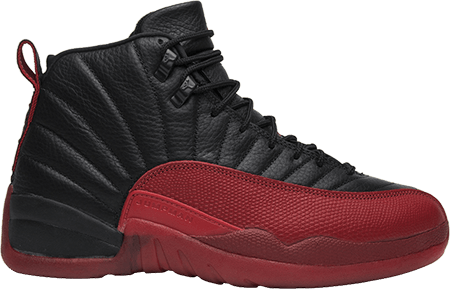
In November 2009, Jordan Brand altered the formula on the 2009 retro (130690-065, $150 retail). Designers swapped the black leather upper for matte black nubuck. That 2009 edition also stitched “97,” “38,” and a sick-face mascot onto the heel and tongue. Deadstock 2009 pairs average $550 per aftermarket data. Seven years later, the May 2016 retro (130690-002) restored original leather at $190 retail. Those 2016 pairs trade near $450 per resale data.
| Edition & Style Code | Release Year | Original Retail MSRP | Upper Material & Market Benchmark |
|---|---|---|---|
| 1997 OG Flu Game (130690-061) | June 1997 | $135 retail | Black tumbled leather / Red mudguard (~$600 ask) |
| 2003 Retro Flu Game (136001-063) | 2003 | $135 retail | First retro leather edition (~$500 ask) |
| 2009 Retro “38 Points” (130690-065) | November 2009 | $150 retail | Black nubuck with 97/38 & sick face (~$550 ask) |
| 2016 Retro OG Spec (130690-002) | May 2016 | $190 retail | Remastered OG tumbled leather (~$450 ask) |
What Makes the December 26, 2020 Jordan 12 Reverse Flu Game Unique?
To honor the Chicago Bulls palette without repeating the 2016 release, Air Jordan signature history introduced an inverted color-blocking scheme. The Air Jordan 12 Retro “Reverse Flu Game” (style code CT8013-602) launched on December 26, 2020. Men’s pairs carried an official retail price of $190, while Grade School sizes retailed at $140.
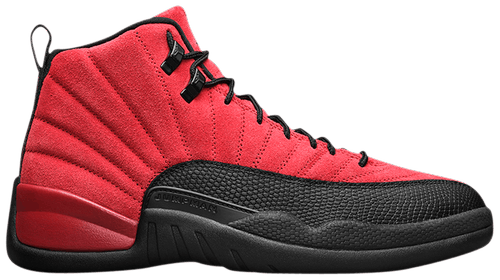
Instead of black leather, the 2020 edition wraps the stitched radiating upper panels in Varsity Red suede. Matte black faux-lizard leather covers the lateral and medial mudguards above a solid black Phylon midsole. Early pre-launch projections reached $500 per pair. Post-release deadstock pairs trade between $230 and $320 per market data.
“Swapping black tumbled leather for Varsity Red suede on the December 2020 release gave collectors a bold alternate tribute to Game 5 of the 1997 Finals.”
How Does the Air Jordan 12 Fit and Perform Across Suede and Leather Uppers?
The Air Jordan 12 fits true to standard US men’s sizing across both OG leather and suede editions. Its thick internal padding and high-cut ankle collar feel supportive right out of the box. Wearers with wide forefeet can consult our complete Air Jordan styling and fit guide. Going up 0.5 size gives wide feet extra room.
Technically, the 1997 Jordan 12 was the first model in the line to use a full-length Zoom Air unit. Combined with a woven carbon-fiber torsion plate and herringbone traction pods, the sole delivers responsive court cushioning. On the 2020 Reverse edition, the supple red suede upper flexes immediately without the 3-day break-in period of stiff leather. Metallic black upper eyelets also lock the ankle collar firmly during lateral cuts.
How Do Marketplace Seller Fees Affect Air Jordan 12 Net Payouts?
Collectors trading deadstock 1997, 2016, or 2020 editions across authenticated platforms compare commission rates before listing a pair. According to eBay’s athletic shoe fee schedule, sneakers sold for $150 or more carry a flat 8% final value fee. Selling a 2016 retro for $450 gross on eBay deducts $36 in fees and leaves a $414 net payout.
By contrast, StockX’s seller fee schedule charges Level 1 accounts a 9% base fee plus a 3% payment processing fee. On a $450 sale, those 12% combined fees deduct $54 and leave $396 before shipping. Meanwhile, GOAT’s official fee structure applies a 9.5% base commission plus a $5 fee and a 2.9% cash-out deduction. That GOAT fee structure leaves $390.78 net on a $450 gross sale.
| Marketplace Platform | Gross Sale (2016 Retro) | Commission & Processing Structure | Net Seller Payout |
|---|---|---|---|
| eBay Authenticity Guarantee | $450.00 gross sale | 8.0% flat final value fee ($36.00) | $414.00 net payout |
| StockX Level 1 Marketplace | $450.00 gross sale | 9.0% transaction + 3.0% processing ($54.00) | $396.00 net before shipping |
| GOAT Standard Consignment | $450.00 gross sale | 9.5% + $5 fee + 2.9% cash-out ($59.22) | $390.78 net payout |
| 2020 Reverse Edition (eBay) | $280.00 gross sale | 8.0% flat final value fee ($22.40) | $257.60 net payout |
How Can Collectors Secure Holiday Air Jordan 12 Drops at Retail?
December holiday Air Jordan retros attract heavy buyer traffic across Nike SNKRS and national foot-locker chains. Following our checklist for buying limited sneakers at retail helps collectors enter FLX app reservations and JD Sports Status access before drop morning. Completing loyalty profile verification 48 hours ahead of launch maximizes raffle eligibility across local mall doors.
When online stores release inventory at 10:00 AM EST, many buyers use automated sneaker checkout software to manage multi-site release queues. In the all-in-one automation category, platforms such as Valor AIO, Cybersole, and NikeShoeBot support Shopify boutiques and regional retail modules. Pairing those checkout tools with residential proxies keeps task connections steady across release morning. Buyers also track restock monitors for 48 hours after the initial launch window.
Was Michael Jordan actually sick with the flu during Game 5 on June 11, 1997?
While announced during the 1997 broadcast as flu-like symptoms, trainer Tim Grover and Michael Jordan later shared in The Last Dance documentary that the illness was severe food poisoning from a late-night pizza delivery in Salt Lake City.
How can you tell the 2009 retro apart from the 1997 and 2016 editions at a glance?
The 2009 retro (130690-065) uses a matte black nubuck upper instead of pebbled leather and features “97,” “38,” and a sick-face graphic stitched on the heel and tongue.
Tagged